Part 6 · Resources
Citizen Science
Community-driven science in Emery County: iNaturalist biodiversity documentation, eBird migration monitoring, CoCoRaHS precipitation filling a rural data gap, Globe at Night dark-sky measurement, Utah Water Watch stream quality, SKYWARN severe-weather spotting, paleontology and archaeological site stewardship, and the citizen-naturalist programs that extend professional research across one of the most data-sparse landscapes in the American West.
Ch40 — Citizen Science
40.1 What Is Citizen Science?
Citizen science — increasingly known as community science — is the practice of enlisting members of the general public in the collection, classification, or analysis of scientific data. The term encompasses activities as varied as photographing a wildflower on a hiking trail, measuring rainfall in a backyard gauge, counting birds at a feeder, and transcribing nineteenth-century ship logs for climate researchers. What unites these disparate activities is a shared logic: that scientific observation is not the exclusive property of credentialed professionals, that large-scale questions require large-scale data, and that the people who live closest to a landscape often make its most attentive observers.
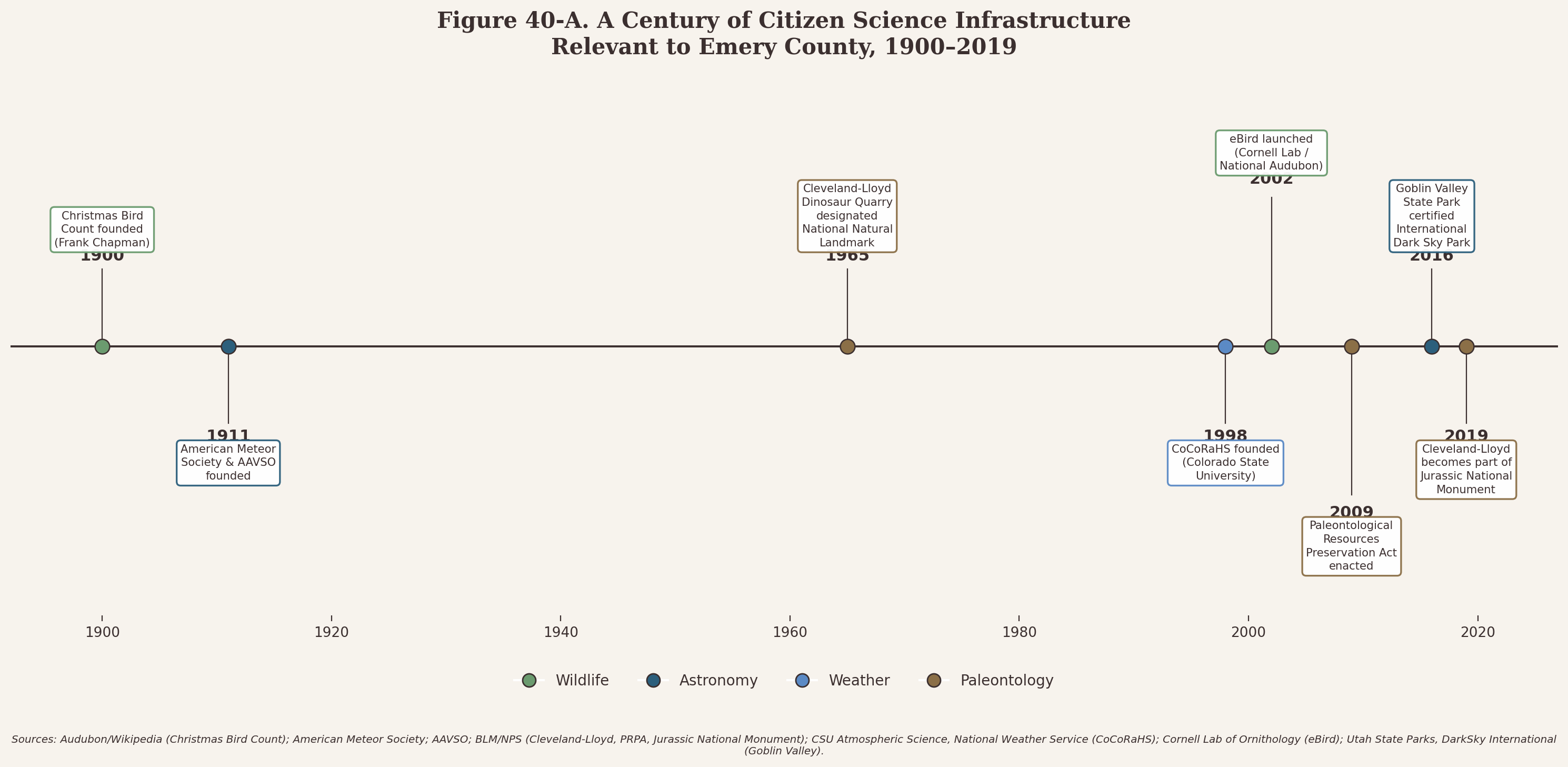
Citizen science is not a new idea. Charles Darwin relied on observations submitted by amateur naturalists around the world. The Christmas Bird Count, launched by ornithologist Frank Chapman in 1900 as an alternative to the traditional holiday hunt, is now the longest-running citizen science project in North America, with tens of thousands of participants in more than 2,600 circles every December. What is new is the infrastructure — smartphone apps, cloud databases, and satellite-positioned GPS — that allows millions of observers worldwide to submit data that reaches scientists within minutes.
For Emery County, the case for citizen science is compelling and urgent. The county covers approximately 4,462 square miles of canyon, plateau, and river bottomland, most of it federal land managed by the Bureau of Land Management or U.S. Forest Service. Its permanent resident population of roughly 9,800 people is spread across a dozen communities. That ratio — one permanent resident per 0.45 square miles — means that vast stretches of the county’s most ecologically interesting terrain go unobserved for weeks or months at a time. No government agency has the staff to fill this gap. Citizen science programs, each well matched to the landscape, can.
This chapter surveys the major programs available to Emery County residents and visitors, explains how to participate, and describes what each program contributes to the scientific understanding of the county’s natural and cultural heritage. Readers who complete even a single CoCoRaHS precipitation measurement, eBird checklist, or iNaturalist observation join a worldwide network of observers whose collective data shapes species protection decisions, weather forecasting models, and conservation policy.
40.2 iNaturalist: Documenting Emery County’s Biodiversity
The single most versatile citizen science tool for naturalists in Emery County is iNaturalist (inaturalist.org), an independent nonprofit (formerly a joint initiative of the California Academy of Sciences and National Geographic Society). The platform functions as a global biodiversity database and social network for naturalists: users upload photographs of wild organisms — plants, animals, fungi, even lichens and slime molds — and the community helps identify them. Observations confirmed by at least two independent identifications achieve “research-grade” status and flow into the Global Biodiversity Information Facility (GBIF), where they are available to scientists worldwide.
iNaturalist maintains a dedicated Emery County, Utah place page (inaturalist.org/places/emery-county) where all county observations are aggregated and searchable by taxon, date, and observer. The platform has also generated a San Rafael Swell and Desert Check List (inaturalist.org/check_lists/64400), documenting the species recorded across the broader Swell landscape. Documented county species include Killdeer (Charadrius vociferus), White-faced Ibis (Plegadis chihi), Canyon Tree Frog (Dryophytes arenicolor), Red-spotted Toad (Anaxyrus punctatus), and Long-nosed Leopard Lizard (Gambelia wislizenii).
The Natural History Museum of Utah (NHMU) has embraced iNaturalist as its primary citizen science platform, using it for the Western Firefly Project (active late May through early July, tracking firefly populations across the state), a Fox Squirrel survey (monitoring the spread of an introduced species), and a statewide pollinator survey expanded in 2024 to encompass all pollinators observed on flowering plants. NHMU’s Neighborhood Naturalists program invites participants statewide to document nearby nature — a program easily adapted to Emery County’s extraordinary diversity of habitats.
The Utah Division of Wildlife Resources (DWR) directs community scientists to iNaturalist for reptile and amphibian observations and specifically to the “Herps of Utah” iNaturalist group, where location data is integrated into DWR’s state databases. Biologists independently verify submitted photographs. DWR also coordinates boreal toad surveys, western toad monitoring, migratory shorebird counts, and rosy-finch conservation through community science partnerships. USU Eastern has collaborated with DWR on mule deer collar research that tracks animals through the San Rafael Swell — research that community observers could supplement with sighting reports.
How to participate: Download the free iNaturalist app (iOS or Android). In the field, photograph any wild plant, animal, or fungus. The app records GPS location automatically. Submit the observation; the community assists with identification. Research-grade observations contribute directly to scientific databases. [needs additional sources: current research-grade observation count for Emery County place page]
40.3 eBird: Tracking Birds Across the County
For birdwatchers, the essential platform is eBird (ebird.org), launched in 2002 by the Cornell Lab of Ornithology and the National Audubon Society. eBird is the world’s largest biodiversity database by volume of records; its data has been shown to match trends in bird species populations measured by U.S. government surveys to within 0.4 percent (University of Utah analysis). The platform employs regional reviewers who follow up on unusual sightings, and observations of rare species trigger automatic quality-control flags. When a region accumulates more than 10,000 checklists, eBird data is considered sufficient to detect reliable population trends.
Emery County’s bird community is rich and varied. The county spans multiple life zones — from the cottonwood-lined San Rafael River at 4,100 feet to the Manti–La Sal National Forest slopes above 11,000 feet — and lies on a migratory corridor connecting Great Basin breeding grounds with Sonoran Desert wintering areas. The Utah Birds website (utahbirds.org/counties/emery/index.html) maintains an Emery County page linking to the county’s eBird data.
How to participate: Download the eBird app or use the website. Before or during a birding outing, start a checklist and record every bird species seen or heard. Enter counts and behavior notes; upload photographs and audio recordings when possible. Even a five-minute “incidental” checklist from a roadside stop contributes useful location data. Rare sightings generate automatic prompts to provide additional details and photographs.
40.4 Globe at Night: Measuring Darkness Worth Protecting
Goblin Valley State Park became a certified International Dark Sky Park in 2016, one of a handful in Emery County. The broader San Rafael Swell offers Bortle Class 1 skies — the darkest category on the standard scale — across large stretches of roadless terrain. (See Chapter 35 for a full treatment of Emery County’s dark sky resources. See Ch35: Night Sky Tourism ↗ 5 Ch35: Night Sky Tourism Dark skies as Emery County's emerging tourism resource: Goblin Valley State Park's 2016 International Dark Sky designati... Read chapter → .) Protecting and documenting that darkness is itself a citizen science opportunity.
Globe at Night (globeatnight.org), administered by NSF’s NOIRLab, is the leading international citizen science campaign for night sky brightness monitoring. On scheduled observing nights each month (roughly ten campaign windows per year), volunteers step outside, allow their eyes to adapt to darkness for ten minutes, locate a target constellation (Orion in winter, Leo or Virgo in spring), and estimate how many stars are visible. They then submit the observation — along with GPS location and a cloud-cover estimate — to the Globe at Night database. More sophisticated observers use Sky Quality Meters (SQM, about $130 from Unihedron) to produce quantitative brightness measurements in magnitudes per square arcsecond (mag/arcsec²). The resulting dataset feeds into light pollution research and supports applications for dark sky designation.
DarkSky International (formerly the International Dark-Sky Association) also provides measurement protocols for light pollution assessment at its website (darksky.org/get-involved/measuring-light-pollution). Globe at Night data from Emery County would complement the Falchi et al. (2016) light pollution atlas used in existing dark sky research and strengthen future designation applications.
A peer-reviewed study published in Scientific Reports validated Globe at Night data as scientifically useful, demonstrating consistency between volunteer sky brightness observations and independent instrumental measurements (Kyba et al., 2013). [needs additional sources: whether active Globe at Night SQM stations currently exist within Emery County proper]
How to participate: Visit globeatnight.org for the current campaign schedule. Go outside during a moonless night in Emery County’s dark interior, allow ten minutes for dark adaptation, find the target constellation, count visible stars, and submit the report using the Globe at Night web form or iOS/Android app. Include an SQM reading if you have access to a meter. Observers in Goblin Valley, the Wedge Overlook area, or along Buckhorn Wash are particularly well positioned to contribute data that supports the county’s dark sky reputation.
40.5 CoCoRaHS: Filling the Precipitation Data Gap
Official weather stations in Emery County are sparse. The Green River Municipal Airport provides automated surface observations; Castle Dale has limited records. The remote valleys of the San Rafael Swell, the high plateaus of the Wasatch Plateau, and the canyon corridors between them go largely unmeasured. This gap matters: precipitation in Emery County is highly variable in space and time, with localized convective storms capable of dropping several inches in an hour while neighboring drainages stay dry.
CoCoRaHS — the Community Collaborative Rain, Hail and Snow Network (cocorahs.org) — fills gaps like this with volunteer observers. Founded in 1998 at Colorado State University after a catastrophic 1997 Fort Collins flash flood overwhelmed the sparse official network, CoCoRaHS has grown to more than 20,000 active observers in the United States. The program is recognized by NOAA and NASA’s Global Precipitation Measurement mission. During extreme precipitation events, CoCoRaHS reports reach National Weather Service forecasters’ workstations directly, in some cases providing the only ground-truth data for flash flood warnings.
CoCoRaHS has identified Emery County by name as a county where observers are “especially needed,” alongside a dozen other rural Utah counties including Garfield, Grand, and San Juan. Utah participation in the network began in 2008. Emery County station identifiers follow the UT-EM prefix.
How to participate: Register for free at cocorahs.org. Purchase a standard 4-inch CoCoRaHS rain gauge (approximately $30; available through the CoCoRaHS store and major retailers). Each morning at roughly the same time, read the gauge and enter the measurement online. The commitment is about five minutes per day. No scientific background is required; training materials are available on the CoCoRaHS website. [needs additional sources: current active station count in Emery County]
Connection to Chapter 4: CoCoRaHS data directly supports the climate and weather research described in Chapter 4 (see Ch04: Climate & Weather ↗ 1 Ch04: Climate & Weather Climate as invisible architecture: precipitation, temperature, and weather patterns shaping life across Emery County's e... Read chapter → ). An Emery County observer’s gauge readings become part of a permanent record accessible to researchers and water managers.
40.6 Utah Water Watch: Monitoring Streams and Lakes
Utah has nearly 15,000 miles of permanent streams and more than 2,000 lakes, most of which are never formally sampled between official state water quality assessments. Huntington Creek, Ferron Creek, Cottonwood Creek, and the San Rafael River are the major drainages of Emery County; Joe’s Valley Reservoir is the county’s most heavily used recreational water body. Utah Water Watch (UWW) extends scientific monitoring to these waters through volunteer observers.
Utah Water Watch is a statewide citizen water quality monitoring program managed by USU Water Quality Extension in partnership with Utah’s Division of Water Quality (extension.usu.edu/waterquality/utahwaterwatch). The program is free and open to volunteers of all ages. Participants commit to monitoring a single site once per month from May through September. Two training tiers are available: Tier 1 covers visual assessments and basic quantitative measurements; Tier 2 adds chemical and biological monitoring using standardized equipment provided at training workshops. All data enters a public database shared with local water managers and the Utah Division of Water Quality.
A subsidiary program, the HAB Squad, mobilizes volunteers to make real-time observations at priority lakes and streams during recreation season, watching for harmful algal blooms (HABs) — dense growths of cyanobacteria that can be toxic to humans, pets, and livestock. Joe’s Valley Reservoir, with its significant recreational use, is a logical candidate for HAB Squad monitoring.
How to participate: Contact Utah Water Watch at waterquality@usu.edu or (435) 797-2580. Attend a free training workshop. Identify a monitoring site in Emery County — a named stream reach, reservoir shoreline, or spring — and commit to monthly visits through the summer season. [needs additional sources: whether active UWW monitors currently operate on Emery County waterways]
Connection to Chapter 3: Water Watch monitoring directly supplements the hydrology chapter (see Ch03: Hydrology & Springs ↗ 1 Ch03: Hydrology & Springs Water in the desert: springs, seeps, rivers, and the hydrologic systems that sustain life in Emery County. Read chapter → ). Long-term volunteer datasets from Emery County streams could detect changes in base flow, turbidity, and water chemistry associated with drought, grazing, or land use change.
40.7 SKYWARN: Weather Spotter Training
Flash floods kill more people in Utah each year than any other weather hazard. In canyon country — where a storm cell 30 miles upstream can send a wall of water through a slot canyon occupied by hikers who are standing under blue sky — advance warning can mean the difference between life and death. The National Weather Service trains and coordinates a network of volunteer storm spotters through its SKYWARN program, and Emery County residents are natural candidates.
SKYWARN training is free and available online at meted.ucar.edu/training/SKYWARN as well as through in-person workshops hosted periodically by NWS Salt Lake City. Trained spotters learn to recognize severe weather signatures — rotating updrafts, wall clouds, large hail, damaging winds — and report them in real time to the local NWS office via radio, phone, or the mPING smartphone app. Spotter reports appear on forecasters’ workstations immediately and can trigger or refine official warnings.
Emery County’s terrain amplifies several weather hazards: afternoon thunderstorms develop rapidly over the Wasatch Plateau and can produce devastating flash floods in San Rafael Swell canyons with little warning; high winds are common on the plateau edges and along the Book Cliffs; and winter storms can isolate communities quickly. A network of trained SKYWARN spotters distributed across the county would meaningfully improve warning lead times.
How to participate: Complete the free online SKYWARN Basic training at meted.ucar.edu. Register with NWS Salt Lake City as an official spotter. Install the mPING app and the NWS Wireless Emergency Alert system on a smartphone. Monitor NWS Salt Lake City (weather.gov/slc) for storm watches in Emery County.
40.8 Paleontology: Reporting and Supporting Research
Emery County sits atop one of the richest Late Jurassic fossil deposits on Earth. The Cleveland-Lloyd Dinosaur Quarry — a National Natural Landmark since 1965 and part of Jurassic National Monument since 2019 (see Ch31: Parks & Monuments ↗ 5 Ch31: Parks & Monuments From Goblin Valley State Park to Jurassic National Monument: Emery County's four state parks, a BLM national monument, a... Read chapter → ) — has yielded more than 12,000 bones representing at least 74 individual dinosaurs, including 46 specimens of the apex predator Allosaurus fragilis. Cleveland-Lloyd holds more Allosaurus specimens than any other known site in the world. Additional quarries operate at Hanksville- Burpee (Wayne County) and in the Morrison Formation outcrops throughout the Swell.
The Paleontological Resources Preservation Act (PRPA, 2009) governs fossil collection on federal public lands. Surface collection of invertebrate and plant fossils for personal, noncommercial use is generally permitted without a permit. Vertebrate fossils — dinosaurs, mammals, fish — require a federal permit and may only be excavated by qualified paleontologists. Citizen scientists cannot legally excavate vertebrate fossils from BLM or National Forest land.
Table 40-B — Fossil Collection Rules on Federal Public Land (PRPA, 2009)
| Fossil type | Surface collection (personal, noncommercial) | Excavation | Permit required | What to do if found |
|---|---|---|---|---|
| Invertebrate & plant fossils | Generally permitted | Not applicable — surface only | No | May be collected under PRPA casual-use provisions |
| Vertebrate fossils (dinosaur, mammal, fish) | Not permitted | Only by qualified, permitted paleontologists | Yes — federal permit | Photograph in place; record GPS location; do not remove, clean, or further expose; report to BLM Price Field Office (435-636-3600) |
Source: PRPA (2009); BLM Instruction Memoranda IM-2009-113 and IM-2012-140; §40.8.
What citizens can do is critically important: report newly discovered or eroding fossils to the BLM Price Field Office (435-636-3600) or to the Utah State Paleontologist. Erosion continuously exposes new material in Emery County’s canyon country. Early reporting by observant hikers has led to significant scientific discoveries. The key rule is simple: look, photograph, record the GPS location, leave the fossil in place, and call the BLM.
USU Eastern Prehistoric Museum maintains a formal research collaboration with BLM at Jurassic National Monument, conducting excavation, preparation, and exhibit work. The museum’s Research Quest digital platform uses real Cleveland-Lloyd data for educational purposes, demonstrating how citizen science principles — working with authentic scientific datasets — can be applied even to a strictly managed paleontological site.
How to report a fossil find: Photograph the fossil without disturbing it. Record the GPS coordinates using a smartphone. Note the geological context (rock type, approximate stratum). Contact BLM Price Field Office: (435) 636-3600. Do not attempt to remove, clean, or further expose any vertebrate fossil material.
40.9 Archaeological Site Stewardship
The San Rafael Swell contains hundreds of documented archaeological sites — petroglyph panels, pictograph sites, granaries, campsites, and lithic scatters spanning at least 10,000 years of human occupation. Rock art at Buckhorn Wash, the Black Dragon site, and dozens of smaller panels represents an irreplaceable cultural record of Indigenous peoples whose descendants include the Ute, Paiute, and Fremont cultural traditions. (See Chapters 8–13 for the full story of Indigenous presence in Emery County; see Ch13: Archaeological Stewardship ↗ 2 Ch13: Archaeological Stewardship Legal frameworks, monitoring programs, site stewardship, curation practices, and ethical principles for protecting Emery... Read chapter → for the stewardship treatment.)
These sites face ongoing threats: vandalism, unauthorized inscription, trail erosion, and the slow attrition of weather and visitation. Site stewardship programs train volunteers to monitor archaeological sites on a regular schedule, documenting their condition with photographs and standardized reporting forms so that changes — whether from natural erosion or human impact — are caught early.
Friends of Cedar Mesa, in partnership with BLM Utah, has been developing a statewide site steward program that recruits and trains public volunteers for this role. BLM Utah’s cultural resources program has a long tradition of partnering with institutions and community organizations to monitor significant cultural resources (blm.gov/programs/cultural-resources/archaeology/utah). The Natural History Museum of Utah operates a Systematic Archaeological Survey program (nhmu.utah.edu/systematic-archaeological-survey) that trains volunteers in proper survey protocols.
A critical caveat applies throughout: archaeological sites on or adjacent to traditional Indigenous cultural landscapes carry cultural significance that extends beyond the physical remains. Site stewardship programs operating in these areas should be coordinated with the relevant tribal nations. Readers interested in volunteering should confirm that any program they join operates in consultation with tribal representatives. Utah Project Archaeology at Southern Utah University (suu.edu/utahprojectarchaeology) provides educational resources for communities and educators interested in responsible archaeological stewardship.
How to get involved: Contact the BLM Price Field Office (435-636-3600) about volunteer opportunities in the San Rafael Swell. Inquire with Friends of Cedar Mesa (friendsofcedarmesa.org) about site steward training. Confirm tribal consultation protocols before participating in any program operating near sites with Indigenous cultural significance. [needs additional sources: whether an active BLM site steward program currently operates in Price Field Office jurisdiction]
40.10 Astronomy: Meteor Watching and Variable Star Monitoring
Emery County’s exceptional dark skies — documented at Bortle Class 1 in the interior Swell — make it a productive location for systematic astronomical observation. Two programs in particular benefit directly from Emery County’s conditions.
The American Meteor Society (AMS, amsmeteors.org) coordinates meteor observation and fireball reporting for the United States. The AMS Fireball Program has accepted public sighting reports since 2005; the online form at fireball.amsmeteors.org guides observers through describing a fireball sighting in a way that allows trajectory reconstruction when combined with other reports. The AMS Visual Observing Program trains amateur astronomers to conduct systematic meteor counts during annual showers — the Perseid (August), Geminid (December), and Leonid (November) among others — using standardized protocols that produce data comparable across observers worldwide. From the dark interior of Emery County, a single experienced observer with a clear sky and a simple data form can contribute scientifically useful hourly rates.
The American Association of Variable Star Observers (AAVSO, aavso.org) coordinates global monitoring of variable stars — stars that change in brightness over hours, days, or years. AAVSO observers use modest telescopes to measure stellar brightness and submit light curves that help professional astronomers schedule telescope time and track stellar behavior. Dark sky access in Emery County is a significant advantage for this kind of photometric work.
The Youth Challenge engagement feature in Chapter 35 already introduced the AMS meteor reporting platform as a practical activity. Readers who complete a meteor log during an Emery County stargazing trip become citizen astronomers in the fullest sense — their data is used by planetary scientists studying meteoric phenomena.
40.11 Community History: Transcription and Oral History
Not all citizen science is outdoors. Two programs invite participation in the preservation of Emery County’s human heritage.
FamilySearch Indexing (familysearch.org/indexing) is a worldwide volunteer transcription program in which participants type the names, dates, and places from digital images of historical records — census pages, vital records, military registers, church minutes — into searchable databases. Emery County records at the Utah State Archives include birth registers from 1898 to 1905, marriage records from 1888, LDS Emery Ward records from 1883, and Form E missionary records from 1907 to 1948 (all detailed in Chapter 37; see Ch37: Archives, Museums & Libraries ↗ 6 Ch37: Archives, Museums & Libraries The working back-of-the-book for Emery County research: the County Archives in Castle Dale, the Museum of the San Rafael... Read chapter → ). As these records are digitized, they require indexing. A reader with a few hours per week can make Emery County records searchable to thousands of researchers worldwide.
NHMU Transcription Projects: The Natural History Museum of Utah invites volunteers to transcribe scientific field notes, paper catalogs, specimen labels, and other historical scientific documents (nhmu.utah.edu). This work parallels the Emery County Archives’ 2025 Huntington-Cleveland Irrigation Company digitization grant (described in Chapter 37), which will generate handwritten records requiring transcription.
Oral history: Emery County currently lacks a formal oral history program comparable to the Carbon County Oral History Project. This is a documented gap in the county’s historical preservation infrastructure. [needs additional sources: whether any oral history initiative is currently being planned by the Emery County Historical Society or USU Eastern] Residents with deep community knowledge — former coal miners, farm families, longtime ranchers — represent an irreplaceable source of living memory. Recording, transcribing, and archiving these accounts is citizen science applied to human history. Equipment needs are minimal: a smartphone audio recorder and a willing narrator.
40.12 Getting Started: Local Resources and How to Connect
The following entry points are recommended for Emery County residents and visitors who want to participate in citizen science:
USU Extension Emery County Office (extension.usu.edu/emery/) is the most accessible local anchor for research-based programs. The office can connect residents with Utah Water Watch, wildlife monitoring programs, agricultural data initiatives, and other state and federal citizen science opportunities. It serves as the county’s extension of Utah State University’s research and education mission.
SciStarter (scistarter.org) is a national platform aggregating more than 3,000 citizen science projects, searchable by location, topic, and time commitment. Readers can search “Emery County” or “Utah” to find programs active in the region.
CitizenScience.gov lists federally funded citizen science and crowdsourcing projects across all agencies. Programs funded through NOAA, USGS, NPS, BLM, and EPA are represented here.
Community Science Utah — the Utah Department of Natural Resources maintains an ArcGIS Hub portal (utahdnr.hub.arcgis.com) aggregating community science datasets statewide.
The table below summarizes the programs described in this chapter:
Table 40-A — Citizen Science Programs at a Glance
| Program | Platform | Time Commitment | Data Type | Emery County Relevance |
|---|---|---|---|---|
| iNaturalist | inaturalist.org / app | As available | Species observations | High — biodiversity gaps |
| eBird | ebird.org / app | Per birding outing | Bird checklists | High — migration corridor |
| Globe at Night | globeatnight.org | Monthly campaigns | Sky brightness | High — dark sky documentation |
| CoCoRaHS | cocorahs.org | 5 min/day | Precipitation | High — data gap county |
| Utah Water Watch | extension.usu.edu/utahwaterwatch | 1 visit/month, May–Sept | Water quality | Moderate — local streams |
| SKYWARN | meted.ucar.edu | As needed | Severe weather | High — flash flood hazard |
| AMS Fireball | amsmeteors.org | As needed | Meteor sightings | High — dark sky location |
| AMS Visual | amsmeteors.org | Annual shower nights | Meteor counts | High — Bortle Class 1 |
| FamilySearch Indexing | familysearch.org | Flexible | Historical records | High — archival backlog |
| BLM Site Steward | BLM Price Field Office | Monthly site visit | Archaeological condition | High — Swell rock art |
Source: chapter body §§40.2–40.11.
Table 40-C — Citizen Science Entry Points and Contacts
| Organization / program | Contact | Role |
|---|---|---|
| USU Extension Emery County Office | extension.usu.edu/emery/ | Local anchor connecting residents to state/federal programs |
| Utah Water Watch | waterquality@usu.edu · (435) 797-2580 | Registration and training for stream/lake monitoring |
| BLM Price Field Office | (435) 636-3600 | Fossil reporting; archaeological site steward volunteering |
| Friends of Cedar Mesa | friendsofcedarmesa.org | Site steward training (confirm tribal consultation protocols first) |
| SciStarter | scistarter.org | National directory of 3,000+ citizen science projects |
| CitizenScience.gov | citizenscience.gov | Federal citizen science and crowdsourcing project listings |
| Community Science Utah (UDNR) | utahdnr.hub.arcgis.com | Statewide community science dataset hub |
| NWS Salt Lake City / SKYWARN | meted.ucar.edu · weather.gov/slc | Storm spotter training and registration |
Source: §§40.5–40.12.
Citizen science in Emery County is not a burden — it is an invitation. The county’s landscape is scientifically extraordinary: its geology spans half a billion years, its skies are among the darkest in the contiguous United States, its rivers support rare native fish and amphibians, and its canyon walls hold thousands of years of human expression. Every observation submitted, every rain gauge read, every fireball reported is a small act of stewardship for a place that has more to offer science than science has yet managed to document.
Further Reading & Links
- iNaturalist — Emery County
- eBird
- Globe at Night
- CoCoRaHS
- Utah Water Watch
- SKYWARN Basic Training
- BLM — Cleveland-Lloyd Dinosaur Quarry
- SciStarter
- CitizenScience.gov
Sources
- iNaturalist Emery County place page: https://www.inaturalist.org/places/emery-county
- iNaturalist San Rafael Swell and Desert Check List: https://www.inaturalist.org/check_lists/64400-San-Rafael-Swell-and-Desert-Check-List
- NHMU Citizen Science: https://nhmu.utah.edu/science/citizen-science
- NHMU Neighborhood Naturalists: https://nhmu.utah.edu/citizen-science/neighborhood-naturalists
- NHMU Systematic Archaeological Survey: https://nhmu.utah.edu/systematic-archaeological-survey
- Utah DWR wildlife viewing / citizen science: https://wildlife.utah.gov/viewing
- UPR science (2026): https://www.upr.org/science/2026-05-12/wildlife-conservation-birding-herping
- eBird: https://www.ebird.org
- Utah Birds Emery County: http://www.utahbirds.org/counties/emery/index.html
- University of Utah / UNews eBird data validation: https://unews.utah.edu/citizen-science-birding/
- Globe at Night: https://globeatnight.org/
- NOIRLab Globe at Night program: https://noirlab.edu/public/products/citizenscienceprograms/citizenscienceprogram002/
- DarkSky International measurement protocols: https://darksky.org/get-involved/measuring-light-pollution/
- Globe at Night data validation (Kyba et al. 2013, “Citizen Science Provides Valuable Data for Monitoring Global Night Sky Luminance,” Scientific Reports): https://www.nature.com/articles/srep01835
- CoCoRaHS: https://www.cocorahs.org/
- Drought.gov CoCoRaHS partner page: https://www.drought.gov/about/partners/community-collaborative-rain-hail-and-snow-network-cocorahs
- NASA GPM / Precipitation Education CoCoRaHS: https://gpm.nasa.gov/education/websites/citizen-science-measuring-and-sharing-precipitation-data-cocorahs
- Utah Water Watch: https://extension.usu.edu/waterquality/utahwaterwatch/
- USU Water Quality Extension: https://extension.usu.edu/waterquality/
- BLM Cleveland-Lloyd Dinosaur Quarry: https://www.blm.gov/visit/cleveland-lloyd-dinosaur-quarry
- BLM Jurassic National Monument: https://www.blm.gov/programs/national-conservation-lands/utah/jurassic-national-monument/explore
- USU Eastern / BLM fossil research collaboration: https://www.usu.edu/today/story/usu-eastern-prehistoric-museum-collaborates-with-blm-to-expand-fossil-research
- UGS Hanksville-Burpee quarry: https://geology.utah.gov/map-pub/survey-notes/scientific-investigations-at-hanksville-burpee-dinosaur-quarry/
- BLM Archaeology Utah: https://www.blm.gov/programs/cultural-resources/archaeology/utah
- BLM Partners in Preservation Utah: https://www.blm.gov/programs/cultural-heritage/archaeology/partners-preservation/utah
- Utah Project Archaeology (SUU): https://www.suu.edu/utahprojectarchaeology/
- American Meteor Society: https://www.amsmeteors.org/
- AMS Fireball reporting: https://fireball.amsmeteors.org/
- AMS Visual Observing: https://www.amsmeteors.org/ams-programs/visual-observing/
- USU Extension Emery County: https://extension.usu.edu/emery/
- SciStarter: https://scistarter.org
- CitizenScience.gov: https://www.citizenscience.gov
- Community Science Utah / UDNR ArcGIS Hub: https://utahdnr.hub.arcgis.com/datasets/utahDNR::community-science-utah/about
- FamilySearch Indexing: https://www.familysearch.org/indexing
Proposed Maps and Figures
- Figure 40.1 — Table: Citizen Science Programs at a Glance (see 40.12 inline)
- Figure 40.2 — Map: Monitoring locations in Emery County — CoCoRaHS stations (UT-EM prefix), Utah Water Watch sites, key iNaturalist hotspots. Requires direct lookup on cocorahs.org and UWW database. Base map from UGRC public domain.
- Figure 40.3 — Infographic: What You Can and Cannot Do with Fossils on BLM Land (PRPA summary — invertebrates vs. vertebrates; surface collection vs. excavation; report procedures). Author-generated; no copyright issue.
Proposed Tables
- Table 40.1 (inline in 40.12): Program comparison matrix
- Table 40.2 (standalone): Emery County Waterways Suitable for Utah Water Watch Monitoring (stream name, HUC8 watershed, approximate access point, notes) — would require UWW program coordinator consultation
Engagement Features
Did You Know?
-
Emery County has been identified by CoCoRaHS as a county where volunteer precipitation observers are “especially needed” — placing it on a short list of Utah counties with the most critical data gaps.
-
The Cleveland-Lloyd Dinosaur Quarry has produced more than 12,000 bones, but the most recent significant discoveries were flagged by hikers and campers who reported what they found without touching it — exactly the citizen science role available to any visitor today.
-
Globe at Night sky brightness data from rural locations like the San Rafael Swell helps scientists map the rate at which light pollution is spreading globally. Every measurement from a Bortle Class 1 site is a baseline data point.
-
iNaturalist observations from Emery County can trigger species protection reviews: if a species documented in the county is later listed as threatened or endangered, iNaturalist records become evidence of its historical range.
Family Activity: The County Bioblitz
A bioblitz is a focused, time-limited effort to document every species in a defined area. Plan a family bioblitz for any Emery County location — a campsite at Goblin Valley, a stretch of the San Rafael River, or your own backyard. Set a 24-hour (or even 2-hour) timer. Every plant, insect, bird, reptile, amphibian, mammal, and fungus gets photographed and submitted to iNaturalist. At the end, count how many species your family documented. The Emery County iNaturalist place page will show your observations alongside those of every other observer in the county’s history.
Youth Challenge: The Emery County Science Portfolio
Over the course of one year in Emery County, complete observations in at least four citizen science programs:
- Submit 10 or more iNaturalist observations from Emery County, with at least three different taxonomic groups (e.g., plants, birds, reptiles).
- Complete one eBird checklist during a birding outing in Emery County.
- Submit one Globe at Night observation from a dark location within the county.
- Report one weather event (rain, hail, high wind) through CoCoRaHS or SKYWARN.
Document your portfolio with screenshots and notes. Submit it to the Emery County Historical Society as a record of citizen science participation in the county.
Field Trip: The Two-Program Day
Location: San Rafael River area near the Wedge Overlook trailhead. Time: One day, starting at sunrise.
Morning: Walk the Wedge Overlook trail at first light. Run an eBird checklist for 20 minutes, recording every bird species heard or seen. Then photograph any plant, insect, or reptile you encounter and submit to iNaturalist.
Afternoon: Visit the San Rafael River access point below the Wedge. Note the river’s appearance (color, clarity, flow level) — this is the kind of qualitative observation Utah Water Watch Tier 1 trains volunteers to record.
Evening: Return to the Wedge Overlook after dark (approximately 1.5 hours after sunset). Check whether a Globe at Night campaign is active (globeatnight.org calendar). If so, submit a naked-eye observation of the night sky.
In one day from a single location, you will have contributed data to three separate scientific databases.
Photo Assignment: Before and After — Documenting Change
Select a single location in Emery County — a stretch of creek bank, a rock art panel (photograph from an approved public vantage point, never climb on or approach within 50 feet of panels), a stand of cottonwoods along the San Rafael River. Photograph it in detail: wide shot, medium shot, close-ups of key features. Record the exact GPS coordinates and the date. Return to the same location in one year and repeat the photographs from identical positions. The result is a personal before-and-after archive that documents change — flood erosion, vegetation growth, weathering, visitor impact. Submit your paired images to the Emery County Archives with permission to use them as a research record.