Part 4 · Culture & Identity
Religious Life
From the 1877 Mormon settlement of Castle Valley to today's quiet pluralization, a 145-year religious history of Emery County: pioneer meetinghouses, the 1882 LDS Emery Stake (1982 Castle Dale/Ferron division), the Presbyterian mission school to Ferron (1906-1950s), Greek Orthodox spillover from Carbon County coalfields after the 1924 Castle Gate disaster, two enduring small Catholic congregations, Indigenous spiritual landscapes predating settlement, released-time seminary, Relief Society networks, and a 21st-century rise of the religiously unaffiliated (~1 in 3 residents).
Ch25 — Religious Life
Religion in Emery County has never been a private matter. From the moment the first Mormon settlers drove their wagons over Salina Pass in the autumn of 1877, ecclesiastical structures have organized the rhythm of daily life — laying out the streets, marking the seasons, schooling the children, marrying the young, and burying the dead. Yet beneath that visible Latter-day Saint dominance runs a surprisingly textured religious history: Indigenous spiritual landscapes that predate settlement by millennia, a Presbyterian mission school that ran for half a century, a Greek Orthodox spillover from the Carbon County coalfields that left mass cards on Emery County mantelpieces, two small Catholic congregations that endure to the present, and a quiet 21st-century pluralization in which roughly one in three residents now claims no religious affiliation at all. This chapter charts that lived religion — the meetinghouses, mass schedules, seminary classes, Relief Society casseroles, and shared mourning that have shaped Emery County into one of the most religiously distinctive small communities in the American West.
25.1 The Religious Landscape Today
The 2020 U.S. Religion Census, compiled by the Association of Statisticians of American Religious Bodies and published through the Association of Religion Data Archives, counted 6,039 religious adherents in Emery County out of an estimated population of 9,825 — about 61.5 percent of residents formally affiliated with a religious body (ARDA, 2020). Of those adherents, 5,526 — or 91.5 percent — were members of The Church of Jesus Christ of Latter-day Saints, distributed across 18 congregations. Roman Catholics accounted for 300 adherents in two congregations, non-denominational Christians for roughly 200 in a single congregation, and the Southern Baptist Convention for a handful more. The remaining 38 percent of the county’s population claimed no religious affiliation in the count — though the figure understates participation, since many residents who decline a denominational label still attend services, pray privately, or describe themselves as spiritual.
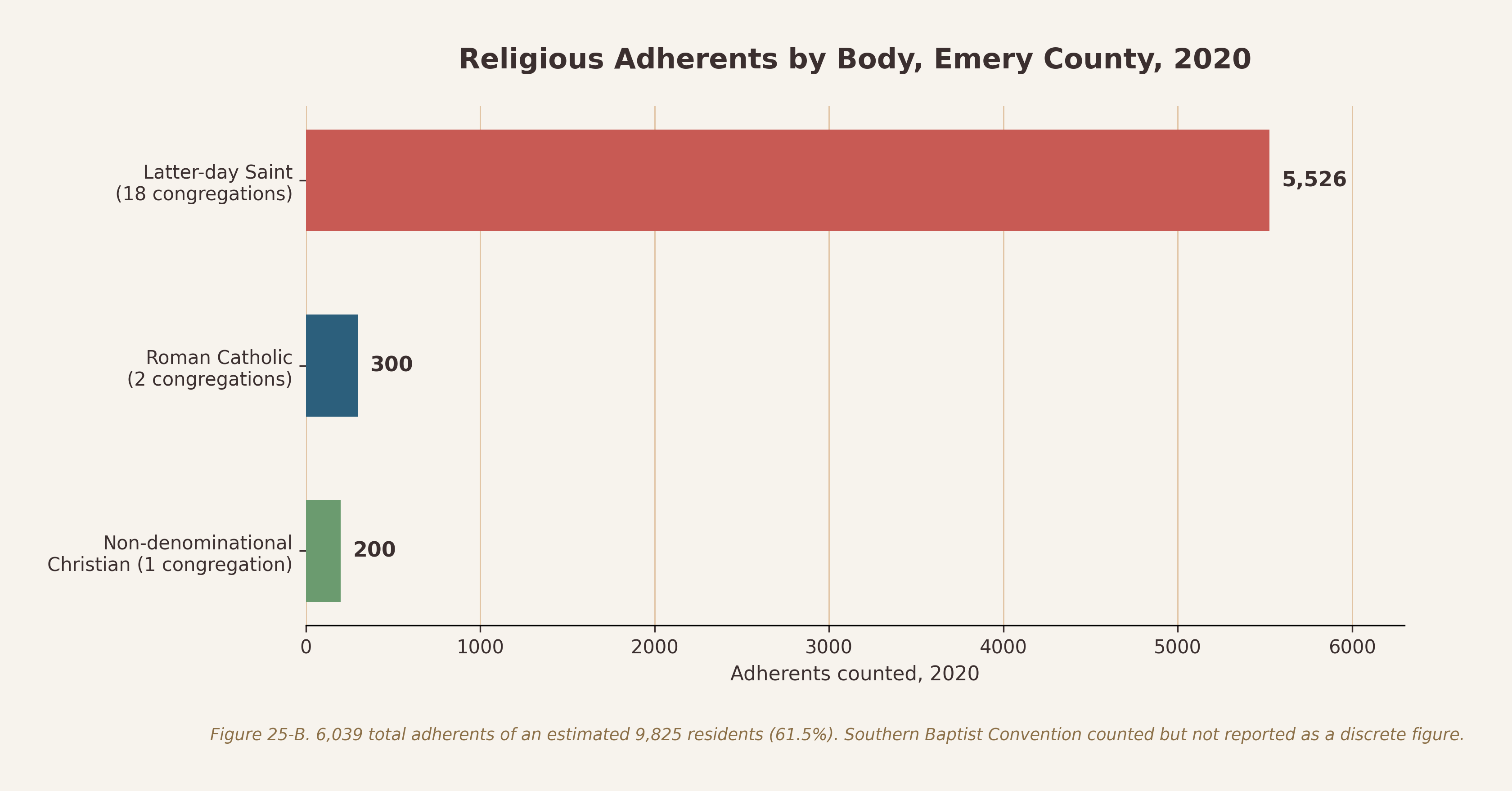
Table 25-A — Religious Adherents in Emery County, 2020
| Religious body | Adherents | Congregations | Share of adherents |
|---|---|---|---|
| The Church of Jesus Christ of Latter-day Saints | 5,526 | 18 | 91.5% |
| Roman Catholic Church | 300 | 2 | 5.0% |
| Non-denominational Christian | ~200 | 1 | ~3.3% |
| Southern Baptist Convention | not separately reported | — | — |
| Total adherents | 6,039 | — | 100% |
| Estimated county population | 9,825 | — | 61.5% affiliated |
Shares are of counted adherents, not of total population. The Southern Baptist Convention is described as accounting for a handful more adherents without a discrete figure. Source: 2020 U.S. Religion Census via ARDA.
The result is a county that is simultaneously one of the most religiously homogeneous in Utah and quietly diverse around the edges. Emery County’s 91.5 percent LDS share of religious adherents far exceeds the statewide average of about 60.7 percent (Pew Research Center, 2014; ARDA, 2020), and the visible architecture confirms it: every incorporated town has at least one LDS chapel, most have a stake center, and seminary buildings stand adjacent to every public high school. Yet the same county also contains a Gothic Revival Presbyterian church on the National Register of Historic Places, a Catholic mass schedule shared with neighboring counties, a clapboard pioneer chapel that is the last of its architectural kind in Utah, and Indigenous rock art panels still understood by their tribal descendants as living religious geography.
25.2 Indigenous Spiritual Traditions on the Land
Long before Brigham Young’s 1877 call sent settlers to Castle Valley, the canyons and benches of what is now Emery County held some of the densest concentrations of religious imagery in the American West. Rock art panels at Buckhorn Wash, Black Dragon Canyon, Rochester Creek, Temple Mountain Wash, Muddy Creek, and Ferron Box (see Ch12: Rock Art & Sacred Landscapes ↗ 2 Ch12: Rock Art & Sacred Landscapes Barrier Canyon Style, Fremont, and Ute rock art traditions across 400+ documented sites in Emery County — styles, chrono... Read chapter → ) record at least three distinct cultural traditions: the Barrier Canyon Style (estimated 3,000 BCE–500 CE), the Fremont culture (roughly 300–1300 CE), and later Numic-speaking peoples — ancestors of today’s Ute and Southern Paiute — whose imagery overlays older surfaces.
Researchers and tribal elders agree that these panels were never decorative. They served, and continue to serve, religious purposes: marking sacred places, recording stories of cosmological encounter, depicting beings encountered in altered states of consciousness, and tracking the obligations between humans, animals, and the land. At the Rochester Creek site — perhaps the most extensively documented of the multi-culture panels — the Ute spiritual leader Larry Cesspooch has narrated public-facing interpretations identifying bear figures with Ute religious cosmology and cautioning visitors that the panel remains a place where prayers are offered (Ancient Art Archive, n.d.). Bear, water-being, and shield-figure motifs appear repeatedly across Emery County panels, often at the heads of canyons, near springs, or above sheltered alcoves used for habitation.
For the Indigenous peoples whose ancestors made these images, the panels are not artifacts of a vanished culture but elements of an ongoing relationship to place. The Ute Indian Tribe of the Uintah and Ouray Reservation, the Navajo Nation, the Hopi Tribe, and the San Juan Southern Paiute Tribe have all asserted ancestral and cultural connections to landscapes within or adjacent to Emery County. Federal land managers — primarily the Bureau of Land Management, which administers most of the county’s public lands — engage in formal consultation with these tribes under the Native American Graves Protection and Repatriation Act (NAGPRA, 1990), the Archaeological Resources Protection Act (ARPA, 1979), and Section 106 of the National Historic Preservation Act (1966) when actions might affect sacred sites (see Ch13: Archaeological Stewardship ↗ 2 Ch13: Archaeological Stewardship Legal frameworks, monitoring programs, site stewardship, curation practices, and ethical principles for protecting Emery... Read chapter → ). Increasingly, interpretive signage and educational programs at the Buckhorn and San Rafael panels reflect collaborative authorship rather than the older convention of treating Indigenous religion in the past tense.
25.3 Mormon Foundation: The Emery Stake (1880) and Its Wards
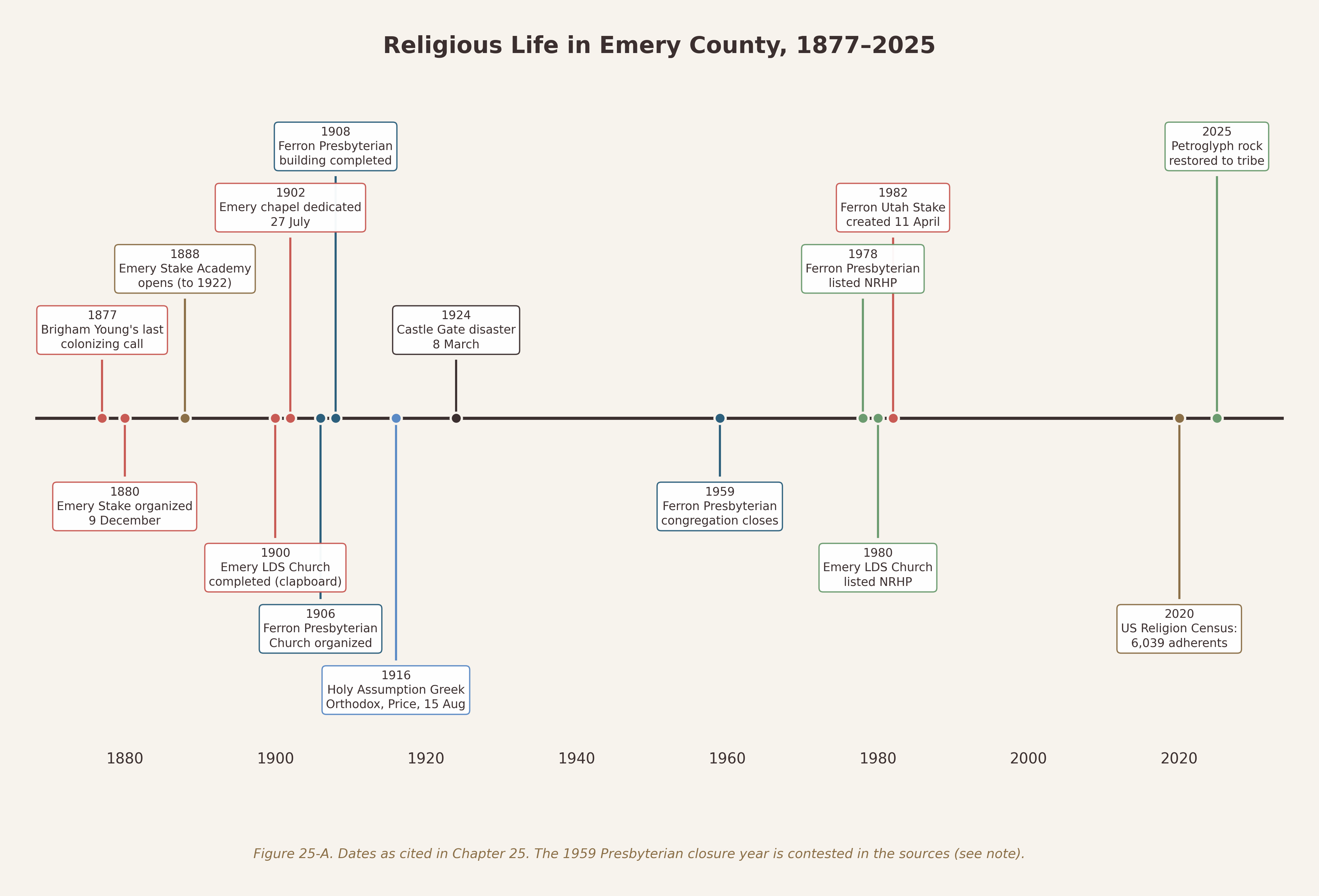
When Brigham Young issued his last colonizing call in the summer of 1877 — instructing leaders in Sanpete County to send families east across the Wasatch Plateau into Castle Valley (see Ch16: Mormon Colonization ↗ 3 Ch16: Mormon Colonization LDS settlement of Emery County: the call to colonize Castle Valley, founding of pioneer towns, cooperative irrigation, a... Read chapter → ) — the religious organization of the new settlements was implicit in the call itself. Mormon colonization in the late territorial period was inseparable from ecclesiastical organization: pioneers traveled as members of wards, settled in patterns dictated by stake-level leadership, laid out townsites with central squares reserved for chapel and school, and reported their progress to general authorities in Salt Lake City. Within three years of the first settlements at Ferron, Castle Dale, Huntington, and Orangeville, the Emery Stake of Zion was organized — on December 9, 1880, the same year Emery County itself was carved out of Sanpete and Sevier counties (FamilySearch, 2025; Castle Dale Utah Stake history).
The Emery Stake’s first president was Christian G. Larsen, with counselors drawn from the leading settler families. Original wards followed the major settlements: Castle Dale, Huntington, Ferron, Orangeville, and (slightly later) Cleveland and Emery. Smaller branches at Lawrence, Mohrland, Rochester, and Victor served outlying coal camps, ranching settlements, and irrigation hamlets. By 1930 the stake encompassed twelve wards and branches, and stake-level conferences drew families from across the county into Castle Dale on biannual weekends — a rhythm that defined religious and social calendars for generations (FamilySearch, Emery Stake Wards and Branches).
Table 25-B — Emery Stake Wards and Branches
| Unit | Type | Community served |
|---|---|---|
| Castle Dale | Ward | Castle Dale (stake headquarters) |
| Huntington | Ward | Huntington |
| Ferron | Ward | Ferron |
| Orangeville | Ward | Orangeville |
| Cleveland | Ward (organized slightly later) | Cleveland |
| Emery | Ward (organized slightly later) | Emery |
| Lawrence | Branch | Lawrence irrigation hamlet |
| Mohrland | Branch | Mohrland coal camp |
| Rochester | Branch | Rochester |
| Victor | Branch | Victor ranching settlement |
Emery Stake wards and branches as named in this chapter, from FamilySearch, Emery Stake, Utah LDS Church Wards and Branches. The stake encompassed twelve wards and branches by 1930; ten are named here. The two unnamed units are not supplied.
The stake’s name and reach changed over the 20th century. Mid-century reorganizations renamed the Emery Stake the Castle Dale Utah Stake, signaling the headquarters town rather than the now-shared county designation. On April 11, 1982, the Ferron Utah Stake was created from a southern division of the Castle Dale Utah Stake, with Jerry D. Mangum (1933–1999), bishop of the Emery Ward, called as first stake president. The 1982 division reflected both growth in the southern wards and a desire to keep stake-level administration manageable for working-class members who would otherwise have driven 30 miles to Castle Dale for monthly leadership meetings. Today, the two stakes — Castle Dale and Ferron — together oversee 18 congregations and serve as the primary ecclesiastical infrastructure for Latter-day Saints across the county.
25.4 Pioneer Meetinghouses and Sacred Architecture
The earliest Castle Valley meetinghouses were practical structures: log rooms or rough-frame halls that doubled as schoolrooms during the week. By the 1890s, prosperity from irrigation farming and county-seat construction had filtered down to the wards, and substantial brick meetinghouses began to rise. Spacious brick chapels were built in Ferron and Huntington during the 1890s. The Emery Ward, which served the southwestern community of Emery and surrounding ranches, undertook its own building in 1898 under the direction of Bishop Alonzo Brinkerhoff. Construction took two years, the meetinghouse was completed in 1900, and — because of difficulty paying the $7,000 final cost — was not formally dedicated until July 27, 1902.
That building, the Emery LDS Church, stands today as the oldest remaining religious building in Emery County and the last surviving “New England” clapboard-style Mormon meetinghouse in Utah. Wood-frame construction sheathed in clapboard, with non-load-bearing adobe interior walls for thermal mass, was an unusual choice for a Mormon meetinghouse at the turn of the 20th century, when most Utah wards were building in brick. The chapel’s white-painted clapboards, modest steeple, and simple gabled roof would not have looked out of place in rural Vermont — a quiet architectural echo of the New England roots of many Castle Valley founding families. The building was added to the National Register of Historic Places in 1980 and remains in active use for occasional services and community events (Wikipedia, Emery LDS Church; HMDB historical marker, 2022).
Table 25-C — Religious Heritage Buildings on the National Register
| Building | Location | Built | NRHP listed | Significance |
|---|---|---|---|---|
| Emery LDS Church | Town of Emery | 1898-1900; dedicated 27 July 1902 | 1980 | Oldest remaining religious building in the county; last surviving “New England” clapboard Mormon meetinghouse in Utah. Wood frame, clapboard sheathing, non-load-bearing adobe interior walls. Final cost $7,000. |
| Ferron Presbyterian Church and Cottage | Mill Road & 200 East, Ferron | 1908 | 1978 | Gothic Revival combined chapel, parsonage, and mission school; built by the Christian Endeavor Society. Congregation active approx. 1906-1959. |
Source: National Register of Historic Places files (1978, 1980); HMDB historical marker. The Castle Dale Stake Center is omitted: its construction year needs verification and no undated row is worth a table line here.
The brick Ferron and Huntington chapels of the 1890s did not survive the consolidation campaigns of the mid-20th century, when the LDS Church replaced many turn-of-the-century buildings with standardized modern stake centers and ward chapels. Castle Dale’s Public Square — the original 1880-era civic and religious heart of the town — historically held the First Emery Stake Academy (1888–1922), Castle Dale Elementary, and a Relief Society building, forming a triad of ecclesiastical, educational, and women’s auxiliary structures characteristic of Mormon village planning. The current Castle Dale Stake Center, built during the post-war modernization era [construction year needs verification against Emery Stake archives or LDS Building Department records], sits on a different site and embodies a different aesthetic — efficient, low-slung, designed for adaptable use across multiple wards rather than a single congregation’s identity. The contrast between the surviving Emery clapboard chapel and the contemporary stake center sketches in miniature the architectural arc of Mormon meetinghouse design across the 20th century.
25.5 The 1982 Stake Division and the Texture of Mormon Community
Stake boundaries in the Latter-day Saint tradition are not casual administrative lines. A stake is, in the church’s self-understanding, a unit of Zion — a gathering of saints organized for mutual aid, ordinance work, and spiritual development under the direction of a stake presidency, high council, and bishopric of each constituent ward. For Emery County’s Mormon majority, stake boundaries determine where one attends church each Sunday, where one’s children attend Mutual on Wednesday evenings, where one’s funeral will be held, and where the senior couple who finally retire will deliver their farewell talks before serving a mission. The 1982 division of the Castle Dale Utah Stake — creating the Ferron Utah Stake to the south — was therefore more than a logistical convenience. It split a single religious community of memory into two adjacent communities of memory, each with its own roster of presidents, its own conference rhythms, and its own slowly accumulating institutional lore.
In practice, the division has eased rather than fractured. Geography helped: the Ferron Utah Stake’s wards (Ferron, Emery, and several smaller units) had always shared the long drive south along Highway 10, and consolidating their leadership in Ferron simply formalized a pattern of association. Cross-stake relationships remain strong; families intermarry across the line, and joint stake activities are common. But for residents who attended Stake Conference at Castle Dale every six months from childhood and now attend at Ferron, the division marked the end of an era — a quiet local watershed alongside the more dramatic economic transitions of the 1980s.
25.6 Relief Society and Women’s Religious Labor
If the wards and stakes are the visible administrative skeleton of LDS life in Emery County, the Relief Society is the connective tissue. Founded in 1842 as the women’s auxiliary of the Latter-day Saint Church, Relief Society in pioneer Castle Valley took on the practical work of building communities: organizing the women who quilted burial cloths for neighbors lost to childbirth or accident; coordinating welfare aid for widows and the unemployed; running the grain-storage program that paid for the famous wheat sale to the U.S. government during World War I; and, in 20th-century iterations, leading the homemaking, literary, and theology classes that still anchor weekday meetings in every ward.
The historical record of Castle Valley Relief Society work is rich but unevenly documented. Castle Dale’s Public Square once held a dedicated Relief Society building — a structure separate from the stake academy and the elementary school, built specifically for women’s meetings, charitable work, and craft instruction. The building has been lost (date of demolition uncertain), but minutes books, photographs, and oral histories preserved in family collections and at the Emery County Historical Society offer glimpses of a parallel religious life conducted largely by women: midwifery training, communal canning operations, the production of temple clothing for the dead, and the slow, patient work of constructing a culture of mutual care that outlasted the original economic rationale of pioneer cooperative settlement.
Modern Relief Society in Emery County continues to organize ward dinners, support meal trains for new mothers and the bereaved, run literacy and English-as-a-second-language programs in the few wards with significant Spanish-speaking populations, and operate the temple-recommend interview process for sister members. The compassionate-service committee — a Relief Society function — remains the first line of community response when a family suffers a death, a fire, a layoff, or a serious illness. For many residents, religious or not, the practical reach of Relief Society casseroles has been a more tangible expression of Emery County’s faith than any sermon.
25.7 The Presbyterian Mission to Ferron, 1906–1950s
The most prominent non-LDS religious institution in 19th- and early 20th-century Emery County was the Ferron Presbyterian Church, organized in 1906 as part of a broader Presbyterian missionary effort across territorial and early-statehood Utah. The driving figure behind that effort was the Reverend Sheldon Jackson (1834–1909), Superintendent of Missions for Iowa, Nebraska, the Dakotas, Montana, Wyoming, Colorado, and Utah, who in his first year traveled 22,690 miles by railroad, stagecoach, horseback, and on foot to organize new congregations across the West (Utah History Encyclopedia, “Presbyterian Church in Utah”). Jackson’s strategy targeted communities where Presbyterian or other mainline Protestant settlers were arriving in numbers — coal-camp workers, federal employees, railroad families — and where Mormon dominance might be diluted by sustained missionary investment in schools.
Ferron, by 1906, fit the profile imperfectly but adequately. The town’s 1910 population had grown to 1,022, with a substantial country-town economy: schools, churches, a flour mill, a hotel, stores, and a saloon (Utah History Encyclopedia, “Ferron”). Among the population were enough non-Mormon families — Italian and Welsh coal miners, ranching families with mainline Protestant roots, a few professionals attracted by the new high school — to sustain a small Presbyterian congregation. The new church organized formally in 1906 and, two years later, completed construction of a Gothic Revival church-and-cottage building at the corner of Mill Road and 200 East. The 1908 building was constructed by the Christian Endeavor Society, a youth-led Protestant organization that had become the funding engine for Presbyterian church-building across the Mountain West.
The Ferron Presbyterian Church and Cottage operated as a combined chapel, parsonage, and mission school for roughly half a century. Its school component competed quietly with both the public school and the LDS Emery Stake Academy, offering a Protestant-flavored alternative to families who, for whatever reason, did not want their children educated in Mormon settings. By the 1940s, declining enrollments and shrinking mainline Protestant populations across rural Utah began to thin Presbyterian missions throughout the region. The Ferron congregation operated approximately 1906–1959, when it closed; sources vary slightly on the final year, with some citing mid-decade closure and others the end of 1959. [needs additional sources: Utah Presbyterian Mission records for Ferron congregation final year] The Green River congregation (a separate Presbyterian outpost near the Utah-Colorado approach) left the denomination in the late 1950s. The Ferron building, however, survived. It was added to the National Register of Historic Places in 1978, recognized for its architectural significance and as a visible record of Utah’s mainline Protestant missionary period (NRHP file; Wikipedia, Ferron Presbyterian Church and Cottage).
25.8 Catholic Presence and the Greek Orthodox Coal-Country Spillover
Roman Catholics have always been a small minority in Emery County, but a continuous one. The 2020 ARDA religion census counted 300 adherents in two congregations — a figure consistent with multi-decade patterns showing 2 to 5 percent of the county’s residents identifying as Catholic. These Emery County adherents have been served primarily by mission stations of the Diocese of Salt Lake City: a small chapel-station in Green River that draws on tourist and ranching populations, and a second mission point in the central county. It should be noted that the principal Catholic parish historically serving the broader Castle Country region — Our Lady of Lourdes (Notre Dame de Lourdes) — is located in Price, Carbon County, not in Emery County; Emery County’s Catholic families have typically traveled to Price for feast days, sacraments, and major liturgical observances. Mass schedules at the Emery County mission stations have depended on visiting priests rotating from Price and other Carbon County parishes.
The more dramatic religious story of the early-20th-century coalfields played out just north of the Emery County line in Carbon County — and spilled over into Emery County families through marriage, work, and shared mourning. No Greek Orthodox congregation was ever organized within Emery County itself; the Holy Assumption Greek Orthodox Church in Price was the institutional anchor, and Emery County families crossed the county line to worship there. Beginning around 1903, Greek immigrant labor flooded the Carbon County coalfields (see Ch17: Coal, Copper & Uranium ↗ 3 Ch17: Coal, Copper & Uranium The extractive century: coal seams of the Wasatch Plateau, uranium-rich sandstones of the San Rafael Swell, copper bypro... Read chapter → ). In 1900 only three Greeks lived in Utah; by 1916, roughly 3,000 young Greek men were working Carbon County coal mines, and they had built and dedicated the Holy Assumption Greek Orthodox Church in Price on August 15, 1916 — the 33rd Greek Orthodox parish established in the Americas (Utah History Encyclopedia, “Greeks in Utah”; CNEWA Magazine).
For Emery County’s coal camps — Mohrland, Hiawatha (which straddled the county line), Sweet, and the smaller satellite settlements — the Holy Assumption parish in Price was the only Greek Orthodox church within reach. Funerals, baptisms, and weddings drew miners and their families across the county line in numbers that left a permanent mark on local memory. The catastrophe came on March 8, 1924, when the Castle Gate mine disaster in Carbon County killed 172 men, 50 of them Greek. The combined Greek funeral services overflowed the Price parish; the joint memorial was held in a public hall, and the whole town mourned. Emery County families lost husbands, fathers, brothers, and tenants in the disaster, and the orthodox prayers chanted at Castle Gate echoed for a generation in the small Greek-speaking households scattered through Mohrland and Hiawatha (UEN; CNEWA, “Greek Orthodoxy in Mormon Zion”).
Today the Greek Orthodox community in Emery County itself is virtually invisible in the religion census — descendants have either dispersed or assimilated into Catholic, LDS, or non-affiliated households — but the cemetery markers in the abandoned coal-camp graveyards, with their distinctive Greek crosses and Cyrillic inscriptions, remain a quiet record of a religious history that flourished briefly and then receded with the coal industry that brought it.
25.9 Religious Education: Seminary, Institute, and Released Time
Religious education in Emery County operates at several layers, the most visible of which is the released-time seminary program for Latter-day Saint high-school students. Under released-time arrangements typical in heavily LDS counties, students in grades 9 through 12 may leave a public-school period each day to attend seminary classes in a building owned by the LDS Church and located adjacent to or on land directly abutting the public high school. In Emery County, every public high school — Emery High in Castle Dale, Green River High School (until its closures and consolidations described in Chapter 24), and Pinnacle Canyon Academy — has had an associated seminary building, with curriculum spanning the Old Testament, New Testament, Book of Mormon, and Doctrine and Covenants on a four-year rotation.
Seminary teaching is paid, professional work for senior teachers and a volunteer calling for early-morning seminary leaders. Released-time seminary in Emery County is the practical inheritor of the Emery Stake Academy mission of 1888–1922 — the formal church school that provided a religious-education option in an era before public secondary schools were widespread in rural Utah. (The Academy’s full educational history is treated in Chapter 24, see Ch24: Education & Learning ↗ 4 Ch24: Education & Learning From dugout-classroom pioneer schoolhouses through the Emery Stake Academy (1889-1922), the three-high-school era, and t... Read chapter → .) When the Academy closed in 1922 and Emery District opened consolidated public schools, seminary inherited the religious-instruction function while leaving secular curriculum to the public system — an arrangement that has persisted for more than a century and that few Emery County students experience as controversial.
Beyond seminary, the Institute of Religion program provides college-level religious education for LDS young adults. The closest institute to Emery County is the USU Eastern Institute in Price, which serves both Carbon and Emery county students enrolled at USU Eastern’s Price campus or the small Castle Dale campus operations. The institute building hosts weekly classes, social events, and pre-marriage counseling. Enrollment fluctuates with USU Eastern’s overall headcount, which itself reflects post-coal-economy demographic trends discussed in Chapter 24.
Non-LDS religious education in Emery County is essentially confined to congregational youth groups at the Catholic mission stations and at the few small evangelical and non-denominational Christian congregations that have appeared since 2000. The Ferron Presbyterian Church’s school component — once the most substantial non-LDS educational option in the county — has been closed for over half a century.
25.10 Modern Demographics and Generational Change
Emery County’s religious profile in the 21st century reflects two competing currents. On one side, the county remains overwhelmingly Latter-day Saint by any measure: 91.5 percent of religious adherents in 2020, 18 active congregations, two stakes, ward boundaries that organize neighborhood relationships and political identity to a degree few other counties in the United States can match. On the other side, the share of the county’s population identifying with no religion at all — the “nones,” in the language of contemporary survey research — has grown noticeably. Where statewide Utah has seen LDS share fall from a clear majority to roughly 60.7 percent (Pew, 2014; ARDA, 2020), Emery County’s residual religious adherence rate of 61.5 percent of total population suggests roughly 38 percent of residents are unaffiliated — a figure that would have been unthinkable a generation ago.
Several forces drive the change. Out-migration of the young — described in Chapter 22 (see Ch22: Demography & Social Change ↗ 3 Ch22: Demography & Social Change From pioneer founding cohort to post-coal crossroads: population boom and bust, LDS social architecture, an aging and sh... Read chapter → ) — has hollowed out the under-30 demographic that historically anchored ward youth programs and seminary classrooms. The economic decline of coal employment has dispersed the working-class Catholic and Greek Orthodox descendant populations whose attendance once supplied the small but steady non-LDS religious communities. Generational secularization, well-documented across all American religious traditions, has reached even Emery County’s traditionally devout LDS households; younger members are less likely to attend weekly services, less likely to serve missions, and more likely to describe themselves as “post-Mormon” or “culturally LDS but not active” than their parents and grandparents (Pew Research Center, 2024 trend data).
The visible signs are subtle. Sacrament-meeting attendance in some smaller wards is noticeably thinner than 1990s-era photographs suggest. The Emery Stake — once large enough to require a 1982 division — has not grown back to merit reconsolidation, and several wards have been administratively merged or moved to alternative meeting times to consolidate the pews on Sundays. At the same time, the religious institutions that remain are deeply rooted: bishops’ storehouse welfare networks, missionary farewells and homecomings, ward holiday parties, weekly Relief Society and elders’ quorum gatherings, and the steady cycle of stake conferences continue to organize community life for the majority who still identify as LDS, even as the active-attendance rate softens.
25.11 Pluralism, Spiritual-but-Not-Religious, and Quiet Diversification
The 2020 figures conceal a quieter pluralism than they might suggest. Behind the categorical “no religious affiliation” label sit a variety of patterns: residents who attend LDS services occasionally without claiming formal membership; residents who attend non-denominational Christian fellowships in Price or Wellington and commute home; residents whose religious identity is rooted in nature, the desert landscape, or family-based Mormonism rather than congregational practice; and residents — including a small but real population of returning Indigenous descendants and Latino Catholic in-migrants — whose religious lives are shaped by traditions outside the Anglo-Mormon-mainline framework that has dominated Castle Valley demographics for 150 years.
The growth of small evangelical and non-denominational Christian fellowships across the past two decades has been the most visible non-LDS religious development. The 2020 ARDA count identified 200 adherents in a single non-denominational Christian congregation; field reports suggest at least one additional small fellowship has organized informally in Castle Dale or Huntington since the count, drawing a modest but committed group of Sunday attenders. These fellowships have not yet built dedicated buildings; they meet in rented school auditoriums, community centers, or repurposed storefronts. Their growth pattern — small, slow, networked through Carbon County’s larger evangelical congregations — mirrors a broader trend in rural Utah’s small towns where a few percent of the population now find their religious home outside the LDS framework.
Latter-day Saints themselves participate in pluralization in a quieter form. The “TBM” (true-believing-Mormon) household model — in which weekly attendance, family home evening, daily scripture study, and tithe-paying are shared by all household members — coexists in many Emery County families with siblings, spouses, or children who have stepped back from active practice without formally leaving the church. These “post-Mormon” or “PIMO” (physically in, mentally out) members complicate any clean count of religious affiliation. So do residents who have formally resigned from LDS membership — a small but visible category since the church streamlined the resignation process in the 2010s — but who remain socially embedded in Mormon family and community structures.
Indigenous religious life within Emery County has its own quiet pluralism. While few enrolled tribal members reside permanently in the county today, ceremony continues at Indigenous-determined intervals at sites that include — though rarely with public announcement — points within Emery County’s public lands. Pilgrimage and prayer at petroglyph sites occurs alongside the ongoing work of cultural-resource consultation between the BLM, the Forest Service, the Ute Indian Tribe, the Navajo Nation, and the Hopi Tribe. The 2025 collaborative restoration of a sacred petroglyph rock to its tribal community of origin — coordinated through multi-year partnership with land managers and the Church of Jesus Christ of Latter-day Saints — demonstrated a model of cross-religious cooperation around Indigenous sacred objects that may shape future practice in Emery County (Church News, December 2025).
25.12 The Future of Faith Communities in Emery County
Predicting the religious future of any small American county is difficult; predicting it in Emery County is particularly so, because the demographic and economic forces buffeting the county’s faith communities are powerful and largely external. The continued decline of coal employment, the slow grind of out-migration among young adults, the secularization trends affecting all American religious traditions, and the intra-LDS shifts toward two-hour Sunday meeting blocks and home-centered, church-supported gospel learning all interact in ways that make linear projection unreliable.
A few patterns nonetheless seem clear. Latter-day Saint institutional infrastructure in Emery County — its 18 congregations, two stakes, seminary buildings, and welfare network — will remain the dominant religious presence for the foreseeable future, even if active-membership share continues to soften. Stake reconsolidation (re-merging the Castle Dale and Ferron stakes) is conceivable if attendance declines significantly, though as of 2026 there is no public indication that such a reorganization is imminent. The historic non-LDS buildings — the Emery clapboard chapel, the Ferron Presbyterian Church and Cottage — will continue to serve as architectural touchstones of religious history rather than active worship sites, with their preservation increasingly entwined with heritage-tourism promotion described in Chapters 30 through 36.
The two Catholic mission stations and the small evangelical fellowships are likely to persist at small numbers — sustained by visiting priests, regional networks of pastoral support, and the trickle of in-migrants drawn by retirement, remote work, or specialty agriculture. Indigenous religious life on the land will continue under tribal direction, increasingly visible in interpretive and consultative contexts even as the underlying ceremonial practice remains private. The most important variable may be one that statistical surveys do not capture well: whether Emery County’s faith communities — Mormon and otherwise — succeed in transmitting a sense of meaning, belonging, and shared moral purpose to a generation whose economic and cultural lives are reshaping faster than the meetinghouses they grew up in.
For 150 years, religion in Emery County has been a public, communal, architecturally visible affair. The chapels, the funerals, the Relief Society casseroles, the seminary buildings beside the high schools, the rock art panels at the canyon mouths — all bear witness to the central place of belief and practice in this small corner of the Colorado Plateau. Whatever the next 50 years bring, that physical and communal record will remain, available to be read by anyone who pauses to look.
Sources
ARDA (Association of Religion Data Archives). 2020. U.S. Religion Census: County Membership Reports — Emery County, Utah. https://www.thearda.com/us-religion/statistics/rankings
Ancient Art Archive. n.d. Rochester Rock Art Panel, Emery County Utah. https://www.ancientartarchive.org/rochester-rock-art-panel-emery-county-utah/
CNEWA Magazine. n.d. Greek Orthodoxy in Mormon Zion. https://cnewa.org/magazine/greek-orthodoxy-in-mormon-zion-33475/
Castle Dale Utah Stake. ChurchOfJesusChristWikia (Fandom). https://churchofjesuschrist.fandom.com/wiki/Castle_Dale_Utah_Stake
Emery County Utah. Castle Dale City Profile. https://emery.utah.gov/wp-content/uploads/2023/02/Castle-Dale.pdf
Emery Town. Pioneer Church. https://www.emerytown.com/general-7
FamilySearch. 2025. Emery Stake, Utah LDS Church Wards and Branches. https://www.familysearch.org/en/wiki/Emery_Stake,_Utah_LDS_Church_Wards_and_Branches
FamilySearch. 2025. Stakes and Wards of The Church of Jesus Christ of Latter-day Saints in Emery County, Utah. https://www.familysearch.org/en/wiki/Stakes_and_Wards_of_The_Church_of_Jesus_Christ_of_Latter-day_Saints_in_Emery_County,_Utah
Ferron Utah Stake. ChurchOfJesusChristWikia (Fandom). https://churchofjesuschrist.fandom.com/wiki/Ferron_Utah_Stake
HMDB (Historical Marker Database). Emery LDS Church. https://www.hmdb.org/m.asp?m=147830
Kem C. Gardner Policy Institute. May 2024. Utah Demographic Characteristics: Religious Affiliation Databook. https://d36oiwf74r1rap.cloudfront.net/wp-content/uploads/2024/05/DivDataBook-Religion-May2024.pdf
National Register of Historic Places. 1980. Emery LDS Church (Emery, Utah). NRHP file.
National Register of Historic Places. 1978. Ferron Presbyterian Church and Cottage (Ferron, Utah). NRHP file.
Pew Research Center. 2014. Religious Landscape Study: Utah. https://www.pewresearch.org/religious-landscape-study/state/utah/
The Church News. December 2025. “Multiyear collaboration restores sacred petroglyph rock to its rightful home.” https://www.thechurchnews.com/living-faith/2025/12/18/multiyear-collaboration-restores-sacred-petroglyph-rock-rightful-home/
U.S. Census Bureau. 2024. QuickFacts: Emery County, Utah. https://www.census.gov/quickfacts/fact/table/emerycountyutah/PST045224
Utah History Encyclopedia. Ferron. https://www.uen.org/utah_history_encyclopedia/f/FERRON.shtml
Utah History Encyclopedia. Greeks in Utah. https://www.uen.org/utah_history_encyclopedia/g/GREEKS_IN_UTAH.shtml
Utah History Encyclopedia. The Presbyterian Church in Utah. https://www.uen.org/utah_history_encyclopedia/p/PRESBYTERIAN_CHURCH_IN_UTAH.shtml
Utah Historical Quarterly. 1975. “Religious Architecture of the LDS Church: Influences and Changes since 1847.” Vol. 43, No. 3. https://issuu.com/utah10/docs/uhq_volume43_1975_number3
Utah Historical Quarterly. 1998. “History Written on the Land in Emery County.” Vol. 66, No. 3. https://issuu.com/utah10/docs/uhq_volume66_1998_number3
Wikipedia. Emery County, Utah. https://en.wikipedia.org/wiki/Emery_County,_Utah
Wikipedia. Emery LDS Church. https://en.wikipedia.org/wiki/Emery_LDS_Church
Wikipedia. Ferron Presbyterian Church and Cottage. https://en.wikipedia.org/wiki/Ferron_Presbyterian_Church_and_Cottage
Wikipedia. Institute of Religion. https://en.wikipedia.org/wiki/Institute_of_Religion
See Also
- Ch12: Rock Art & Sacred Landscapes ↗ 2 Ch12: Rock Art & Sacred Landscapes Barrier Canyon Style, Fremont, and Ute rock art traditions across 400+ documented sites in Emery County — styles, chrono... Read chapter →
- Ch13: Archaeological Stewardship ↗ 2 Ch13: Archaeological Stewardship Legal frameworks, monitoring programs, site stewardship, curation practices, and ethical principles for protecting Emery... Read chapter →
- Ch16: Mormon Colonization ↗ 3 Ch16: Mormon Colonization LDS settlement of Emery County: the call to colonize Castle Valley, founding of pioneer towns, cooperative irrigation, a... Read chapter →
- Ch17: Coal, Copper & Uranium ↗ 3 Ch17: Coal, Copper & Uranium The extractive century: coal seams of the Wasatch Plateau, uranium-rich sandstones of the San Rafael Swell, copper bypro... Read chapter →
- Ch22: Demography & Social Change ↗ 3 Ch22: Demography & Social Change From pioneer founding cohort to post-coal crossroads: population boom and bust, LDS social architecture, an aging and sh... Read chapter →
- Ch24: Education & Learning ↗ 4 Ch24: Education & Learning From dugout-classroom pioneer schoolhouses through the Emery Stake Academy (1889-1922), the three-high-school era, and t... Read chapter →
Further Reading
- Association of Religion Data Archives — U.S. Religion Census County Membership Reports
- National Register of Historic Places
- Utah History Encyclopedia — The Presbyterian Church in Utah
- Utah History Encyclopedia — Greeks in Utah
- FamilySearch — Emery Stake, Utah LDS Church Wards and Branches
- Kem C. Gardner Policy Institute — Utah Religious Affiliation Databook (May 2024)
Proposed Maps and Figures
- Map 25.1 — Active places of worship in Emery County, 2026 (LDS chapels, Catholic mission stations, non-denominational fellowships, plus historic Ferron Presbyterian and Emery LDS chapel as heritage sites).
- Figure 25.1 — Photograph: Emery LDS Church (clapboard, 1900). Source candidate: HMDB or Wikimedia Commons.
- Figure 25.2 — Photograph: Ferron Presbyterian Church and Cottage (1908 Gothic Revival). Source candidate: NRHP file image / Wikimedia Commons.
- Figure 25.3 — Photograph: Rochester Creek rock art panel (with Indigenous-collaborative interpretive caption, used with permission). Source candidate: Ancient Art Archive.
- Figure 25.4 — Diagram: Emery Stake → Castle Dale Stake → Ferron Stake division timeline (1880 / 1982 / present). Original artwork.
Proposed Tables
- Table 25.1 — 2020 religious adherent count in Emery County by denomination (ARDA data).
- Table 25.2 — Original 1930 Emery Stake wards and branches (FamilySearch enumeration).
- Table 25.3 — Comparison: Emery County LDS share of religious adherents vs. statewide Utah, 1990 / 2000 / 2010 / 2020.
Engagement Features
Did You Know?
- The Emery LDS Church — the white clapboard chapel in the town of Emery, completed in 1900 — is the last surviving “New England” style Mormon meetinghouse in Utah. It looks like it belongs in rural Vermont, not the Colorado Plateau desert, because many Castle Valley founding families had New England roots. It is still on the National Register of Historic Places and still hosts occasional services.
- The Ferron Presbyterian Church was built in 1908 by the Christian Endeavor Society, a youth-led Protestant organization. Despite serving a tiny congregation in a heavily LDS county, the building survived for over a century and earned its own listing on the National Register of Historic Places in 1978 — making Ferron one of the few Utah towns with two nationally recognized historic religious buildings.
- The 2020 U.S. Religion Census found that 91.5 percent of religious adherents in Emery County were Latter-day Saints — but about 38 percent of the county’s total population reported no religious affiliation at all, a figure that would have been almost unthinkable a generation ago and that reflects a quiet but real generational shift even in one of America’s most religious counties.
Family Activity
Take a “sacred architecture walk” in two Emery County towns. In the town of Emery (about 20 miles south of Castle Dale on Highway 10), find the 1900 clapboard LDS meetinghouse and read the historical marker. Then drive to Ferron (another 10 miles south) and find the 1908 Presbyterian Church and Cottage at Mill Road and 200 East. Stand in front of both buildings and compare them: What materials were used? What does the architecture say about the congregation that built it? What does the presence of a Presbyterian church in a heavily LDS town tell you about the people who were here? Both buildings are on the National Register of Historic Places, and both still stand.
Youth Challenge
You are a rock-art detective. At the Buckhorn Wash Pictograph Panel in the San Rafael Swell (about 30 miles north of Castle Dale via Highway 10 and the Buckhorn Wash Road), find the Barrier Canyon Style figures — the tall, ghostly anthropomorphs that are the oldest imagery on the panel. Using the interpretive signage and what you know from section 25.2, answer: What three cultural traditions left their mark on this panel? What does the Ute spiritual leader Larry Cesspooch say these figures represent? Why is this panel considered a living sacred site, not just an archaeological artifact? Photograph the panel from a respectful distance (no touching — ever) and write a caption that treats the images the way their makers intended.
Field Trip
Visit two of Emery County’s nationally recognized historic religious buildings in a single afternoon. Start at the Emery LDS Church (town of Emery, on Main Street), which has a historical marker and is occasionally open for events. Then drive north to Ferron and find the Ferron Presbyterian Church and Cottage (Mill Road and 200 East). From Ferron, if time allows, continue to Castle Dale’s Public Square area and try to identify where the original Emery Stake Academy once stood — compare historical photographs from the Emery County Archives blog with what you see today. The full route is about 45 miles round-trip from Castle Dale and requires no admission fee.
Photo Assignment
Photograph something that represents religious life in Emery County that isn’t a building: a seminary building standing adjacent to a public high school (visible at Emery High in Castle Dale), a Greek cross or Cyrillic-inscribed headstone in one of the old coal-camp cemeteries near the Carbon County border, or the BLM interpretive sign at Buckhorn Wash that acknowledges the rock-art panels as living Indigenous sacred sites. Write a caption explaining what your photograph reveals about the diversity of religious traditions that have shaped this county — including traditions that left no chapels behind.