Part 3 · Settlement
Demography & Social Change
From pioneer founding cohort to post-coal crossroads: population boom and bust, LDS social architecture, an aging and shrinking workforce, school enrollment cliff, healthcare access gaps, and the resilience of a community navigating energy transition and demographic change.
Ch22 — Demography & Social Change
22.1 Introduction — A County Measured in People
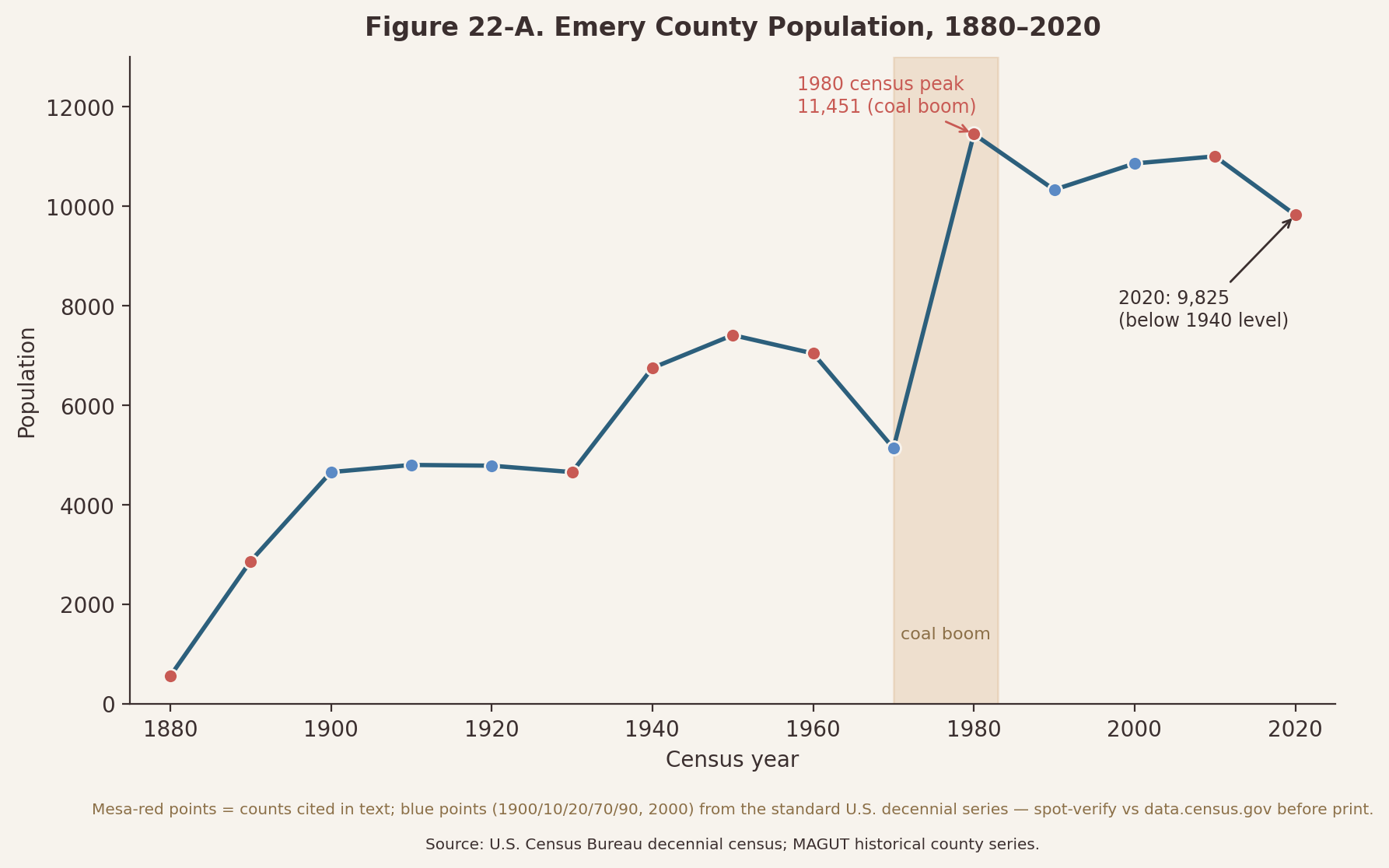
Numbers tell stories. In Emery County, Utah, the census figures from each passing decade read like a barometer of economic fortune: slow growth during pioneering years, a Great Depression dip, a modest mid-century plateau, then an astonishing eruption in the 1970s as coal brought thousands of newcomers flooding into Castle Valley, followed by an equally unmistakable retreat that has continued, with occasional pauses, to the present day. As of the 2020 census, 9,825 people called Emery County home — fewer than lived here in 1940, and roughly 15 percent fewer than the county’s population peak of 11,451 recorded in the 1980 census, at the height of the coal boom.
Population totals, however, capture only a fraction of the social story. Emery County’s demography is also a story about who its people are: predominantly white and LDS in religious affiliation, with a slowly growing Hispanic minority; a workforce shaped first by irrigation agriculture, then by coal, and now groping toward a post-fossil-fuel identity; an educational system squeezed by decades of enrollment decline; and a healthcare landscape that forces most residents to drive to neighboring Carbon County for anything beyond routine care. Woven through all of it is the distinctive social architecture of The Church of Jesus Christ of Latter-day Saints, which has organized community life in Castle Valley since the first pioneer wagon rolled in during the autumn of 1877.
This chapter traces the human geography of Emery County from its founding cohort through the present — not just how many people, but who they were, how they organized their lives, and what pressures have shaped the community they left behind.
22.2 The Pioneer Wave: Settlement Demographics 1877–1920
The federal census of 1880 counted 556 people in Emery County — though local historians have long recognized that figure as an undercount, as many prominent settler families were inadvertently omitted from the county rolls in those early years. Whatever the precise number, the founding cohort was small, closely connected, and almost entirely drawn from LDS communities in neighboring Sanpete County to the west.
The impetus for settlement came directly from Church leadership. Brigham Young, in the final years of his life, directed families southeastward into Castle Valley, motivated by two concerns: a land shortage in the densely settled Sanpete valleys, and a strategic desire to occupy the territory before non-LDS settlers could claim it (see Ch16: Mormon Colonization ↗ 3 Ch16: Mormon Colonization LDS settlement of Emery County: the call to colonize Castle Valley, founding of pioneer towns, cooperative irrigation, a... Read chapter → ). Young died in August 1877, but the colonization project he set in motion continued under his successors. By 1880 the core communities of Huntington, Ferron, Castle Dale, and Orangeville were established as going concerns, each organized around an LDS ward that functioned simultaneously as congregation, civic government, and mutual-aid society.
Growth accelerated through the final decades of the nineteenth century. By 1890 the county’s population had risen to 2,866, and by 1900 it exceeded 4,600, supported by more than 450 farms and an estimated 25,000 acres under irrigation cultivation, maintained by the cooperative canal companies that anchored the county’s water economy (see Ch19: Water for the Desert ↗ 3 Ch19: Water for the Desert Water, the defining constraint of Emery County life: pioneer ditches and the 1890s salinization crisis, the federal Emer... Read chapter → ).
The period 1900–1920 brought slower growth and the first hints of out-migration, as younger members of established families began departing for Price, Salt Lake, and other growing Utah centers. The 1920 census captured a county on the cusp of transition — still primarily agricultural, still almost entirely LDS, but beginning to feel the gravitational pull of an urbanizing state.
22.3 Stabilization and Depression: 1920–1960
The mid-century decades present a pattern of modest fluctuation. The 1930 census registered 4,657 residents — essentially flat compared to 1900, reflecting both the Depression’s economic pressure and the continued quiet exodus of young adults. By contrast, 1940 showed a notable jump to 6,750, driven partly by New Deal employment programs, particularly the Civilian Conservation Corps, which brought workers into the region for road construction and range improvement projects, and by the expansion of small coal operations in the Book Cliffs and Wasatch Plateau.
The 1950 census recorded 7,411 residents — the county’s highest count to that point — before a slight decline to 7,042 in 1960. This modest contraction reflected a familiar rural dynamic: mechanization was reducing agricultural labor demand (see Ch20: Agriculture & Ranching ↗ 3 Ch20: Agriculture & Ranching Pioneer canal-building and cooperative irrigation, the salinization crisis, the federal Emery County Project's dams and ... Read chapter → ), and the small-scale coal mines operating in Carbon and Emery counties could not absorb the displaced workforce. The 1950s and 1960s were years in which Emery County held its own but did not grow, functioning as what demographers sometimes call a “sending county” — a place that reliably produced more young people than its economy could employ.
Throughout these decades the LDS ward structure continued to provide the scaffolding of social life. Mutual improvement associations, women’s Relief Societies, and the cooperative irrigation companies that maintained the county’s canal infrastructure were all deeply intertwined with Church membership. A non-LDS resident — and there were some, particularly in the carbon-extraction trades — would have found a community that was friendly but organized around institutions in which full participation required Church affiliation. This social architecture was not enforced by law or overt coercion; it was simply the water in which Emery County swam.
22.4 The Coal Boom: Population Explosion 1970–1983
Nothing in Emery County’s demographic history compares to the transformation of the 1970s. Driven by the United States energy crisis and the consequent surge in demand for domestically produced coal, the county’s population rocketed from roughly 5,000–6,000 in 1970 to approximately 11,451 by the 1980 census — a near-doubling in a single decade, with growth continuing into the early 1980s before the peak was reached. This was not organic growth. It was a sudden infusion of workers and their families from across the intermountain West, drawn by wages that handily exceeded anything the agricultural economy had ever offered.
The catalysts were large and visible: the construction of the Hunter Power Plant near Castle Dale (1978) and the Huntington Power Plant near Huntington (1974), both operated by PacifiCorp, and the corresponding expansion of underground and surface coal mines in the Book Cliffs, Wasatch Plateau, and Castle Strip (see Ch17: Coal, Copper & Uranium ↗ 3 Ch17: Coal, Copper & Uranium The extractive century: coal seams of the Wasatch Plateau, uranium-rich sandstones of the San Rafael Swell, copper bypro... Read chapter → ). By mid-1979, the Savage Brothers’ coal and trucking operations alone employed approximately 1,600 Emery County residents. By 1980 the county had surpassed Carbon County to become Utah’s top coal producer, extracting 6.32 million tons in that year alone.
The demographic consequences were immediate and sometimes jarring. Existing communities were not built for such rapid growth. Castle Dale, Huntington, and Ferron scrambled to expand housing, schools, roads, and water systems. Temporary trailer parks appeared on the outskirts of established towns. The school district saw enrollment surge. The newcomers — miners, plant workers, electricians, equipment operators, and their families — were not all LDS, introducing for the first time a meaningful non-LDS presence into communities that had been almost uniformly Church-affiliated for a century.
Social tensions, while rarely violent, were real. Established residents sometimes described the newcomers as insufficiently rooted, more transient, and less committed to community institutions. The boom brought prosperity but also crowding, infrastructure strain, and an unfamiliar social heterogeneity. As with mining booms across the American West, the money flowed freely and the pace of change outstripped the community’s capacity to absorb it gracefully.
22.5 The Long Decline: Bust, Automation, and the Post-Coal Era
The population peak captured in the 1980 census — 11,451 residents — proved as fragile as every other coal-boom apex in the American West. Coal employment in Utah fell by roughly half between the early 1980s and the mid-1990s, the product of a triple squeeze: declining national coal prices as natural gas became more competitive, the introduction of continuous mining machinery that allowed fewer workers to produce more tons, and the closure of marginally profitable operations as the economics turned unfavorable (see Ch21: Energy Transition ↗ 3 Ch21: Energy Transition From coal peak to post-carbon crossroads: mine closures, shifting retirement timelines for Hunter and Huntington power p... Read chapter → ). Workers who had arrived with their families in search of stable wages found themselves unemployed, and many departed as quickly as they had come.
The bust did not empty the county overnight. Many families who had put down roots — bought houses, enrolled children in local schools, joined wards and communities — chose to stay despite the economic headwinds. But the demographic trajectory was unmistakably downward. By 2010 the census counted 11,004 residents, down substantially from the 1980 census peak of 11,451. By 2020 the count was 9,825, and 2023 estimates suggest approximately 9,970 — a population essentially back to 1940 levels, despite a century of intervening growth.
Table 22-A — Emery County Decennial Population, 1880-2020
| Census | Population | Note |
|---|---|---|
| 1880 | 556 | Cited; considered an undercount |
| 1890 | 2,866 | Cited |
| 1900 | >4,600 | Cited as “exceeded 4,600” |
| 1910 | ~4,800* | Standard series — verify |
| 1920 | ~4,800* | Standard series — verify |
| 1930 | 4,657 | Cited |
| 1940 | 6,750 | Cited |
| 1950 | 7,411 | Cited |
| 1960 | 7,042 | Cited |
| 1970 | ~5,137* | Draft: “5,000–6,000” — pin exact figure, verify |
| 1980 | 11,451 | Cited — coal-boom peak |
| 1990 | ~10,332* | Standard series — verify |
| 2000 | ~10,860* | Standard series — verify |
| 2010 | 11,004 | Cited |
| 2020 | 9,825 | Cited |
Values marked with an asterisk are gap-year figures from the standard decennial series, not cited in the chapter body — spot-verify vs data.census.gov before print. Source: U.S. Census Bureau decennial census; MAGUT historical county series.
The decline has not been evenly distributed across age groups. Emery County is aging. With a median age of 39.1 years as of 2023 — nearly eight years older than Utah’s statewide median of approximately 31 — the county reflects the departure of young adults who have left for college, employment, or military service and who often do not return. Between the 2010 and 2020 censuses, Emery County was one of only eight Utah counties to experience net population loss; the others include Carbon, Sevier, Garfield, and Kane — all counties similarly dependent on extractive industries.
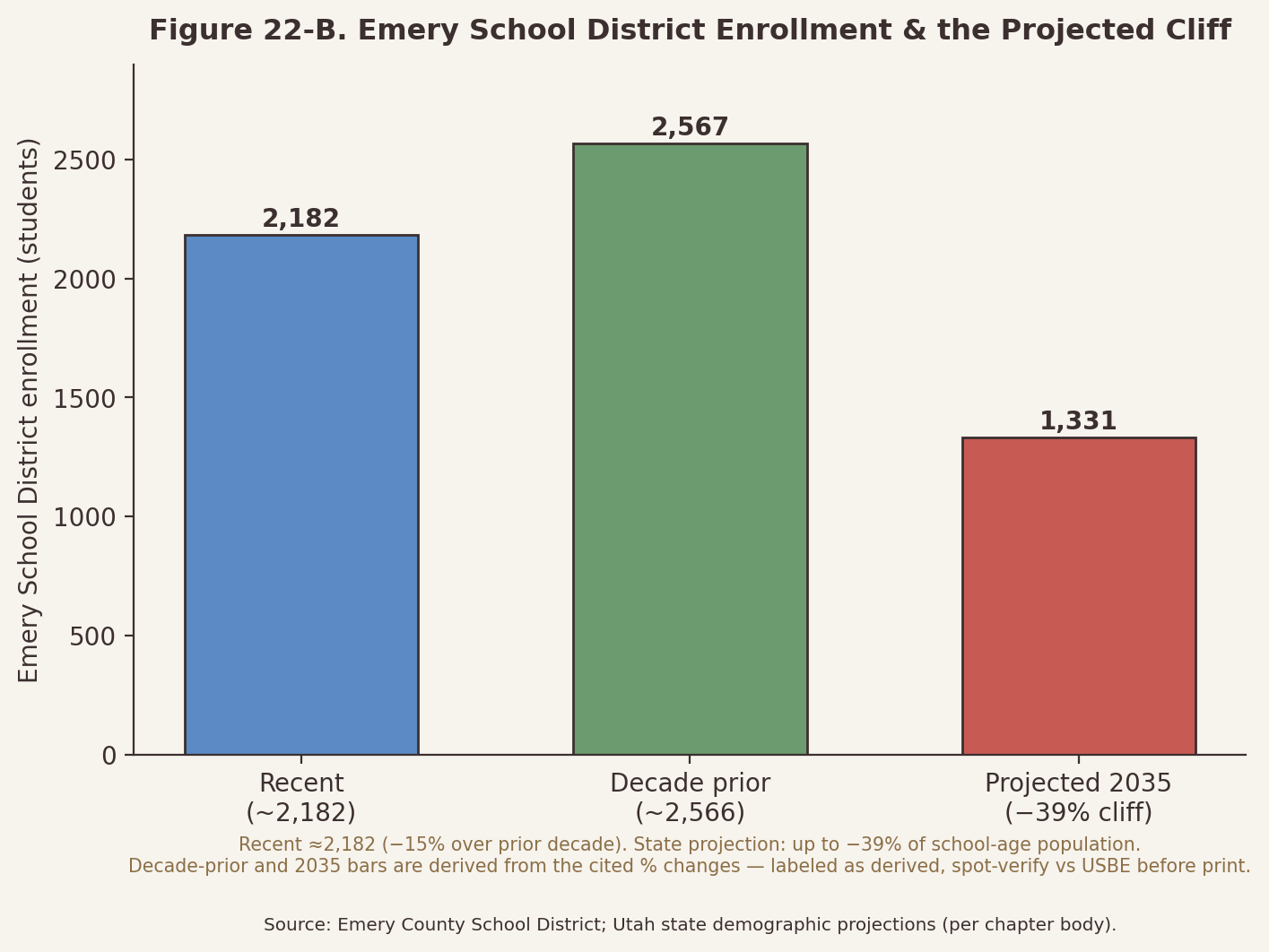
The school enrollment figures are perhaps the starkest leading indicator of what lies ahead. The Emery School District enrolled approximately 2,182 students in its ten schools in recent years — down nearly 15 percent over the preceding decade. State demographic projections suggest a potential 39 percent drop in school-age population in Emery County, one of the most severe forecasts for any Utah district. If those projections materialize, the implications for school funding, teacher retention, and community vitality will be profound.
22.6 Who Lives Here: Current Demographics, Race, and Ethnicity
As of the 2020 census and subsequent American Community Survey estimates, Emery County remains one of Utah’s more racially homogeneous counties. Non-Hispanic white residents account for approximately 89.5 percent of the population. Hispanic and Latino residents make up 7.3 percent — roughly 730 people — with individuals of two or more races accounting for another 1.8 percent. All other groups together represent less than 1 percent of the county total.
The Hispanic share, while modest in absolute numbers, represents a gradual long-term increase consistent with statewide trends. Across Utah, the Hispanic population grew from 201,000 in 2000 to nearly 600,000 by 2024, a nearly threefold increase driven by both immigration and natural population growth (Kem C. Gardner Policy Institute, 2024). Emery County’s growth has tracked these trends at a much smaller scale, slowed by the county’s limited employment base and its distance from the urban employment hubs — Weber, Davis, Salt Lake, and Utah counties — where more than 82 percent of Utah’s Hispanic population is concentrated.
The county’s Hispanic residents have historically been connected to labor in agriculture (particularly the Green River melon harvest and ranching operations), construction and mine service industries, and the retail and food-service sectors. Community organizations specific to the Hispanic population are limited in scale compared to those in urban Utah, reflecting both the community’s size and the continuing dominance of LDS ward structures as the primary vehicle for social organization.
Median household income in the county stood at approximately $69,956 in 2023, with an average of $81,960 — figures that are competitive with many rural Utah counties but that mask a widening gap as high-wage mining jobs diminish and are replaced by lower-paying service and retail positions. The poverty rate for individuals is 11.3 percent, just below the national average of 12.4 percent; for families, it is 6.8 percent. Among school-age children, 36.5 percent of Emery School District students qualify as economically disadvantaged — a figure that underscores the economic precarity affecting a significant portion of county households.
Table 22-C — Key Demographic Indicators Compared
| Indicator | Emery County | Utah statewide |
|---|---|---|
| Median age | 39.1 | ~31 |
| Median household income (2023) | ~$69,956 | — |
| Poverty rate (individuals) | 11.3% | (US ~12.4%) |
| Unemployment (Dec 2025) | 5.2% | 3.6% |
| Non-Hispanic white | ~89.5% | — |
| Hispanic / Latino | 7.3% (~730) | — |
| Students economically disadvantaged | 36.5% | — |
| Religious adherents (2020) | ~61.5% of pop.; LDS ~91.5% of adherents | — |
Source: U.S. Census / ACS; Utah Workforce Services (2025-26); ARDA (2020); Kem C. Gardner (2024). Note: the 2023 population estimate here (~9,970) differs from Ch21 §21.10 (~10,144) — flagged for a cross-chapter census-vintage reconciliation.
22.7 Faith and Family: LDS Culture as Social Architecture
To understand Emery County’s social life without understanding The Church of Jesus Christ of Latter-day Saints is to misread the landscape entirely. The Church was not merely present at the county’s founding — it was the organizing rationale for settlement, the vehicle through which cooperative labor was directed, and the institution that structured everything from canal maintenance to marriage customs to community recreation for the better part of a century.
The 2020 congregational membership data compiled by the Association of Religion Data Archives indicates that religious adherents accounted for approximately 61.5 percent of Emery County’s total population, with the LDS Church far and away the dominant body. Among that adhering population, the LDS share has remained dominant but has gradually declined: from an estimated 93 percent of religious adherents in 1980, at the height of the coal boom, to approximately 91.5 percent in 2020 (ARDA, 2020) — a modest narrowing that reflects both the arrival and departure of non-LDS boom-era workers and a slow, generational broadening of religious pluralism. The actual percentage of residents with LDS cultural affiliation — including those who are less active or who have not formally resigned — is almost certainly higher, as the Church does not publicly release county-level membership totals.
The practical effects of this religious majority on daily social life have been substantial and are worth examining in concrete terms. The LDS ward and stake system provided Emery County’s communities with ready-made mutual aid networks. When a family suffered illness, crop failure, or job loss, the ward mobilized. The Relief Society — the Church’s women’s organization, one of the oldest and largest women’s organizations in the world — coordinated welfare, childcare, and home-nursing in an era when no formal social service infrastructure existed. The construction of meetinghouses, which doubled as community recreation halls, provided gathering spaces for dances, theatrical performances, and civic meetings in communities too small to otherwise sustain them.
Family structure in Emery County reflects this LDS context in measurable ways. Utah as a whole consistently ranks among the highest states for marriage rates and among the lowest for divorce rates; rural LDS counties like Emery tend to fall near the more conservative end of those distributions. Household sizes historically ran larger than national norms — a product of both LDS teachings encouraging large families and the practical reality that farm and ranch operations benefited from ample labor. That pattern has moderated in recent generations, as family sizes have decreased across Mormon Utah generally, but multi-generational households and extended family proximity remain more common in Castle Valley than in comparable non-LDS rural communities.
It would be incomplete, however, to describe the LDS social architecture as uniformly stabilizing. The same close-knit community structure that supported neighbors in hardship could also produce social pressure, conformity expectations, and difficulties for residents who were not LDS, who had left the Church, or whose lives did not map neatly onto conventional family models. The boom years of the 1970s introduced a larger non-LDS minority than the county had previously known, and some long-term residents describe those years as a period when the older social consensus was under genuine stress. That stress largely resolved as the non-LDS boom workers departed after the bust — but it left traces: a somewhat more diverse religious landscape and, among longtime residents, a more self-conscious awareness of the county’s LDS character as something specific rather than simply universal.
22.8 Educating the County: Schools, Achievement, and the Enrollment Cliff
The Emery County School District operates ten schools serving students across the county’s geographically dispersed communities. Enrollment as of the most recent reporting period stands at approximately 2,182 students — a figure that has declined by nearly 15 percent over the preceding decade and that is projected to fall much further as the school-age population contracts.
Educational attainment among Emery County adults reflects the county’s historical economy more than its aspirations. Approximately 38 percent of adult residents hold a high school diploma as their highest credential, while about 30 percent have completed some college or a vocational certificate, and only 9.6 percent hold a bachelor’s degree. That last figure is striking: Utah’s statewide bachelor’s-degree attainment rate is approximately 33 percent, meaning Emery County’s four-year degree rate is less than one-third the state norm. This gap is not unique to Emery County — it appears across rural, mining-economy counties throughout the intermountain West — but it has real consequences for the county’s ability to attract employers that value credential-based hiring.
Table 22-B — Educational Attainment, Adults (2023 ACS)
| Highest credential | Emery County | Utah statewide |
|---|---|---|
| High school diploma (highest) | ~38% | — |
| Some college / vocational | ~30% | — |
| Bachelor’s degree | 9.6% | ~33% |
Source: American Community Survey (2023).
Student performance in Emery schools sits near state averages in mathematics (42 percent proficiency, versus Utah’s 40 percent) but below average in reading (35 percent proficiency, versus 43 percent statewide). The graduation rate of 87 percent has declined modestly from a recent high of 90–94 percent. About 36.5 percent of district students are classified as economically disadvantaged — a proportion that complicates instructional planning and strains support services.
The enrollment trajectory is the district’s most pressing long-term challenge. State projections suggest Emery County could lose as much as 39 percent of its school-age population — a figure that, if realized, would force school consolidations, teacher reductions, and difficult conversations about which communities can sustain their own neighborhood schools. The Emery County School Board has publicly acknowledged the concern: Superintendent Shank has noted the particularly worrying pattern of small kindergarten registration cohorts, which function as a leading indicator of enrollment conditions five to twelve years into the future.
The district has responded with curriculum emphasis on career and technical education — practical credentials in trades, health care, and energy technologies — that may keep some students locally employed rather than pushing them toward four-year programs that carry both debt and relocation. Whether those strategies can meaningfully slow the enrollment decline remains to be seen.
22.9 Health, Services, and the Rural Access Gap
Emery County has no full-service hospital within its borders. The primary hospital serving the county is Castleview Hospital in Price, Carbon County — a 39-bed facility that has earned a Joint Commission Gold Seal of Approval, Level IV Trauma Center designation, and multiple Top 100 and Top 20 Rural & Community Hospital recognitions from the Chartis Center for Rural Health over the past four decades. For Emery County residents, Price is 25 to 35 miles from the county’s main communities — a manageable drive under normal conditions but a meaningful barrier in medical emergencies, during winter weather, or for residents without reliable transportation.
Within the county itself, the Emery Medical Center in Castle Dale provides family practice and urgent care services as a satellite clinic under the Castleview/LifePoint Health umbrella. This clinic handles routine and episodic care for much of the county’s population but does not offer inpatient services, surgical capabilities, or the specialty medicine available in Price. Residents requiring cardiology, oncology, orthopedic surgery, obstetrics, or behavioral health services typically must travel to Price, and often farther — to Grand Junction, Colorado, or Salt Lake City — for subspecialty care.
The structural reliance on a facility in a neighboring county is a recognized vulnerability. If Castleview Hospital were to close or significantly reduce services — a fate that has befallen rural hospitals across the American West as reimbursement pressures mount — Emery County’s healthcare access problem would become acute. The county itself lacks the population base to support an independent full-service hospital at current reimbursement rates.
Mental health and substance-abuse services present a parallel challenge. Addiction, depression, and anxiety are recognized public health concerns in coal-transition communities nationally, as economic disruption and loss of occupational identity take psychological tolls on affected populations. The precise scale of these challenges in Emery County is not well-documented in public health surveillance data at the county level, but the pattern observed in analogous communities suggests they are significant. [needs additional sources — Utah IBIS-PH county health profiles]
22.10 Work and Wages: Labor Force Shifts
Emery County’s employed workforce numbered approximately 4,371 as of December 2025, with an unemployment rate of 5.2 percent — well above Utah’s statewide rate of 3.6 percent and a persistent indicator of the county’s limited economic opportunity relative to the state at large (Utah Workforce Services, 2025–2026).
The composition of that workforce has changed substantially over the past half century. During the boom years, coal mining and power plant operation were the dominant employers, offering wages that ranked among the highest in rural Utah. By the 2020s, the largest employers included the Emery County School District, Emery County government, the remaining coal operations (Foresight Energy’s Deer Creek and Horizon mines), Castleview/LifePoint’s Emery Medical Center, and a growing array of small businesses in retail, food service, and outdoor recreation.
The shift from extraction to services is not unique to Emery County — it is the defining economic transition of rural coal counties across the intermountain West. But the wages available in services, education, and healthcare are, on average, lower than those that extraction once provided, and they rarely include the benefit packages — pensions, employer-provided health insurance, hazard pay premiums — that unionized mining jobs historically offered. The practical consequence is a workforce whose nominal wages have declined in real purchasing power relative to the boom years, even as the cost of living in rural Utah has been partly inflated by the recreational amenity demand emanating from the greater Wasatch Front.
Women’s workforce participation, historically constrained by the LDS community’s emphasis on maternal roles in the home, has increased steadily across rural Utah since the 1970s and particularly since the economic disruptions of the post-boom years. As mining wages declined and household income pressure grew, dual-income families became more common, and women entered the local labor market in larger numbers — primarily in teaching, healthcare support, retail, and government employment. [needs additional sources — ACS gender/labor-force time series for Emery County]
22.11 The Departure Problem: Out-Migration and an Aging County
Demographers use the term “brain drain” to describe the systematic departure of younger, more educated residents from rural communities toward urban centers offering broader economic opportunity. Emery County exhibits the pattern in textbook form. The county’s median age of 39.1 years is nearly eight years above Utah’s state median — an age gap that reflects not only the post-boom departure of working-age adults but the consistent outflow of young adults in the 18–28 cohort who leave for higher education or employment and rarely return.
This is not a new trend. Emery County has been a net exporter of people since at least the mid-twentieth century, with periodic interruptions — most notably the boom of the 1970s — when economic conditions temporarily reversed the flow. The difference today is that the interruptions are harder to imagine. Unlike the energy crisis that triggered the 1970s surge, the forces driving Emery County’s current economic condition — the global shift away from coal, the cost advantages of natural gas and renewables, the automation of remaining mine operations — do not appear likely to reverse.
The consequences of persistent out-migration and population aging compound one another. As the working-age population shrinks, the county’s tax base narrows, making it harder to fund schools, roads, and public services at levels that might attract or retain residents. As the school-age population declines, communities that have organized social life around youth sports, school events, and the rhythms of the academic calendar find those anchors weakening. As older residents age into disability and death, the county’s population loss accelerates even without further net out-migration.
Community leaders in Emery County have identified tourism and outdoor recreation as a potential counterweight (see Ch30: Landscapes of Adventure ↗ 5 Ch30: Landscapes of Adventure A practical field guide to Emery County's adventure landscape: San Rafael Swell slot canyons and OHV routes, Goblin Vall... Read chapter → ) — and Chapter 21 discusses the economic transition in detail. What matters here is the demographic implication: the visitors who come to explore the San Rafael Swell, Goblin Valley, or the Book Cliffs do not, for the most part, choose to live in Castle Dale or Ferron. Converting recreational visitation into residential population is one of the more difficult challenges facing amenity-economy counties nationwide, and Emery County has not yet solved it.
22.12 Looking Forward: Social Change and Community Resilience
It would be easy — and wrong — to read Emery County’s demographic story purely as a narrative of decline. The county has outlasted every economic disruption it has faced since 1877: the collapse of early irrigation dreams, the Depression’s squeeze, the bust that followed the 1970s boom, and the long coal retreat of the 1990s and 2000s. Each contraction produced predictions of community collapse that proved exaggerated.
What persists, generation after generation, is a social fabric that is unusually dense for a county of its size. Extended families that have lived in Castle Valley for five and six generations provide continuity and informal support networks that more transient communities cannot replicate. The LDS ward structure, whatever its limitations, continues to deliver mutual aid, social connection, and a sense of shared purpose at the neighborhood level. The county’s small size — 9,825 people across more than 4,000 square miles — means that individuals matter in ways they would not in a suburb of Salt Lake City. Local history is close and personal.
Social change in Emery County is not, therefore, best understood as a story of a community slowly dissolving. It is better understood as a community in ongoing negotiation — between its pioneer heritage and the economic realities of the twenty-first century; between the pull of LDS cultural tradition and the pluralism that has always been present at the county’s edges; between the desire to keep the next generation at home and the recognition that economic opportunity is genuinely limited. The residents who remain have made an active choice to be here, and that choice reflects values — of place, of community, of landscape — that cannot be fully captured in census columns.
How Emery County navigates the coming decades will depend partly on forces beyond its control: energy markets, state and federal policy, and the relative attractiveness of rural versus urban life for a generation that has grown up with remote work as a possibility. But it will also depend on choices made by county residents, school boards, economic development offices, and the families who decide, one household at a time, whether to stay or go. The demographic data reveals the pressures. The outcome is not yet written.
Sources
- U.S. Census Bureau QuickFacts: Emery County, Utah. https://www.census.gov/quickfacts/emerycountyutah
- USAFacts. “Emery County, UT population by year, race, & more.” https://usafacts.org/data/topics/people-society/population-and-demographics/our-changing-population/state/utah/county/emery-county/
- population.us. “Emery County population.” https://population.us/county/ut/emery-county/
- Data USA. “Emery County, UT.” https://datausa.io/profile/geo/emery-county-ut
- Utah Demographics. “Emery County Demographics: Current Utah Census Data.” https://www.utah-demographics.com/emery-county-demographics
- Point2Homes. “Emery County, UT Household Income, Population & Demographics.” https://www.point2homes.com/US/Neighborhood/UT/Emery-County-Demographics.html
- FRED / St. Louis Fed. “Resident Population in Emery County, UT (UTEMER5POP).” https://fred.stlouisfed.org/series/UTEMER5POP
- Wikipedia. “Emery County, Utah.” https://en.wikipedia.org/wiki/Emery_County,_Utah
- MAGUT (Utah Association of Government). “Utah Counties Population 1900 to 2000.” https://magutah.gov/static/files/data/demographics/PopulationHistoricUtahCountiesState.pdf
- Kem C. Gardner Policy Institute. “Exploring Utah’s Hispanic or Latino Groups: A Detailed Analysis.” July 2024. https://d36oiwf74r1rap.cloudfront.net/wp-content/uploads/2024/07/Hispanic-FS-July2024.pdf
- Kem C. Gardner Policy Institute. “76% of Utah’s population identify a religious affiliation.” https://gardner.utah.edu/news/76-of-utahs-population-identify-a-religious-affiliation-the-largest-of-any-state/
- Association of Religion Data Archives (ARDA). “Emery County, Utah — County Membership Report (2020).” https://www.thearda.com/us-religion/census/congregational-membership?y=2020&y2=0&t=0&c=49015
- Grokipedia. “Emery County, Utah.” https://grokipedia.com/page/Emery_County,_Utah
- High Country News. “Utah’s coal mines can’t find enough workers.” 2025. https://www.hcn.org/issues/57-3/utahs-coal-mines-cant-find-enough-workers/
- KSJD Public Radio. “Rural communities shift away from boom and bust.” January 25, 2022. https://www.ksjd.org/2022-01-25/rural-communities-shift-away-from-boom-and-bust
- ETV News. “Concerns About Student Enrollment and Funding Heard by Emery School Board.” https://etvnews.com/articles/youth-education/concerns-about-student-enrollment-and-funding-heard-by-emery-school-board/
- Public School Review. “Emery School District (2026).” https://www.publicschoolreview.com/utah/emery-school-district/4900270-school-district
- U.S. News & World Report. “Emery District.” https://www.usnews.com/education/k12/utah/districts/emery-district-106349
- Castleview Hospital. “About Castleview Hospital.” https://www.castleviewhospital.net/about
- LifePoint Health. “Castleview Hospital Now Designated as a Level 4 Trauma Center.” https://www.lifepointhealth.net/white-papers/castleview-hospital-now-designated-as-a-level-4-trauma-center
- NPI Registry. “Emery Medical Center, Castle Dale, Utah.” https://npino.com/primary-clinic/1285771220-emery-medical-center/
- Utah Workforce Services. “Workforce — Emery County.” https://emery.utah.gov/home/department-directory/economic-development/workforce/
- Wharton Public Policy. “Rural America is Losing Young People — Consequences and Solutions.” https://publicpolicy.wharton.upenn.edu/live/news/2393-rural-america-is-losing-young-people-
- Kem C. Gardner Policy Institute. “Utahns on the Move: State and County Migration Age Patterns.” September 2019. https://d36oiwf74r1rap.cloudfront.net/wp-content/uploads/MigrationReport-Sep2019-Final.pdf
See Also
- Ch16: Mormon Colonization ↗ 3 Ch16: Mormon Colonization LDS settlement of Emery County: the call to colonize Castle Valley, founding of pioneer towns, cooperative irrigation, a... Read chapter →
- Ch17: Coal, Copper & Uranium ↗ 3 Ch17: Coal, Copper & Uranium The extractive century: coal seams of the Wasatch Plateau, uranium-rich sandstones of the San Rafael Swell, copper bypro... Read chapter →
- Ch19: Water for the Desert ↗ 3 Ch19: Water for the Desert Water, the defining constraint of Emery County life: pioneer ditches and the 1890s salinization crisis, the federal Emer... Read chapter →
- Ch20: Agriculture & Ranching ↗ 3 Ch20: Agriculture & Ranching Pioneer canal-building and cooperative irrigation, the salinization crisis, the federal Emery County Project's dams and ... Read chapter →
- Ch21: Energy Transition ↗ 3 Ch21: Energy Transition From coal peak to post-carbon crossroads: mine closures, shifting retirement timelines for Hunter and Huntington power p... Read chapter →
- Ch30: Landscapes of Adventure ↗ 5 Ch30: Landscapes of Adventure A practical field guide to Emery County's adventure landscape: San Rafael Swell slot canyons and OHV routes, Goblin Vall... Read chapter →
Further Reading
- U.S. Census Bureau QuickFacts — Emery County, Utah
- Kem C. Gardner Policy Institute — Exploring Utah’s Hispanic or Latino Groups (2024)
- Association of Religion Data Archives — Emery County Membership Report (2020)
- Kem C. Gardner Policy Institute — Utahns on the Move: Migration Age Patterns (2019)
- ETV News — Concerns About Student Enrollment and Funding Heard by Emery School Board
Proposed Maps and Figures
- Fig. 22.1 — Population graph (1880–2024): line chart showing census counts by decade; annotate boom peak (1983) and 2020 figure.
- Fig. 22.2 — Age pyramid comparing Emery County vs. Utah statewide (2020 ACS); illustrates older skew.
- Fig. 22.3 — Race/ethnicity pie chart (2020); white/Hispanic/other breakdown.
- Fig. 22.4 — School enrollment trend (Emery School District, 2015–2025); bar or line chart with projected 2035 figure.
- Fig. 22.5 — Map: Emery County healthcare access — Castleview Hospital (Price), Emery Medical Center (Castle Dale), drive-time rings.
- Fig. 22.6 — Employment by sector comparison: 1980 vs. 2024 (coal/mining, education, government, services, agriculture).
Proposed Tables
- Table 22.1 — Decennial census population totals for Emery County, 1880–2020.
- Table 22.2 — Educational attainment breakdown (adult population, 2023 ACS).
- Table 22.3 — Key demographic indicators compared: Emery County, rural Utah average, Utah statewide (median age, income, poverty, HS/bachelor’s attainment, unemployment).
Engagement Features
Did You Know?
- Emery County’s median age is 39.1 years — nearly eight years older than Utah’s statewide median of about 31. That gap reflects decades of young adults leaving for college and employment and, for the most part, not returning.
- In the early 1980s, Emery County’s population hit a census peak of 11,451 in 1980 — nearly double its 1970 level — driven almost entirely by the coal boom. By 2020 it had fallen to 9,825, lower than the county’s 1940 population.
- Only 9.6 percent of Emery County adults hold a four-year college degree, compared to about 33 percent statewide — one of the largest educational-attainment gaps between a rural county and its state average anywhere in Utah.
Family Activity
Create a family population timeline for Emery County using the decennial census figures from this chapter (556 in 1880; 2,866 in 1890; 4,657 in 1930; 6,750 in 1940; 11,451 at 1980 census peak; 11,004 in 2010; 9,825 in 2020). Graph the numbers on a sheet of paper with years on the horizontal axis and population on the vertical. Mark the coal boom of the 1970s and the subsequent bust. Then mark any years when your own family members were living in Emery County — were they part of the boom? The pioneer founding? The post-bust era? Discuss what it would have felt like to arrive during the boom and watch the town grow overnight, versus staying through the long decline that followed.
Youth Challenge
Community Change Interview Project. Find an Emery County resident who has lived in the county for at least 40 years — ideally someone who was an adult during the 1970s coal boom. Ask them three questions: (1) What was Castle Valley like during the boom years? (2) What changed most noticeably after the bust? (3) What do they think the county will look like in 20 more years? Record their answers in writing or on your phone. You are doing primary-source oral history — the same kind of research that historians and encyclopedists rely on when they want to understand what it felt like to live through a major social change, not just what the census numbers show.
Field Trip
Castle Dale to Green River — A Demographics Drive. Drive the full length of UT-10 from Castle Dale south to its junction with I-70 near Green River, stopping at each community along the way: Orangeville, Huntington, Lawrence, Emery, Ferron, and Moore. At each stop, count the number of businesses open and operating on the main street. Note the condition of any vacant buildings. Look at the school if there is one — is there a sign showing current enrollment? In Green River, drive through the residential neighborhoods and notice the mix of occupied and vacant properties. This 70-mile corridor tells the demographic story of this chapter more vividly than any table of statistics: you are seeing, in real time, what it looks like when a rural county contracts.
Photo Assignment
Photograph a school building in any Emery County community during a school day — ideally capturing the building, the parking lot, and if possible any students or activity outside. Then photograph the same school’s marquee or any posted enrollment or event information. Pair this with a historical photograph (search the Utah State Historical Society digital collections at history.utah.gov for “Emery County school”) showing the same school or a comparable one during the boom era, when enrollment was at its peak. The comparison across time — full versus emptying — is the most honest portrait of what demographic change looks like at the community level.