Part 6 · Resources
Historic Registries
Emery County's 22 National Register of Historic Places listings, one National Historic Landmark (Cleveland-Lloyd Dinosaur Quarry, designated Nov. 24, 1968), the parallel National Natural Landmark designation, the Old Spanish National Historic Trail, Jurassic National Monument (designated Jan. 17, 2025), and the procedural mechanics of how to nominate a property and what designation actually protects.
38.1 Why Historic Registries Matter
A historic registry is, at base, a list of places that a public body has formally recognized as worth preserving — and once a place is on such a list, the recognition carries practical consequences. Listing on the National Register of Historic Places makes a property eligible for federal and state rehabilitation tax credits, triggers Section 106 review when a federal action might affect it, and enters the property into the public record as one of the resources future generations are entitled to consider before any decision is made about its fate.
Emery County’s relationship with historic registries is unusually layered for a rural Utah county. Twenty-two properties and districts are listed on the National Register of Historic Places, including one National Historic Landmark — the highest federal designation for a historic site. The Cleveland-Lloyd Dinosaur Quarry holds a separate but parallel federal designation as a National Natural Landmark. The Old Spanish National Historic Trail crosses the county’s eastern and northern edges. Jurassic National Monument was proclaimed in 2019 to encompass and protect the Cleveland-Lloyd quarry area. Six of the National Register listings are rock-art sites whose physical addresses are restricted to discourage vandalism — a quiet acknowledgement that recognition and access can pull in opposite directions.
This chapter is the chapter’s road map to those designations: what each one is, why it matters, what is on it, and how a property owner or community member can add to it. Two principles run through the discussion. The first is that the National Register is descriptive, not protective — listing does not freeze a property in amber, and most owners retain full freedom to modify or demolish their listed buildings (with significant tax consequences they may wish to consider). The second is that registries are administered by people, and the most effective use of them generally begins with a conversation with those people: the Utah State Historic Preservation Office, the Emery County Historic Preservation Commission, the BLM cultural-resources staff, and the relevant tribal cultural-resource offices.
Table 38-B — Federal Historic Designation Summary
| Designation | Count in Emery County | Administering agency | Example |
|---|---|---|---|
| National Register of Historic Places (NRHP) | 22 | National Park Service | Buckhorn Wash Rock Art Sites |
| National Historic Landmark (NHL) | 1 | National Park Service | Desolation Canyon (1968) |
| National Natural Landmark (NNL) | 1 | National Park Service | Cleveland-Lloyd Dinosaur Quarry (1965) |
| National Historic Trail (NHT) crossing | 1 | NPS / BLM (joint) | Old Spanish National Historic Trail (2002) |
| National Monument | 1 | Bureau of Land Management | Jurassic National Monument (2019) |
Source: Ch38 §38.2, §§38.8–38.10; Ch38_sources.md items 8–12.
38.2 The National Register of Historic Places — Emery County Overview
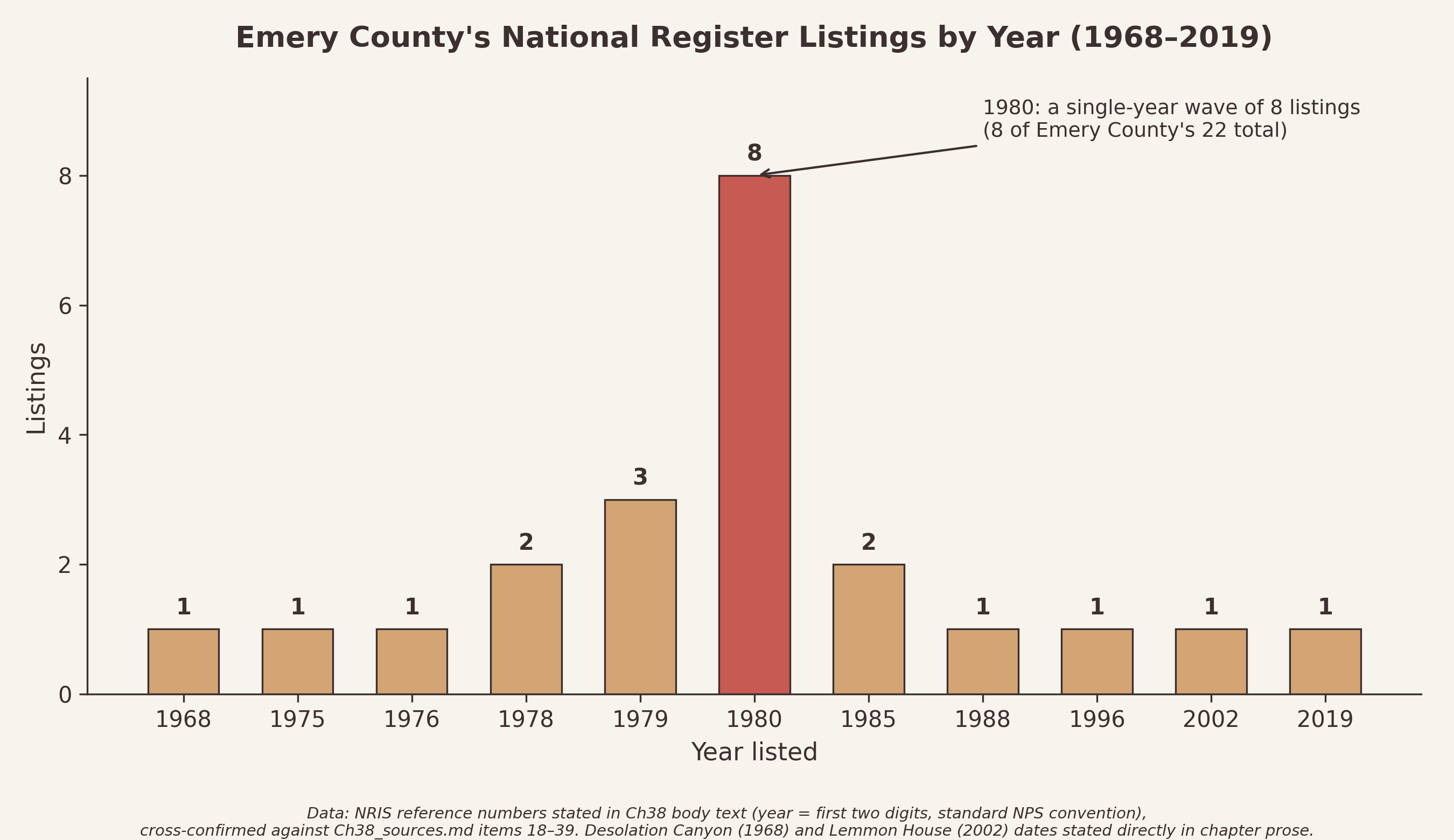
The National Register of Historic Places (NRHP) is the United States’ official list of historic sites worthy of preservation. It was established by the National Historic Preservation Act of 1966 and is administered by the National Park Service. As of the most recent National Park Service listings posted January 17, 2025 (per Wikipedia/NRIS, accessed for this edition), twenty-two properties and districts in Emery County are listed on the National Register, of which one is a National Historic Landmark.
Five themes are visible across the twenty-two listings:
Rock art (six listings, all address-restricted). Black Dragon Canyon Pictographs, Buckhorn Wash Rock Art Sites, Ferron Box Pictographs and Petroglyphs, Rochester-Muddy Creek Petroglyph Site, Temple Mountain Wash Pictographs, and — implicitly through Desolation Canyon’s broader designation — the rock-art panels along the Green River. Together these comprise about twenty-seven percent of the county’s listings. The Buckhorn Wash panel alone spans more than 130 feet of cliff face and contains Barrier Canyon Style figures (1,500–4,000 years old) overlaid in places by later Fremont work — one of the most significant rock-art ensembles in the American Southwest.
Castle Dale built environment (six listings). The county seat’s preservation history is anchored by Castle Dale Bridge, Castle Dale High School Shop, Castle Dale School (which now houses both Castle Dale City Hall and the Emery County Pioneer Museum), the Paul C. Christensen House, the Peter Johansen House, and the Justus Wellington Seeley II House. The pattern reflects Castle Dale’s role as county seat from 1880 and its long-running community engagement with preservation.
Religious architecture (four listings). Emery LDS Church, the Huntington Tithing Granary, the Ferron Presbyterian Church and Cottage, and the Green River Presbyterian Church. The two Presbyterian churches deserve special note: in a county where Latter-day Saint settlement dominates the religious history, the two surviving Presbyterian church buildings represent the modest but durable Protestant minority presence — particularly in the trail-and-railroad town of Green River.
Industrial and infrastructure (four listings). The Denver and Rio Grande Lime Kiln near Cleveland, the Huntington Roller Mill and Miller’s House, the San Rafael Bridge over the San Rafael River, and Castle Dale Bridge over Cottonwood Creek. These document the brief but significant railroad-era industrial moment of the late nineteenth and early twentieth century and the road/water infrastructure that followed.
Pioneer residences (five listings). Beyond the Castle Dale houses already enumerated, the Lars Peter Larson House in Cleveland, the Leander Lemmon House in Huntington, and the Samuel Singleton House south of Ferron complete the county’s individual-residence listings.
Plus the singular Desolation Canyon listing — both a National Register property (#68000057, listed 1968) and a National Historic Landmark, covering a swath of the Green River canyon shared with Grand, Carbon, and Uintah counties.
Table 38-A — Complete Inventory of Emery County's NRHP Listings
| Property | NRIS # | Year listed | Community | Category | Address |
|---|---|---|---|---|---|
| Black Dragon Canyon Pictographs | 80003905 | 1980 | Green River vicinity | Rock art | Restricted |
| Buckhorn Wash Rock Art Sites | 80003898 | 1980 | Castle Dale vicinity | Rock art | Restricted |
| Ferron Box Pictographs and Petroglyphs | 80003904 | 1980 | Ferron | Rock art | Restricted |
| Rochester-Muddy Creek Petroglyph Site | 75001803 | 1975 | Emery | Rock art | Restricted |
| Temple Mountain Wash Pictographs | 76001814 | 1976 | Hanksville vicinity | Rock art | Restricted |
| Castle Dale School | 78002657 | 1978 | Castle Dale | Built environment | 65 E 100 North |
| Castle Dale High School Shop | 85000804 | 1985 | Castle Dale | Built environment | 300 N Center St |
| Paul C. Christensen House | 80003899 | 1980 | Castle Dale | Built environment | 15 E 100 North |
| Peter Johansen House | 80003900 | 1980 | Castle Dale | Built environment | 830 N Center St |
| Justus Wellington Seeley II House | 79002493 | 1979 | Castle Dale | Built environment | Center & 100 South |
| Castle Dale Bridge | 100004394 | 2019 | Castle Dale vicinity | Industrial/infrastructure | ~200 S Center St |
| Emery LDS Church | 80003903 | 1980 | Emery | Religious | Off SR-10 |
| Huntington Tithing Granary | 85000261 | 1985 | Huntington | Religious | 45 W 300 North (rear) |
| Ferron Presbyterian Church and Cottage | 78002658 | 1978 | Ferron | Religious | Mill Rd & 3rd West |
| Green River Presbyterian Church | 88002998 | 1988 | Green River | Religious | 134 W 3rd Ave |
| Denver and Rio Grande Lime Kiln | 80003901 | 1980 | Cleveland vicinity | Industrial/infrastructure | County Rd 335, SE of Cleveland |
| Huntington Roller Mill and Miller’s House | 79002495 | 1979 | Huntington | Industrial/infrastructure | 400 North & 550 West |
| San Rafael Bridge | 96000617 | 1996 | Castle Dale vicinity | Industrial/infrastructure | County Rd 3-32, ~23 mi S |
| Lars Peter Larson House | 80003902 | 1980 | Cleveland | Pioneer residence | 210 E 100 South |
| Leander Lemmon House | 02001040 | 2002 | Huntington | Pioneer residence | 45 W Center St |
| Samuel Singleton House | 79002494 | 1979 | Ferron | Pioneer residence | South of Ferron on SR-10 |
| Desolation Canyon | 68000057 | 1968 | Green River (spans 4 counties) | NHL + NRHP | — |
Source: Ch38 §§38.2–38.8; NRIS reference numbers; Ch38_sources.md items 18–39.
38.3 The Rock Art Listings
Six of Emery County’s twenty-two National Register listings are pre-contact Indigenous rock-art sites (see Ch12: Rock Art & Sacred Landscapes ↗ 2 Ch12: Rock Art & Sacred Landscapes Barrier Canyon Style, Fremont, and Ute rock art traditions across 400+ documented sites in Emery County — styles, chrono... Read chapter → ). All six have their specific addresses restricted in the public registry — a deliberate measure to discourage vandalism that has cost the panels dearly over the past century.
Buckhorn Wash Rock Art Sites (Castle Dale vicinity, #80003898) is the most accessible of the six. The panel runs more than 130 feet along the Buckhorn Draw cliff face and includes figures in both Barrier Canyon Style — painted in red ochre 1,500 to 4,000 years ago — and the later Fremont tradition, with Fremont figures sometimes superimposed on the older Barrier Canyon ones. The Old Spanish Trail passed directly below the panel, and the high traffic over time produced both informal carved graffiti and twentieth-century vandalism. In 1996, as part of Utah’s statehood centennial commemoration, the State of Utah and Emery County jointly restored the panel — removing modern graffiti, stabilizing the cliff face, and installing low-impact viewing infrastructure that allowed continued public access without further damage. The Buckhorn restoration remains a model of community-led rock-art conservation.
Black Dragon Canyon Pictographs (Green River vicinity, #80003905) sit in a side canyon off the I-70 corridor west of Green River. The panel is notable for the large Barrier Canyon Style “dragon” figure for which it is informally named — a figure that has been the subject of revisionist interpretation in recent decades.
Ferron Box Pictographs and Petroglyphs (Ferron, #80003904) lie in the upper Ferron Creek drainage and are accessible only with significant effort.
Rochester-Muddy Creek Petroglyph Site (Emery, #75001803) is one of Utah’s most important Fremont rock-art panels. Its concentration of large figures — including what scholars have read as ceremonial scenes — make it a touchstone for Fremont iconography studies.
Temple Mountain Wash Pictographs (Hanksville vicinity, #76001814) sit in the southern Swell near the Goblin Valley access road.
Desolation Canyon’s rock-art assemblage is protected under the broader Desolation Canyon NHL listing.
For all six sites, public access policies are coordinated between the BLM Price Field Office, the Utah SHPO, and the relevant tribal cultural-resource offices (principally Ute, Hopi, and Paiute) (see Ch13: Archaeological Stewardship ↗ 2 Ch13: Archaeological Stewardship Legal frameworks, monitoring programs, site stewardship, curation practices, and ethical principles for protecting Emery... Read chapter → ). Researchers and visitors are asked to coordinate with BLM before publishing precise locations, photographs that disclose locations, or detailed access information.
Emery County has 22 places on the National Register of Historic Places — but the exact addresses of six of them are deliberately hidden from the public record. All six are ancient Indigenous rock-art sites, and their locations are restricted to protect them from vandalism that has already scarred panels across the Southwest. It's a quiet admission that recognition and access can pull in opposite directions: sometimes the best way to honor a place is not to broadcast where it is. When you do visit a managed panel like Buckhorn Wash, you're seeing art made 1,500 to 4,000 years ago — treat it as you would any sacred place.
38.4 The Castle Dale Cluster
Castle Dale’s concentration of National Register listings — six within a town of fewer than 1,500 residents — reflects three things: its role as county seat from the county’s founding in 1880, its early adoption of brick and frame architecture in the 1890s and 1900s, and the active preservation work of generations of Castle Dale residents.
Castle Dale School (65 E 100 North, #78002657) is the standout. Built as the town’s central school, the building has been adaptively reused: it now houses both Castle Dale City Hall and the Emery County Pioneer Museum (Ch37). The adaptive-reuse model — government office above, public museum below — is held up across the state as a model for small-town historic-school stewardship.
Castle Dale High School Shop (300 N Center St, #85000804) is a separate later listing — a discrete industrial-arts building that survived intact when the rest of the high school was replaced.
Paul C. Christensen House (15 E 100 North, #80003899) is a 1906 Victorian home that served as the home and office of Castle Dale’s first dentist. Its architectural distinctness in a town dominated by vernacular brick farmhouses contributed to its early listing.
Peter Johansen House (830 N Center St, #80003900) and Justus Wellington Seeley II House (Center & 100 South, #79002493) round out the residential listings.
Castle Dale Bridge (approximately 200 S Center St, #100004394) — a more recent addition to the register — spans Cottonwood Creek and represents a surviving example of early-twentieth-century rural concrete-bridge engineering.
Beyond the listed properties, Castle Dale’s Main Street streetscape and the Emery County Courthouse (Castle Dale’s two-story brick courthouse erected in 1892, with the modern county complex at 1850 N 560 W) preserve much of the visual character of an early Utah county seat.
38.5 Religious Architecture
Four religious-architectural listings document the principal denominational presence in Emery County and the minority traditions alongside it.
Emery LDS Church (off SR-10 near Emery, #80003903) is the county’s most architecturally distinctive Latter-day Saint chapel and, as Ch25 of this volume notes, the last surviving clapboard “New England-style” Mormon meetinghouse in Utah, completed in 1900. Its survival owes to a combination of community attachment, careful maintenance, and the conscious decision not to replace it with a modern stake center.
Huntington Tithing Granary (45 W 300 North, rear, #85000261) preserves one of the few remaining structures from the LDS tithing-in-kind era, when ward members brought a tenth of their harvest to a community granary in lieu of cash tithing. Such granaries were once standard fixtures in every Utah ward; few survive intact.
Ferron Presbyterian Church and Cottage (Mill Rd & 3rd West, #78002658) is one of two surviving Presbyterian buildings in the county. Late-nineteenth-century Presbyterian missions in Utah focused on small communities outside the major LDS centers, and Ferron — with its small population and accessibility from the SR-10 corridor — was one such mission station.
Green River Presbyterian Church (134 W 3rd Ave, #88002998) is the other surviving Presbyterian listing, built to serve the railroad town’s mixed-denomination population in the late nineteenth century.
38.6 Industrial and Infrastructure
Four listings document the brief but significant industrial moment of the late nineteenth and early twentieth century.
Denver and Rio Grande Lime Kiln (southeast of Cleveland on County Road 335, #80003901) is a stone-and-brick beehive kiln built to produce lime — calcium oxide — for use in railroad masonry, mortar, and agriculture. The kiln operated during the railroad-construction era when the D&RG was extending its trackage across central Utah. Its survival in a remote location south of Cedar Mountain has protected it from the scrapping that befell most industrial structures of the period.
Huntington Roller Mill and Miller’s House (400 North & 550 West, #79002495) is the county’s most complete surviving industrial-and-residential complex. Roller mills replaced the older buhrstone gristmills around 1880, allowing fine flour production with much higher throughput. The Huntington Mill served the agricultural communities along Huntington Creek and was central to local economic life through the early twentieth century. The associated miller’s house adds residential context that gives a fuller picture of how the milling industry was organized.
San Rafael Bridge (County Road 3-32 over the San Rafael River, approximately 23 miles south of Castle Dale, #96000617) is the famed swinging bridge — a 1937 suspension structure that for decades was the only road crossing of the San Rafael River south of the I-70 corridor. It remains in use today as a pedestrian bridge alongside a modern replacement, and serves as one of the iconic photographic subjects of the Swell.
Castle Dale Bridge (approximately 200 S Center St, over Cottonwood Creek, #100004394) is a recent addition to the registry, recognizing the surviving early-twentieth-century concrete-bridge engineering that connected Castle Dale to its agricultural hinterland.
38.7 Pioneer Residences
Beyond the Castle Dale houses listed in §38.4, three additional residential listings document the pioneer-era domestic architecture of the county’s other towns.
Lars Peter Larson House (210 E 100 South, Cleveland, #80003902) — a vernacular pioneer home representing the early Cleveland community.
Leander Lemmon House (45 W Center St, Huntington, #02001040) — a turn-of-the-twentieth-century home distinctive enough to earn individual listing in 2002, one of the more recent residential additions to the registry.
Samuel Singleton House (south of Ferron on SR-10, #79002494) — an isolated farmhouse representing the rural residential pattern of the Ferron area.
Each of these residences carries an interpretive weight greater than its individual architectural significance: they document the social geography of the county’s early communities and, through their listing, signal a community commitment to remembering it.
38.8 Desolation Canyon — Emery County’s Only National Historic Landmark
Desolation Canyon is the only National Historic Landmark in Emery County. The NHL designation, formally made on November 24, 1968 (concurrent with the canyon’s National Register listing, #68000057 and the Powell-expedition centennial year), is the highest federal historic designation available — reserved for sites of outstanding national historical significance.
Desolation Canyon’s significance is two-fold. First, it is directly associated with John Wesley Powell’s 1869 expedition (see Ch15: Powell Expeditions ↗ 3 Ch15: Powell Expeditions John Wesley Powell’s 1869 and 1871–72 voyages through Desolation Canyon and the Green River corridor: scientific mapping... Read chapter → ) down the Green and Colorado rivers — the first known navigation of the canyon by non-Indigenous travelers. Powell named the canyon for its imposing, seemingly unspoiled character. Second, the canyon and its associated wilderness has remained, by the standards of the twentieth and twenty-first centuries, remarkably intact: free of dams, roads, and significant industrial development.
The canyon is split among Emery, Grand, Carbon, and Uintah counties — its southern reach lies in Emery County and provides the canyon’s primary downstream takeout. Recreation on the river is managed by the BLM under a permit system; access is described in Ch33 (Climbing, Canyoneering & Rivers) and Ch36 (Travel & Logistics).
In 2019, the John D. Dingell Jr. Conservation, Management, and Recreation Act — which incorporated the Emery County Public Land Management Act — designated significant portions of Desolation Canyon as federal wilderness, adding statutory protection to the cultural designation that had been in place since 1968. The dual designation (NHL plus wilderness) makes Desolation Canyon one of the more comprehensively protected major river canyons in the United States.
38.9 National Natural Landmarks — Cleveland-Lloyd
Cleveland-Lloyd Dinosaur Quarry is not on the National Register of Historic Places. It is, instead, designated under a parallel federal program — the National Natural Landmarks (NNL) program, also administered by the National Park Service.
The distinction matters. The National Register recognizes sites of historic and cultural significance. The National Natural Landmarks program recognizes sites of outstanding geological, biological, or natural significance. Cleveland-Lloyd is one of the world’s most important paleontological sites — densest concentration of Jurassic-aged dinosaur bones ever discovered, with at least 74 individual animals (predominantly Allosaurus fragilis) represented in some twelve thousand bones — and its 1965 NNL designation recognizes that natural-scientific significance.
The quarry’s history of formal recognition spans six decades:
- 1965 — designated a National Natural Landmark by the National Park Service
- 1968 — the BLM opens its first-ever visitor center at the site
- 2007 — current expanded visitor-center facility dedicated (April 28)
- 2019 — incorporated into the newly proclaimed Jurassic National Monument (see Ch31: Parks & Monuments ↗ 5 Ch31: Parks & Monuments From Goblin Valley State Park to Jurassic National Monument: Emery County's four state parks, a BLM national monument, a... Read chapter → ), providing additional statutory protection
A property that holds a National Natural Landmark designation is eligible for the same general suite of conservation considerations as a National Register property — federal-undertaking review (loosely analogous to Section 106), interpretive support, and recognition in public planning processes — but the legal framework is distinct.
Table 38-C — Federal Historic Designation Programs at a Glance
| Program | Basis | Administering agency | Emery County example |
|---|---|---|---|
| National Register of Historic Places (NRHP) | Historic/cultural significance | National Park Service | 22 listed properties and districts |
| National Historic Landmark (NHL) | Outstanding national historic significance (top tier within NRHP) | National Park Service | Desolation Canyon |
| National Natural Landmark (NNL) | Geological or biological significance | National Park Service | Cleveland-Lloyd Dinosaur Quarry |
| National Historic Trail (NHT) | Linear route of historic significance | NPS / BLM (joint) | Old Spanish National Historic Trail |
| National Monument | Executive/legislative proclamation protecting an area | Bureau of Land Management | Jurassic National Monument |
Parallel programs, not tiers of one hierarchy — NHL is the one sub-relationship worth naming (the top tier within NRHP itself). Source: §38.1, §38.2, §§38.8–38.10; NPS program descriptions.
38.10 Old Spanish National Historic Trail
The Old Spanish National Historic Trail (see Ch14: Spanish Trails & Fur Trappers ↗ 3 Ch14: Spanish Trails & Fur Trappers The era of exploration and trade preceding Euro-American settlement: ancient Ute commerce routes, the Old Spanish Trail,... Read chapter → ) was designated by Congress on December 4, 2002, becoming part of the National Trails System under joint administration by the National Park Service and the Bureau of Land Management.
The historic trail — used principally for trade and stock movement between Santa Fe and Los Angeles between roughly 1829 and 1848 — crosses Emery County diagonally. From the southeast, it enters Utah near present-day Ucolo (east of Monticello), runs north and west through eastern Utah, crosses the Green River near the present town of Green River, then skirts the northern edge of the San Rafael Swell. Its northernmost point in Utah lies in the Black Hills of present Emery County, after which it bends to the southwest and continues across the Great Basin toward Los Angeles. The trail’s run from Green River across the northern Swell to the Black Hills bend lies entirely within Emery County.
The Emery County Historical Society installed identifying markers along the trail in the Green River area in the early 1990s, well before the federal designation. Following the 2002 federal listing, the BLM has developed a dedicated mobile-map portal for Emery County visitors and is gradually adding interpretive panels. The trail crossing connects directly to Ch15 (Exploration & Trade) of this volume.
38.11 The Nomination Process
Adding a property to the National Register of Historic Places is a defined, multi-step process administered jointly by the Utah State Historic Preservation Office and the National Park Service. The process is open: any person can nominate any property, regardless of ownership, although the property owner is notified and has the formal right to comment on the nomination.
The procedure typically runs as follows:
- Contact Utah SHPO. All nominations begin with a conversation with the Utah State Historic Preservation Office at ushpo.utah.gov. SHPO staff can advise on whether a property appears likely to qualify, what supporting documentation will be required, and what nomination categories (individual building, district, archaeological site, traditional cultural property) fit best.
- Prepare the nomination. The applicant — frequently the owner, sometimes a preservation consultant, sometimes a volunteer historian — prepares the nomination form, which includes detailed narrative text, photographs of the property, location maps, architectural drawings or figures as appropriate, and a sustained argument for the property’s significance under one or more of the four National Register criteria (association with significant events, association with significant persons, architectural significance, archaeological/informational significance).
- Preliminary SHPO review. SHPO staff review the draft nomination and request revisions. This phase often produces several rounds of revision before the nomination is ready for board consideration.
- State Historic Preservation Review Board. The Utah State Historic Preservation Review Board considers the nomination at one of its periodic meetings. Approval at this level forwards the nomination to the federal level.
- NPS National Register review. The National Register of Historic Places office in Washington, DC conducts a final review and, if approved, formally adds the property to the register.
The entire process typically takes six to eight months from initial submission to formal listing. SHPO recommends consulting a preservation consultant for complex nominations but provides comprehensive guidance for owners who choose to prepare nominations themselves — including a 2024 update to the Guide for Preparing National Register Nominations.
Table 38-D — SHPO Nomination Process Timeline
| Step | Action | Typical duration |
|---|---|---|
| 1 | Contact Utah SHPO for an initial eligibility conversation | Days to weeks |
| 2 | Prepare the nomination form (narrative, photographs, maps, significance argument) | Weeks to months (varies by property complexity) |
| 3 | Preliminary SHPO review and revision rounds | Several weeks to a few months |
| 4 | Utah State Historic Preservation Review Board considers the nomination | At the Board’s next scheduled meeting |
| 5 | NPS National Register office (Washington, DC) final review and listing | Up to 45 days after state referral |
Source: §38.11; Utah SHPO 2024 Guide.
Nominate a Place You Love
Pick a building or site at least 50 years old that tells a story about your family or community, photograph it from several angles, ask the four National Register questions (event, person, architecture, archaeology), and — if any answer is yes — call the Utah State Historic Preservation Office to see whether it might qualify.
What you'll need:
A place that matters to you — a house, barn, bridge, or church, A camera, A notebook
38.12 Working with Listed Properties
For owners of National Register-listed properties, listing carries practical benefits and a small set of obligations.
Benefits. Listed income-producing properties (commercial buildings, rental housing, agricultural production buildings) are eligible for federal historic rehabilitation tax credits of up to twenty percent of qualified rehabilitation expenditures, and may stack additional state-level Utah tax credits administered by SHPO. Owner-occupied residential properties do not qualify for the federal credit but may qualify for state credits. Listing also confers eligibility for various preservation grants administered through SHPO and through Preservation Utah.
Obligations and restrictions. Listing on the National Register imposes no restrictions on the owner’s right to modify or demolish a property paid for and undertaken solely by the owner. The Register is descriptive, not regulatory. However:
- Federal undertakings (any project receiving federal funding, permits, or licenses) that may affect a listed or eligible property trigger Section 106 review under the National Historic Preservation Act. Section 106 requires the federal agency to consult with SHPO and the public and to consider impacts before proceeding.
- Tribal consultation is required under Section 106 for properties of religious or cultural significance to a federally recognized tribe — which, in Emery County, frequently means rock-art sites and ancestral landscapes.
- Tax-credit projects must comply with the Secretary of the Interior’s Standards for Rehabilitation, which prescribe how rehabilitation work should be carried out to retain historic character.
For Emery County property owners, the practical first step is a conversation with either the Emery County Historic Preservation Commission (reached through the Historical Society at 435-381-3563) or directly with Utah SHPO. Most questions about eligibility, process, and tax-credit availability are resolved in that initial conversation.
For researchers and visitors, the more useful access points are the Historic Utah Buildings GIS web map maintained by SHPO and the public-facing summary entries maintained by the National Park Service’s National Register Information System (NRIS). Together these tools make Emery County’s twenty-two National Register listings — and their parallel federal designations — accessible to anyone with a question.
Further Reading & Links
- National Register of Historic Places listings in Emery County, Utah (Wikipedia)
- National Register Information System (NRIS)
- Utah State Historic Preservation Office
- Utah SHPO Guide for Preparing National Register Nominations (2024)
- Historic Utah Buildings GIS web map (SHPO)
- Cleveland-Lloyd Dinosaur Quarry National Natural Landmark (NPS)
- Old Spanish National Historic Trail (NPS)
Sources
- National Register of Historic Places listings in Emery County, Utah (Wikipedia, current through NPS weekly listings Sept 26, 2025) — https://en.wikipedia.org/wiki/National_Register_of_Historic_Places_listings_in_Emery_County,_Utah
- National Register Information System (NRIS) — https://npgallery.nps.gov/NRHP
- Utah State Historic Preservation Office — https://ushpo.utah.gov/ ; https://hub.utah.gov/shpo/
- Utah SHPO Guide for Preparing National Register Nominations (2024) — https://ushpo.utah.gov/wp-content/uploads/2024/05/NRHP-Guide-2024.pdf
- Historic Utah Buildings GIS web map (SHPO) — https://shpo.utah.gov/portal/apps/webappviewer/index.html?id=8e218e18c2b74477b5f520e5617bebaf
- Cleveland-Lloyd Dinosaur Quarry National Natural Landmark (NPS NNL program) — https://www.nps.gov/subjects/nnlandmarks/site.htm?Site=CLLL-UT
- Jurassic National Monument — https://www.blm.gov/programs/national-conservation-lands/utah/jurassic-national-monument
- Old Spanish National Historic Trail (NPS) — https://www.nps.gov/olsp/planyourvisit/utah.htm
- Old Spanish National Historic Trail (BLM) — https://www.blm.gov/visit/old-spanish-trail-national-historic-trail
- Buckhorn Draw Pictograph Panel (Wikipedia) — https://en.wikipedia.org/wiki/Buckhorn_Draw_Pictograph_Panel
- BLM Buckhorn Panel — https://www.blm.gov/visit/buckhorn-panel
- Preservation Utah — National Register of Historic Places — https://www.preservationutah.org/protection-strategies/national-register-of-historic-places
- Utah Historical Society — “What is the National Register and How do I Nominate a Building?” — https://history.utah.gov/what-is-the-national-register-and-how-do-i-nominate-a-building-part-2/
Proposed Maps & Figures
- Figure 38.1 — Map: all 22 NRHP listings in Emery County, color-coded by category (rock art / built / industrial / residential / religious / district). Address-restricted sites shown at community-level only.
- Figure 38.2 — Photograph: Buckhorn Wash Pictograph Panel (post-1996 restoration; BLM-published image).
- Figure 38.3 — Photograph: Castle Dale School (current City Hall + Pioneer Museum).
- Figure 38.4 — Photograph: Huntington Roller Mill exterior.
- Figure 38.5 — Photograph: San Rafael swinging bridge (1937).
- Figure 38.6 — Infographic: Federal historic-designation hierarchy showing where each Emery designation fits (NHL > NRHP > NNL > NHT > NM).
- Figure 38.7 — Map: Old Spanish National Historic Trail route through Emery County (using BLM mobile-map dataset).
Proposed Tables
- Table 38.1 — Complete inventory of Emery County’s 22 NRHP listings: name, NRIS reference number, date listed, community, type, address status.
- Table 38.2 — Federal designation summary: NRHP (22), NHL (1), NNL (1), National Historic Trail crossings (1), National Monument (1 — Jurassic).
- Table 38.3 — Nomin