Part 3 · Settlement
Agriculture & Ranching
Pioneer canal-building and cooperative irrigation, the salinization crisis, the federal Emery County Project's dams and reservoirs, alfalfa and hay farming, Green River's celebrated melons, cattle and sheep ranching on public lands, and the water future facing Emery County agriculture.
Ch20 — Agriculture & Ranching
20.1 Introduction: The Farmer’s Gamble in the Desert
When the first LDS families rolled their wagons into Castle Valley in the autumn of 1877, they confronted a paradox familiar to every dry-land settler in the American West: the land looked promising but the water was scarce, the soil was treacherous, and survival depended on cooperation. Yet within a generation, the valleys of the Huntington, Ferron, and Cottonwood Creeks were threaded with hand-dug canals, their banks watering fields of grain, hay, and garden vegetables that fed growing communities. Agriculture has been the quiet foundation of Emery County life ever since — overshadowed in national headlines by coal and uranium, but present in every irrigation ditch, every stack of baled alfalfa, every melon ripening along the banks of the Green River.
This chapter traces the full arc of farming and ranching in Emery County: the pioneer cooperative spirit that transformed desert benches into productive fields; the salt-alkali crisis that threatened to undo all that effort; the federal reclamation project that reshaped the county’s water future; the enduring cattle-and-hay economy that persists into the twenty-first century; and the singular agricultural phenomenon of Green River’s celebrated melons. Agriculture in Emery County has never been easy, but it has always been integral to the county’s identity.
20.2 The Land Before Plows: Soils, Creeks, and Climate
Emery County’s agricultural potential is shaped by forces that predate any plow by millions of years. The county’s valleys sit in the rain shadow of the Wasatch Plateau, receiving only seven to twelve inches of annual precipitation on the valley floors — far below the fifteen to twenty inches typically required for dry-land farming. The county’s streams — the Huntington, Ferron, Cottonwood, and Price River tributaries — carry snowmelt off the plateau, and it is along these streams that agriculture has always been concentrated.
The soils presented a more subtle challenge. Much of Emery County’s subsoil is derived from Mancos Shale, ancient marine sediment laden with sodium salts accumulated during the Cretaceous Seaway (see Ch02: Deep-Time Geology ↗ 1 Ch02: Deep-Time Geology A billion-year journey through stone: Precambrian foundations, Paleozoic seas, Mesozoic dinosaurs, and recent tectonics. Read chapter → ). This shale weathers into clay soils that are sticky when wet and brick-hard when dry — difficult to plow, difficult to drain, and carrying a hidden chemical threat: when irrigation water raises the water table into these salt-laden substrates, the salts wick upward through capillary action. In the dry heat of a Utah summer, evaporation then concentrates the salts at the surface, creating white alkali crusts that can render land biologically dead within a few seasons.
The county’s topography also creates microclimates that matter for agriculture. The Green River corridor at roughly 4,000 feet elevation has a long frost-free season and extreme summer heat — unsuitable for peaches but ideal for melons. The upper valleys around Huntington and Castle Dale, at 5,500 to 6,000 feet, have shorter growing seasons but richer soils near the creek benches and better access to the plateau’s water supply.
20.3 Pioneer Settlement and First Fields (1877–1890)
The agricultural story of Emery County begins not with farmers but with stockmen. As early as 1875, livestock growers from Sanpete County had recognized that Castle Valley offered what their overgrazed home county lacked: a natural grazing corridor between the high Wasatch Plateau to the west and the San Rafael Swell winter range to the east. They brought cattle and sheep into the valley before any permanent settlers arrived, establishing a pattern of livestock dependence that would persist for 150 years.
Formal agricultural settlement followed in the fall of 1877, when young Latter-day Saint families — responding in part to encouragement from LDS church leadership to occupy unorganized territory before outside interests could claim it — began moving into Castle Valley from Sanpete and other central Utah counties (see Ch16: Mormon Colonization ↗ 3 Ch16: Mormon Colonization LDS settlement of Emery County: the call to colonize Castle Valley, founding of pioneer towns, cooperative irrigation, a... Read chapter → ). They established the communities that would become Huntington, Ferron, Castle Dale, and Orangeville, each sited near a reliable stream with land suitable for both farming and grazing. By 1880, when the Utah Territorial Legislature formalized Emery County’s existence, the agricultural enterprise was well underway.
The first farms were small, clustered near the streams, and intensively productive in a subsistence sense. Settlers grew wheat, corn, potatoes, garden vegetables, and fruit trees on whatever level land they could bring under irrigation. They also kept cattle, hogs, chickens, and milch cows — the full suite of pioneer mixed farming. By 1900, Emery County’s 450-plus farms had placed roughly 25,000 acres under cultivation, a remarkable achievement for a county where every drop of irrigation water had to be carried by human ingenuity from mountain streams to valley fields.
20.4 The Art of the Ditch: Cooperative Irrigation in the Pioneer Era
In a dry landscape, water defines community. From the earliest days of settlement, Emery County farmers organized collectively to build the canals and ditches that made agriculture possible — and the story of those water works is inseparable from the social history of the county.
Utah water law, grounded in the doctrine of prior appropriation (“first in time, first in right”), gave legal primacy to the earliest water claimants. But the physical geography of Castle Valley created a chronic tension: the most recently built canals often diverted water higher on the creeks than older ones, placing them upstream from senior users who held prior legal rights. Managing that tension required constant negotiation among neighbors, formal water company structures, and, periodically, litigation.
The irrigation works themselves were products of communal labor. Pioneer Ditch Number One and Pioneer Ditch Number Two were among the first formal water corporations in Carbon and Emery Counties. In Ferron, the Ferron North Ditch — begun in 1879 — carried water to the townsite and eventually extended north to Rock Canyon, while the King Ditch (1879) and Upper South Canal (1881–82) brought the southern portion of the Ferron Creek valley under cultivation. At Huntington, settlers constructed the Huntington Canal in stages between 1879 and 1884, opening the flats to the west and south of town to farming.
The Cleveland Canal offers the most dramatic example of pioneer water ambition. The settlement of Cleveland lay four miles from the nearest water and more than eleven miles from its planned diversion point on Huntington Creek. Building a canal across that distance required the community’s collective labor across multiple seasons — a project that historian Edward A. Geary, in his detailed study of Emery County water development, identifies as the exemplar of the cooperative spirit that characterized water development throughout the county. These were not ditch-diggers working for wages; they were families staking their survival on shared effort and shared water.
Table 20-C — Pioneer irrigation works
| Canal | Year begun | Area served |
|---|---|---|
| Pioneer Ditch No. 1 & No. 2 | Among the earliest formal water corporations in Carbon and Emery Counties | Early Castle Valley farmland |
| Ferron North Ditch | 1879 | Ferron townsite, later extended north to Rock Canyon |
| King Ditch | 1879 | Southern Ferron Creek valley |
| Upper South Canal | 1881–82 | Southern Ferron Creek valley |
| Huntington Canal | 1879–1884 (built in stages) | Flats west and south of Huntington |
| Cleveland Canal | Multi-season community project | Cleveland, four miles from nearest water, eleven-plus miles from diversion point |
Founding years per ward/county histories; to be verified against LDS ward minute books, Utah State Archives. Source: §20.4.
All these pioneer canals were built with pick-and-shovel labor and horse-drawn plows and scrapers.
20.5 The Salt in the Ground: Salinization and Agricultural Crisis (1890s–1940s)
By the 1890s, the very success of irrigation was beginning to undermine itself. The Mancos Shale beneath much of Castle Valley held a hidden chemical trap: irrigate the land enough to raise the water table, and the ancient salts in the shale would begin their slow migration to the surface. Farmers who had invested years of labor in their fields began watching white alkali crusts creep across their best soil.
The problem was systemic and hard to counter. A 1903 report by the U.S. Department of Agriculture concluded that more than 30 percent of the developed farmland in Emery County had been abandoned because of salt-related soil degradation — a staggering figure for a county barely twenty years old. The soil that remained productive was increasingly confined to the well-drained benches near the stream channels; the lower flats, where the water table was highest, became wastelands of alkali.
The crisis deepened in the 1920s and 1930s. A severe regional drought overlaid the structural problems of salinized soil with the immediate catastrophe of too little water to irrigate at all. Emery County, already identified by the Forest Service in 1934 as part of a “severely eroded” zone encompassing the entire land areas of Carbon, Emery, Grand, and Kane Counties, saw farm abandonment accelerate. Families who had pioneered the county in the 1870s and 1880s gave up land their grandparents had broken by hand. Utah Historical Quarterly scholars have described the period between 1925 and 1939 as one of “struggle against great odds” for Utah’s marginal agricultural areas, and Emery County sat squarely in the marginal zone.
The livestock industry fared somewhat better than crop farming during these decades, partly because rangeland on the Wasatch Plateau and San Rafael Swell could sustain cattle and sheep even when valley fields were struggling. But overgrazing had its own consequences: by 1934, the Forest Service reported that roughly 60 percent of Utah’s rangeland was severely eroded, a condition that Congress addressed the following year by passing the Taylor Grazing Act of 1935, which created a federal permit system for public rangeland grazing and brought the long era of unrestricted open-range use to an end.
The mid-twentieth century found Emery County’s agricultural community diminished but not defeated — waiting, as it would turn out, for a federal intervention that would fundamentally reshape the county’s relationship with water.
20.6 Federal Water for a Dry Land: The Emery County Project (1963–1970)
The answer to Emery County’s water problems arrived in the form of federal reclamation — one of the most significant structural investments the federal government ever made in the county’s agricultural future. The Emery County Project, authorized as part of the larger Colorado River Storage Project and directed by the Bureau of Reclamation, transformed the county’s irrigation infrastructure from the pioneer-era network of small ditches into an engineered system of dams, reservoirs, and canals capable of delivering reliable water across an expanded service area.
Construction commenced on June 20, 1963, and the project was substantially completed by 1966, when the first irrigation water flowed through its new canals. The principal structures were ambitious by any measure. Joes Valley Dam, an earthfill structure on Seely Creek, rose 187 feet above the streambed with a crest 750 feet long and a volume of 1,290,000 cubic yards. Its reservoir — Joes Valley Reservoir — impounded 62,460 acre-feet of water across a surface area of 1,170 acres, creating what would become one of the most beloved recreational lakes in east-central Utah as well as a critical agricultural storage facility. Ten miles downstream, the Swasey Diversion Dam channeled water into the Cottonwood Creek–Huntington Canal system, while the Huntington North Service Canal and its associated dikes created Huntington North Reservoir, extending the project’s reach into the agricultural districts north of Huntington.
At the southern end of the county, Millsite Reservoir was constructed on Ferron Creek at the base of Ferron Canyon, serving the Ferron agricultural district. Dedicated on June 11, 1971, with Governor Calvin L. Rampton delivering the keynote address, Millsite Reservoir completed the project’s geographic coverage of the county’s principal farming valleys.
The Emery County Project was designed to provide an estimated average of 28,100 acre-feet of water annually, serving 18,755 acres of farmland — including 771 acres of previously unirrigated land. The Bureau transferred operation and maintenance of the project’s facilities to the Emery Water Conservancy District on January 1, 1970, placing local control over what had been built with federal resources. In a later historic step, the U.S. Department of the Interior transferred actual ownership of the project infrastructure to local water users — formalizing the transition from federal project to community-owned resource.
The effects on agriculture were significant. More than 90 percent of the irrigated area served by the project produces hay and grain, and the increased water supply permitted expanded livestock production of beef, sheep, and dairy products. The project did not solve the salinization problem — alkali soils remained a challenge wherever drainage was poor — but it stabilized the county’s water supply against the year-to-year variability that had made farming so precarious in the preceding decades — the same water system treated in full in Ch19: Water for the Desert ↗ 3 Ch19: Water for the Desert Water, the defining constraint of Emery County life: pioneer ditches and the 1890s salinization crisis, the federal Emer... Read chapter → .
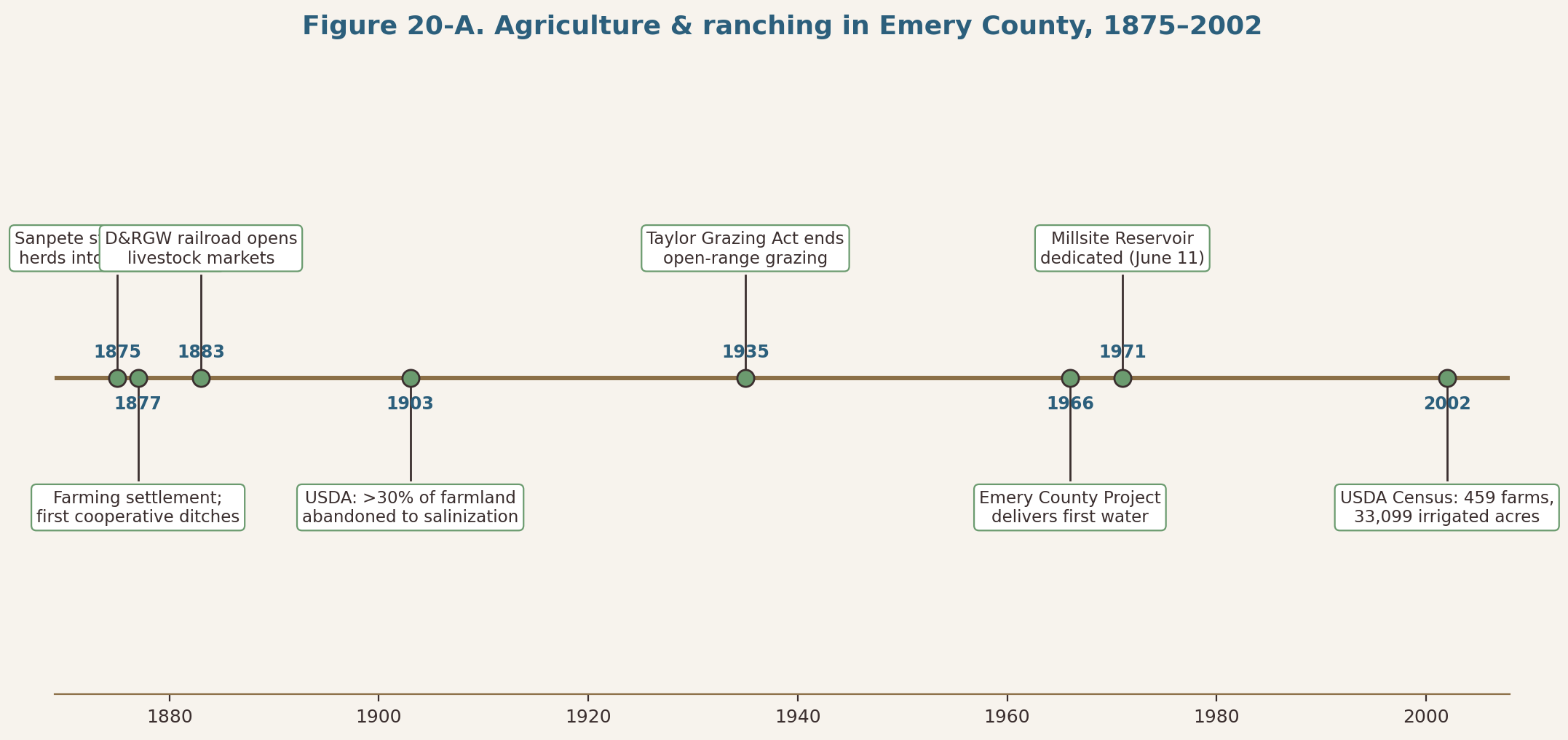
Table 20-A — Emery County Project key statistics
| Structure | Stream | Height | Reservoir capacity | Service area |
|---|---|---|---|---|
| Joes Valley Dam / Reservoir | Seely Creek | 187 ft (750-ft crest, 1,290,000 cu yd) | 62,460 acre-feet across 1,170 surface acres | County’s principal storage facility |
| Swasey Diversion Dam | Ten miles downstream of Joes Valley | — | — | Channels water into the Cottonwood Creek–Huntington Canal system |
| Huntington North Reservoir / Service Canal | Associated dikes north of Huntington | — | — | Agricultural districts north of Huntington |
| Millsite Reservoir | Ferron Creek, base of Ferron Canyon | — | — | Ferron agricultural district; dedicated 11 June 1971 |
Source: USBR; EWCD, as cited in §20.6. Reservoir figures here reflect the values as stated in this chapter's sources; see Ch19 §19.6 for Joe's Valley figures as stated there, and the cross-chapter reconciliation note.
20.7 What the Land Grows: Hay, Grain, and the Farm Mosaic
Emery County farming is not a monoculture. While alfalfa hay dominates the irrigated acreage — as it does across much of the arid West, where hay serves both as cash crop and as feed for the county’s own livestock — the full picture of what Emery County fields produce is more varied.
The 2002 USDA Census of Agriculture counted 459 farms in the county, collectively farming approximately 155,000 acres of land and irrigating 33,099 of those acres — of which 94.2 percent was used for harvested cropland. Hay accounted for 18,323 of those crop-acres, the dominant use by a wide margin. Grain crops were secondary: corn averaged between 100 and 125 bushels per acre, oats between 80 and 90 bushels per acre, and barley occupied 158 acres. Total agricultural sales in 2002 reached $11,452,000, averaging roughly $24,950 per farm — modest returns reflecting both the limited scale of individual operations and the competitive pressures of the commodity hay and grain markets.
Table 20-B — 2002 USDA agricultural census snapshot
| Measure | 2002 value |
|---|---|
| Total farms | 459 |
| Total farmland | ~155,000 acres |
| Irrigated acres | 33,099 |
| Harvested cropland share | 94.2% of irrigated acres |
| Hay acreage | 18,323 acres |
| Barley acreage | 158 acres |
| Total agricultural sales | $11,452,000 |
| Average sales per farm | ~$24,950 |
| Farms with cattle | 281 |
| Farms with horses | 294 |
| Farms with sheep | 45 |
Source: USDA NASS, as cited in §§20.7, 20.9. The 2022 Census of Agriculture supersedes these figures (~280 farms; ~225,000 acres in production per the chapter's fact-check); reported here as the chapter body states them.
Earlier in the county’s history, grain farming was more prominent. Wheat was a staple crop of pioneer agriculture, well suited to the valley floors before salinization took its toll. Small orchards of apples, peaches, and other fruits were planted near most of the early settlements, providing fresh and preserved fruit for family use. By the mid-twentieth century, as farming consolidated and the county’s economy tilted toward coal and uranium mining, many of these diversified small farms gave way to the more specialized hay-and-livestock operations that characterize the county today.
Garden agriculture persists on a small scale. Many farm families maintain kitchen gardens, and local vegetable production supplies some of the county’s restaurants and households. The agricultural extension service of Utah State University has worked with Emery County producers over the decades to identify crop varieties suited to the local soils and climate, improve irrigation efficiency, and manage the chronic challenge of soil salinity.
20.8 The Melon Capital: Green River’s Famous Fruit
No discussion of Emery County agriculture would be complete without Green River’s melons — an agricultural specialty so closely identified with the city that it has become the community’s primary cultural emblem.
Green River occupies a position unusual within Emery County: its elevation of approximately 4,000 feet and position along the Colorado River corridor give it a significantly longer frost-free growing season and more intense summer heat than the upper valleys. The climate proved unsuitable for peaches and other stone fruits that thrived elsewhere in Utah, but a local experimenter identified its perfect fit for melons. A grower known to local history as “Melon” Brown was experimenting with the crop as early as 1900, and his early success established a tradition that would eventually define the city’s identity. Commercial rail shipments of Green River melons are documented from approximately 1906 to 1908, when improvements to the rail spur made volume shipping practical.
The melon industry reached its peak in the 1920s. Green River’s “winter melon” — a hard-skinned variety capable of keeping until Christmas — developed a regional reputation that carried its name to Midwestern and Eastern markets. Railcar shipments of Green River melons were a commercial staple of the era, and the crop’s quality became something of a point of civic pride in a community whose geography otherwise left it somewhat isolated from the county’s agricultural mainstream.
Today, melon farming in Green River remains a labor-intensive craft operation. Each melon is planted by hand and harvested by hand, a process that demands both physical effort and careful judgment about maturity. The growing season runs from late April planting through the harvest windows of late summer and fall. Growers note that the desert conditions along the Green River — hot days, cool nights, and low humidity — concentrate sugars in ways that commercial melon-producing regions struggle to replicate.
The cultural dimension of Green River’s melon heritage is formalized each September in Melon Days, a festival that has drawn upward of 4,000 visitors from outside the community. For a city whose population hovers under 1,000, Melon Days represents both an economic event and a community ritual — an annual assertion that Green River’s particular combination of river, desert, and human ingenuity produces something genuinely excellent (see Ch27: Festivals, Folklore & Foodways ↗ 4 Ch27: Festivals, Folklore & Foodways Emery County's participatory culture - the festivals, foodways, and folk arts that knit a population of fewer than 10,00... Read chapter → for the festival and foodways treatment of Melon Days).
20.9 Cattle, Sheep, and the Open Range
Livestock has been at the center of Emery County’s agricultural economy from before the first permanent settlers arrived. The stockmen from Sanpete County who drove their herds into Castle Valley in 1875 were exploiting what they recognized as exceptional range: the corridor between the Wasatch Plateau’s summer pastures and the San Rafael Swell’s winter range allowed for a seasonal grazing migration that kept animals in good condition year-round without the need for extensive hay-feeding.
The arrival of the Denver and Rio Grande Western Railroad through Emery County in 1883 transformed the economics of the livestock industry (see Ch18: Rails, Roads & Infrastructure ↗ 3 Ch18: Rails, Roads & Infrastructure The transportation and utility networks that wove Emery County into the broader region: the Old Spanish Trail, the 1883 ... Read chapter → ). Before the railroad, marketing cattle and sheep required long overland drives to distant railheads; after it, livestock could be loaded at local stations and shipped to markets in Denver or Salt Lake City within days. The coal mines developing simultaneously at Scofield, Castle Gate, and Sunnyside in neighboring Carbon County provided an additional local market for beef, pork, and dairy products (see Ch17: Coal, Copper & Uranium ↗ 3 Ch17: Coal, Copper & Uranium The extractive century: coal seams of the Wasatch Plateau, uranium-rich sandstones of the San Rafael Swell, copper bypro... Read chapter → ) — a miner’s diet that favored protein-rich foods and created steady demand regardless of distant commodity prices.
Both cattle and sheep were important historically, though the balance has shifted over time. Sheep operations, which once grazed the high Wasatch Plateau in summer and the desert lowlands in winter, declined through the twentieth century as wool prices fell and grazing regulations tightened. Cattle operations have proven more durable. The 2002 Census of Agriculture recorded 281 farms with cattle in Emery County — by far the most common type of livestock operation. Horses remained extremely prevalent, with 294 farms keeping horses in 2002, reflecting both the working-ranch tradition and the county’s recreational riding culture. Sheep persisted on 45 farms, while poultry, hogs, and milk goats occupied smaller numbers of operations.
20.10 Managing the Public Lands: Grazing Permits and Range Health
The rangelands of Emery County are overwhelmingly public lands. The Bureau of Land Management and the U.S. Forest Service administer approximately 76 percent of Emery County’s surface area — with BLM administering roughly 60 percent of the county and the Forest Service accounting for most of the remainder — and Emery County ranchers have long operated under a dual-land system: private land in the valley bottoms for hay production and winter feeding, public land allotments on the plateau and desert for seasonal grazing.
The transition from open-range grazing to regulated allotment grazing was triggered nationally by the Taylor Grazing Act of 1935. Congress passed the Act in direct response to the visible degradation of western rangeland — soil erosion, damaged streambeds, depleted plant communities — that had accumulated across the preceding half-century of unregulated grazing. The Act established a federal permit system requiring ranchers to hold permits tied to specific allotments, with grazing levels set to match the land’s carrying capacity. For Emery County ranchers, who had grazed the San Rafael Swell, the Book Cliffs, and the Wasatch Plateau edges on a first-come, first-served basis, the permit system represented both a constraint and a security — it limited grazing access but also gave permit holders a recognized, transferable interest in specific allotments.
The BLM’s Price Field Office administers the grazing allotments in Emery County’s BLM-managed lands. Permit renewals — such as the recent renewal of the Black Allotment (UT35003) in Emery County — require environmental review and adherence to rangeland health standards. In recent years, the interplay of drought, invasive species (particularly cheatgrass), and reduced stream flows has complicated range management across the Colorado Plateau, including in Emery County. Drought conditions reduce the carrying capacity of allotments in dry years, and the BLM has authority to temporarily reduce permitted animal unit months when range health requires it.
The Forest Service manages the high-elevation grazing allotments on the Manti–La Sal National Forest, which covers the Wasatch Plateau above Emery County. These summer allotments have traditionally been critical to the county’s sheep and cattle operations, allowing animals to graze productively at elevation while valley fields produce hay for winter feeding. Changes in Forest Service allotment management — driven by water quality concerns, threatened species habitat, and wilderness designation debates — have been a recurring source of friction between the agency and local ranching families.
20.11 Agriculture in the Modern Economy
Agriculture’s share of Emery County’s economy has declined relative to coal extraction and, more recently, to the service industries serving tourism and recreation. But it has not disappeared, and its cultural significance continues to outweigh its economic share.
The county’s farms in the early twenty-first century are fewer but larger than their pioneer-era predecessors. The 2002 Census recorded 459 farms with an average size reflecting the consolidation typical of Western agriculture — smaller family operations have been absorbed into larger enterprises, and absentee ownership has increased. Many ranch operators hold both private land and BLM allotments, combining hay production on the valley floor with public-lands grazing on the surrounding plateaus and desert.
The agricultural economy is tightly linked to the livestock industry that has always been the county’s dominant agricultural enterprise. More than 90 percent of the county’s irrigated cropland produces hay and grain destined for on-farm or local livestock consumption — a closed loop of feed-to-livestock-to-market that insulates local producers somewhat from commodity price volatility but also limits their ability to diversify. Total agricultural sales of $11.45 million in 2002 (averaging under $25,000 per farm) reflect the modest scale of most operations.
The Emery Water Conservancy District, which has administered the county’s reclamation infrastructure since 1970 and now owns the former federal facilities outright, plays a central role in the modern agricultural economy. The EWCD manages water delivery from Joes Valley, Millsite, and Huntington North Reservoirs, adjudicating water shares among irrigators and planning for long-term water supply under increasingly variable climate conditions.
20.12 Looking Forward: Drought, Water Rights, and the Future of Farming
The agricultural future of Emery County is inseparable from the question of water — specifically, whether the county’s streams, reservoirs, and water rights can sustain agriculture through an era of intensifying drought.
The twenty-year megadrought gripping much of the western United States has hit Utah hard. As of 2026, water levels across Utah have reached lows described as unprecedented since systematic record-keeping began in 1930, according to monitoring by state and federal agencies. For Emery County, where agricultural viability has always depended on the snowpack of the Wasatch Plateau and the storage capacity of its reservoirs, the implications are acute. Joes Valley Reservoir — the cornerstone of the county’s irrigation infrastructure — fluctuates dramatically with annual snowpack, and multi-year drought periods can dramatically reduce the water available for delivery.
Water rights adjudication adds a legal dimension to the physical challenge. Utah’s prior appropriation system protects senior water right holders from junior claimants in shortage years, but when total available water falls below even senior demands — as chronic drought can cause — the system faces stresses it was not designed to manage. The EWCD and individual water right holders are engaged in ongoing processes to secure and defend their rights within the broader framework of Colorado River Basin water law, which has its own existential challenges as upstream diversions and downstream demands compete for a diminishing river.
Younger generations of farmers and ranchers face a calculus that their grandparents did not: whether to invest in the improvements — more efficient irrigation systems, soil health restoration, diversified crops — needed to sustain agriculture through an uncertain water future, or whether to exit farming as water becomes less reliable and land values for non-agricultural uses (recreation, residential development) increase. The answer will determine whether Emery County’s agricultural tradition, rooted in that first autumn of 1877 when pioneer families dug their first ditches into Castle Valley soil, continues into another century or gradually gives way to a different kind of land use.
What is not in question is the significance of what those pioneers built. The canals they dug, the cooperatives they formed, the land they coaxed into productivity against formidable odds — these achievements constitute one of the central stories of Emery County’s human geography, as much a part of the landscape as the mesas and canyons that surround the fields they watered.
Further Reading
- U.S. Bureau of Reclamation — Emery County Project
- Edward A. Geary — A History of Water Development in Emery County, Utah
- USDA NASS — Census of Agriculture
- BLM Price Field Office — Grazing Allotments
- Emery County — Agriculture
- Utah History Encyclopedia — Livestock Industry
Sources
- emery.utah.gov — Agriculture: https://emery.utah.gov/home/department-directory/economic-development/agriculture/
- USBR — Emery County Project: https://www.usbr.gov/projects/index.php?id=447
- Simonds, William Joe — “A History of the Emery County Project” — waterhistory.org/histories/emery/emery.pdf
- Geary, Edward A. — “A History of Water Development in Emery County, Utah” — waterhistory.org/histories/emery2/emery2.pdf
- USDA NASS — 2022 Census of Agriculture, Emery County: nass.usda.gov
- EWCD — Joes Valley and Millsite Reservoirs: ewcd.org
- Utah History Encyclopedia — “Livestock Industry”: uen.org
- Utah History Encyclopedia — “Green River (Town)”: uen.org
- Deseret News / KSL / High Country News — Green River melon coverage (2024)
- Utah Historical Quarterly Vol. 54, No. 4 (1986) — “Struggle against Great Odds”
- BLM — Black Allotment grazing permit renewal, Emery County
- DOI — Transfer of Emery County Project ownership to local water users
Proposed Maps and Figures
- Map: Emery County Irrigation Infrastructure — showing Joes Valley, Millsite, and Huntington North Reservoirs; Swasey Diversion; Cottonwood Creek–Huntington Canal; service areas. Source: USBR/EWCD.
- Map: Emery County Agricultural Land Use — irrigated cropland vs. rangeland allotments vs. non-agricultural land. Source: USDA/BLM GIS data.
- Historical photograph: Pioneer irrigation ditch construction — showing horse-drawn scrapers and hand-labor canal building. Source: Utah State Archives digital collections.
- Photograph: Joes Valley Reservoir — modern view. Source: USBR or open-license.
- Photograph: Green River melon harvest — contemporary melon farming. Source: open-license or local news.
- Figure: Agricultural statistics timeline — farm count, irrigated acreage, and sales from USDA Census 1950–2022.
Proposed Tables
- Table: Emery County Project Key Statistics — dam name, stream, height, capacity, service area.
- Table: Emery County Agricultural Census Snapshot (2002) — farm count by livestock type; crop acreages; total sales.
- Table: Pioneer Irrigation Works — ditch name, year begun, settlement served, approximate length.
Engagement Features
Did You Know?
- The famous Green River melon owes its exceptional sweetness to the desert itself: the combination of hot days, cool nights, and low humidity along the Green River corridor concentrates sugars in ways that commercial melon-growing regions — with their more moderate climates — simply cannot replicate.
- A 1903 U.S. Department of Agriculture report found that more than 30 percent of all developed farmland in Emery County had already been abandoned due to salinization — less than 30 years after the first settlers arrived. The very act of irrigating the land was poisoning it.
- Green River’s “winter melon” variety was famous enough in the 1920s that railcar loads of melons shipped from the county’s depot reached Midwestern and Eastern markets — and the melons were hard-skinned enough to keep until Christmas.
Family Activity
Visit Green River in late August or September during Melon Days (typically held the third weekend of September) and buy a melon directly from a local grower. Before cutting it open, weigh the melon and have each family member guess the number of seeds inside. Then research how melons are planted and harvested — each one by hand, from planting to picking, requiring careful judgment about when exactly each individual melon is ripe. Ask a grower or festival vendor what makes a Green River melon different from a grocery-store melon. Compare the flavor to a store-bought melon if you have one at home. The difference is usually obvious.
Youth Challenge
Pioneer Ditch Tracker: Using a topographic map of the Huntington or Ferron area (available free through the USGS National Map Viewer at apps.nationalmap.gov), see if you can trace the course of an old irrigation canal by following the contour lines. Irrigation canals follow a nearly flat grade — they drop only a few feet per mile — so a canal will cross many contour lines at a shallow angle rather than following them like a trail would. In the field, look for the telltale signs of old canals: a linear depression in the soil, a line of older cottonwood or willow trees, or a slight berm on one side. These are the ghost lines of the pioneer ditches described in this chapter, some of which have been in use for nearly 150 years.
Field Trip
Joes Valley Reservoir and Millsite Reservoir Loop. Start at Millsite Reservoir on Ferron Creek (take UT-10 south to Ferron, then follow signs up Ferron Canyon Road). The reservoir, rehabilitated with modern seismic upgrades, is a quiet and scenic spot with a visible earthen dam — inspect the face of the dam from the roadside and notice that it’s built entirely from compacted earth, not concrete. Then drive north on UT-10 and turn west at Orangeville onto UT-29 to reach Joes Valley Reservoir, the crown jewel of the Emery County Project. Stop at the dam overlook and read the Bureau of Reclamation marker. The drive between the two reservoirs passes through Castle Dale, where a stop at the courthouse or visitor center can fill in the human story behind the water infrastructure you’re seeing in the landscape.
Photo Assignment
Photograph an alfalfa field in full growth — ideally in June or July when the hay is tall and intensely green — with the dry, pale desert visible immediately beyond the field boundary. The goal is a single image that captures the stark line between irrigated and un-irrigated land: green abundance ending abruptly at the edge of the ditch’s reach, with bare desert starting exactly where the water stops. This is the defining visual metaphor of agriculture in Emery County, and the sharpest way to understand what water means in a landscape that receives fewer than ten inches of rain per year.