Part 3 · Settlement
Powell Expeditions
John Wesley Powell's 1869 and 1871–72 voyages through Desolation Canyon and the Green River corridor: scientific mapping, photography, and the founding of the U.S. Geological Survey.
Ch15 — Powell Expeditions
When Major John Wesley Powell shoved four wooden boats into the current of the Green River at Green River Station, Wyoming Territory on 24 May 1869, he launched the single most consequential scientific expedition ever to pass through the country that would, a decade later, become Emery County. Within six weeks his party had run the ~85 river-miles that form Emery County’s eastern edge, named Desolation Canyon, and reached a crossing that — though then only a sparsely-used ford at the foot of a rising butte — would grow into the railroad town of Green River, Utah. The two Powell voyages of 1869 and 1871–72, together with the triangulation parties and photographers that followed for the better part of a decade, produced the first scientific maps, the first photographs, and the first public policy writing about Castle Valley and the Tavaputs Plateau. They also produced the institutional descendant still doing that work today: the U.S. Geological Survey, established in 1879.
15.1 Pre-Civil War Reconnaissance
Before Powell, the canyons of the Green River through present-day Emery County were among the least-surveyed reaches of the American West. Spanish and Mexican traders along the Old Spanish Trail crossed the river upstream (Chapter 14), and Capt. John W. Gunnison’s 1853 railroad-route survey gave us the name Gunnison Butte — the pale sandstone landmark that still stands guard above the town of Green River — along with “Gunnison Valley” for the broad basin where the river enters the county (Utah Geological Survey). Gunnison himself never descended the canyons; a Paiute ambush on the Sevier River claimed his life only weeks after he left the region.
The last major pre-Civil War attempt belonged to Capt. John N. Macomb of the U.S. Army Corps of Topographical Engineers, who led an expedition in summer 1859 northward out of Santa Fé along the Old Spanish Trail toward the confluence of the Green and Grand (today’s Colorado) Rivers (Smithsonian National Museum of Natural History). With him as physician and naturalist was John Strong Newberry, a Columbia-trained geologist who became the first professional earth scientist to observe southeast Utah. Newberry’s party reached a viewpoint overlooking the confluence from the south but did not enter the canyons, and they passed well south of present-day Emery County. What Newberry did do — and what matters for the Colorado Plateau’s scientific history — was recover Jurassic dinosaur bones from Canyon Pintado and ship three crates of them to the Smithsonian. Publication of his geological report was delayed by the Civil War until 1876 (Library of Congress). By the time it appeared in print, Powell had already floated the canyons that Newberry had only glimpsed.
15.2 Powell’s First River Run (1869)
John Wesley Powell was a one-armed Civil War veteran — he had lost most of his right forearm on April 6, 1862, at the Battle of Shiloh — and a self-taught naturalist teaching geology at Illinois Wesleyan University when he convinced Congress, private donors, and the Smithsonian to back an expedition down the uncharted Green and Colorado Rivers. On 24 May 1869 he launched four boats from Green River Station, Wyoming Territory, with ten men and provisions sized for ten months: the flagship Emma Dean (named for Powell’s wife), Kitty Clyde’s Sister, Maid of the Cañon, and No Name (Powell Geographic Expedition of 1869, Wikipedia).
Trouble came early. On 9 June in Disaster Falls, deep inside Lodore Canyon, the No Name broke up on a mid-river rock, drowning a third of the expedition’s flour and most of its barometers (USGS; Utah Geological Survey). By the time the party reached the mouth of the Uinta River on 28 June, the men were already on short rations. The following day Powell entered the reach no outside observer had descended: the long canyon of the Green between the West and East Tavaputs Plateaus. On 8 July 1869, after a week of hot, shadeless paddling past black shale cliffs and burned-over ridges, Powell wrote in his journal that he had entered a “region of wildest desolation” and christened the canyon accordingly. The name stuck — Desolation Canyon appears on every Emery County map today (USGS 150th Anniversary).
Below Desolation came Gray Canyon, named for the pale, weathered shales and sandstones of the Green River Formation that ribbon the walls. Approximately 16 July 1869 the party emerged at Gunnison’s Crossing, the same river-ford Capt. Gunnison had mapped a generation earlier. There, at the site of the present town of Green River, Utah, they camped, mended boats, and took stock. Below the crossing they entered Labyrinth and Stillwater Canyons toward the Grand confluence. The expedition became legend: food ran short, morale collapsed, and at Separation Rapid in the lower Grand Canyon on 28 August, Oramel and Seneca Howland and William Dunn abandoned the boats and climbed out, never to be seen again (they were killed somewhere in the Shivwits country north of the Grand Canyon; historians still dispute their fate — the Shivwits Paiute theory is the most widely cited but is not certain, and an alternative account attributes the killings to Mormon settlers. The episode is appropriately flagged for sensitivity review in any final treatment). Powell and the five survivors emerged near the mouth of the Virgin River on 30 August 1869, having descended nearly 1,000 river-miles in three months (WyoHistory; USGS).
For Emery County, the crucial legacy of 1869 is not the Grand Canyon drama but the eight days in Desolation and Gray Canyons. Those days produced the first scientific record — partial, hurried, and battered by disaster — of a landscape that would shortly become the county’s eastern frontier.


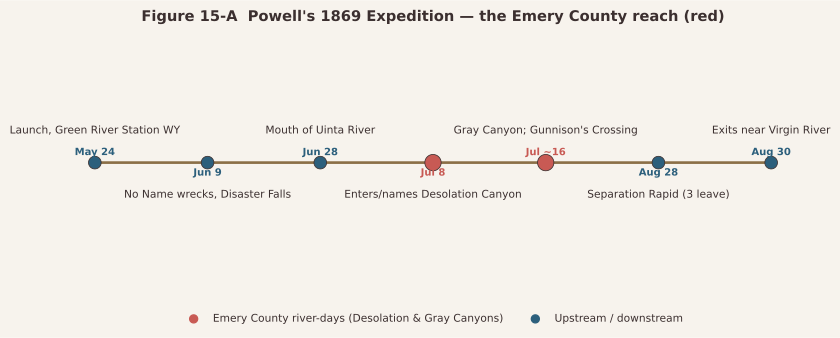
Table 15-A — Chronology of Powell's 1869 Expedition (Emery County river-days in bold)
| Date (1869) | Event | Location |
|---|---|---|
| 24 May | Launch, four boats, ten men | Green River Station, Wyoming Terr. |
| 9 Jun | No Name wrecks at Disaster Falls | Lodore Canyon |
| 28 Jun | Reaches mouth of the Uinta River; short rations | Uinta Basin |
| 8 Jul | Enters and names Desolation Canyon | Emery County reach |
| ~16 Jul | Runs Gray Canyon; camps at Gunnison’s Crossing | Green River, Utah (present town) |
| 28 Aug | Howlands & Dunn leave at Separation Rapid | Lower Grand Canyon |
| 30 Aug | Survivors exit the canyons | Near mouth of the Virgin River |
Source: USGS 150th Anniversary; Utah Geological Survey; WyoHistory.
15.3 Powell’s Second Expedition (1871–72)
Powell understood that the 1869 trip had been an adventure, not a survey. Congress appropriated funds for a second, properly-scientific expedition in 1870, and on 22 May 1871 a new party launched again from Green River, Wyoming (Wikipedia; Utah Geological Survey). The crew this time was built for measurement rather than speed: Powell’s brother-in-law Almon Harris (A. H.) Thompson served as geographer-in-charge; seventeen-year-old artist Frederick S. Dellenbaugh kept a detailed journal and sketchbook; and a rotating series of photographers — E. O. Beaman in 1871, James Fennemore in 1872, and ultimately John K. Hillers (a former boatman promoted to expedition photographer) — produced the first photographs of the Colorado Plateau (Smithsonian American Art Museum; Beinecke Rare Book & Manuscript Library).
The 1871 party retraced the Emery County reach in July, moving slowly through Desolation and Gray Canyons while Thompson triangulated and Beaman exposed wet-plate collodion negatives. The boats wintered at Kanab, Utah (1871–72). When they resumed in 1872, flood conditions in the Grand Canyon forced the expedition to halt at Kanab Creek rather than reach the Virgin River. But for Emery County, the important work had already been done: the Green River reach was mapped, photographed, and described. Thompson continued topographic fieldwork on the Colorado Plateau through 1878, extending control into the Henry Mountains and across the High Plateaus of Utah (Utah Geological Survey).
15.4 Geologic Findings in Castle Valley
Powell himself was a geologist; so were most of his senior staff. The scientific output of the 1871–78 survey transformed the geology of the Colorado Plateau from legend to literature.
Grove Karl Gilbert, working in the Henry Mountains south of Emery County, coined the term laccolith in his 1877 Report on the Geology of the Henry Mountains — a word still used worldwide for a type of intrusive igneous body (USGS publications). Clarence Edward Dutton, mapping the High Plateaus of Utah including the Wasatch Plateau on Emery County’s western flank, published Report on the Geology of the High Plateaus of Utah in 1880: a foundational work on Colorado Plateau stratigraphy, volcanism, and the long-vanished Lake Bonneville shoreline. Powell’s own 1875 book Exploration of the Colorado River of the West and Its Tributaries synthesized the 1869 and early 1871 observations, and it introduced the term “Colorado Plateau” as a distinct physiographic province.
The grey Eocene shales that line Desolation and Gray Canyons — the same strata whose oil-shale resources would be flagged a century later — received their first name during Powell-era mapping: the Green River Formation (see Ch21: Energy Transition ↗ 3 Ch21: Energy Transition From coal peak to post-carbon crossroads: mine closures, shifting retirement timelines for Hunter and Huntington power p... Read chapter → ). Powell’s survey did not overlook what lay beneath Castle Valley either. The coal outcrops along the Wasatch Plateau’s eastern face (see Ch17: Coal, Copper & Uranium ↗ 3 Ch17: Coal, Copper & Uranium The extractive century: coal seams of the Wasatch Plateau, uranium-rich sandstones of the San Rafael Swell, copper bypro... Read chapter → ) were noted in Dutton’s monographs, and the Mancos Shale sea floor whose bones populate Emery County’s dinosaur localities (see Ch02: Deep-Time Geology ↗ 1 Ch02: Deep-Time Geology A billion-year journey through stone: Precambrian foundations, Paleozoic seas, Mesozoic dinosaurs, and recent tectonics. Read chapter → ) was identified and correlated.

15.5 Ethnographic Encounters
Powell was not only a geologist but a serious ethnologist, and the 1871–72 expedition and its aftermath are at least as important for what they recorded about the region’s Indigenous peoples as for what they mapped. During winter at Kanab and subsequent fieldwork in the Uinta Basin, Powell lived with Southern Paiute and Ute communities, compiling vocabularies and recording cultural practices (WyoHistory; Smithsonian Bureau of American Ethnology).
Hillers’ camera captured some of the earliest extant photographs of Colorado Plateau Indigenous people, including the celebrated portrait of Tau-gu, a Southern Paiute chief, and images of Ute encampments (Smithsonian American Art Museum). Many of these photographs are now held at the Smithsonian and remain in active use by descendant communities, even as some raise difficult questions — treated more fully in Ch13: Archaeological Stewardship ↗ 2 Ch13: Archaeological Stewardship Legal frameworks, monitoring programs, site stewardship, curation practices, and ethical principles for protecting Emery... Read chapter → on archaeological and cultural stewardship — about how and whether such images should circulate.
Powell’s ethnographic work led directly, in 1879, to the establishment of the Bureau of American Ethnology (BAE) at the Smithsonian, with Powell as its first director. The BAE’s Emery County legacy is indirect but real: its classificatory work on Numic languages (see Ch10: Numic Expansion ↗ 2 Ch10: Numic Expansion The Numic peoples — ancestors of the Ute, Southern Paiute, and Shoshone — and their arrival on the Colorado Plateau afte... Read chapter → ) shaped every subsequent scholarly account of Ute and Paiute history in the region.
15.6 The Great Surveys Quartet
The Powell Survey did not operate alone. Between 1867 and 1879, four parallel federal expeditions competed, cooperated, and overlapped in their coverage of the American West (USGS Circular 1050):
- Clarence King’s Fortieth Parallel Survey (U.S. Geological Exploration of the 40th Parallel, 1867–1878), which mapped a transcontinental corridor across Wyoming, Utah, and Nevada;
- Ferdinand V. Hayden’s Survey of the Territories (U.S. Geological and Geographical Survey of the Territories, 1867–1878), famous for its Yellowstone and Colorado Rockies work;
- Lt. George M. Wheeler’s Geographical Surveys West of the 100th Meridian (U.S. Army Corps of Engineers, 1872–1879); and
- Powell’s Geographical and Geological Survey of the Rocky Mountain Region (1869–1879), concentrated on the Colorado Plateau.
Hayden’s parties skirted Emery County’s northern edge. Wheeler’s Army surveyors pushed into the San Rafael Swell area in the mid-1870s — the first military topographic work in what would become Emery County’s interior. But Powell’s survey, with its sustained presence on the Green River and High Plateaus, was the dominant scientific authority on Castle Valley through the 1870s. The overlap prompted a National Academy of Sciences study in 1878 that recommended merging the civilian surveys into a single federal bureau — the recommendation that produced the USGS (§ 15.8).
Table 15-B — The Four Great Surveys of the West at a Glance
| Survey (director) | Agency | Dates | Primary region | Successor |
|---|---|---|---|---|
| Fortieth Parallel (Clarence King) | War Dept. (civilian) | 1867–1878 | WY–UT–NV corridor | USGS (King, 1st director) |
| Survey of the Territories (F. V. Hayden) | Interior Dept. | 1867–1878 | Yellowstone, Colorado Rockies | USGS |
| Surveys W. of 100th Meridian (G. M. Wheeler) | Army Corps of Engineers | 1872–1879 | Southwest incl. San Rafael Swell | USGS |
| Rocky Mountain Region (J. W. Powell) | Interior Dept. | 1869–1879 | Colorado Plateau, Green River | USGS (Powell, 2nd director) |
Source: USGS Circular 1050.
15.7 Photographic Legacy
No single innovation of the Powell Survey shaped public perception of the Colorado Plateau more than photography. Over 1871 and 1872, Beaman, Fennemore, and Hillers produced roughly 650 wet-plate collodion negatives (Wikimedia Commons: Second Powell Expedition 1871–1872). Many of them depict places readers of this encyclopedia can still visit: the crossing at present-day Green River, Utah; Gunnison Butte from mid-river; campsites in Desolation Canyon; panoramas from the rim of Gray Canyon.
The wet-plate process required a portable darkroom boat and 20–40 minutes of careful handling per exposure, which vastly slowed travel. But the resulting albumen prints became the standard visual language of the late-19th-century Colorado Plateau. Hillers’ prints hung in Smithsonian galleries, illustrated Powell’s official reports, and were reproduced in magazines and stereographs for a public that had never seen the canyons firsthand.
Today the original negatives are distributed among the USGS Photographic Library (Denver), the Smithsonian Institution, the Beinecke Library at Yale (Dellenbaugh Collection), and the Utah State Historical Society. A substantial subset is public domain and available through Wikimedia Commons — an invaluable resource for a work like this encyclopedia.
15.8 The Birth of the USGS (1879)
On 3 March 1879, only hours before the 45th Congress adjourned, President Rutherford B. Hayes signed the Sundry Civil Expenses Act. Section 5 of that act established the United States Geological Survey, folding the work of the four Great Surveys into a single civilian bureau (USGS Circular 1050; History.com).
Clarence King — a brilliant young mining geologist and the Fortieth Parallel Survey’s director — was appointed first director of the USGS. His tenure was brief (1879–1881); Powell succeeded him in 1881 and held the directorship for thirteen years, concurrently with his role at the Bureau of American Ethnology (USGS). Powell’s decade as USGS director coincided almost exactly with Emery County’s first generation of Anglo-American settlement and its earliest economic development in coal, ranching, and irrigation — work on which the USGS produced technical reports that remain useful today.
15.9 Survey Camps & Supply Lines
Unlike the Yellowstone or High Plains expeditions, Powell’s parties could not rely on forts or settler ranches for resupply in Emery County’s river corridor. The 1869 expedition lived off the river and occasional hunting. The 1871–72 expedition used supply caches at Green River City (Wyoming), the mouth of the Uinta River, and Kanab — but between those points the crews were on their own.
The tiny ford at Gunnison’s Crossing — later known as Blake Station in association with the arrival of the Denver & Rio Grande Western Railway in the early 1880s [railroad date and station-naming etymology pending verification against railroad and USGS Board on Geographic Names records], and eventually as the town of Green River, Utah — was the only reliable resupply point between the Uintah Agency and Lee’s Ferry. It predates Emery County’s organization in 1880 and appears in Powell-era accounts as a waymark rather than a settlement. After 1872, Thompson’s topographic parties used pack trains from Kanab, Escalante, and the Uintah Agency; astronomical stations for longitude work were established at Kanab and on the Aquarius Plateau.
15.10 Place-Name Origins
Powell and his men were prolific namers, and their names stuck. From the stretch of river most relevant to Emery County and its western Colorado Plateau neighbors:
- Flaming Gorge (upstream, but named by Powell on the 1869 journey);
- Lodore Canyon (from Robert Southey’s “Cataract of Lodore”);
- Desolation Canyon and Gray Canyon (both named by Powell, 1869);
- Labyrinth Canyon and Stillwater Canyon (Powell, 1869);
- Dirty Devil River, Escalante River, Glen Canyon, and Cataract Canyon (Powell, 1869).
Within Emery County’s own reach, names predated or paralleled Powell’s: Gunnison Butte (from J. W. Gunnison, 1853); the Book Cliffs (descriptive, Hayden/Powell era); and the Tavaputs Plateau (traditionally interpreted as a Ute word approximating “sun’s going” — “the place where the sun sets,” referring to the western view [Ute etymology pending citation to a scholarly linguistic or ethnographic source]) all received their modern English labels during this same 1853–1880 interval of exploration and survey.
Table 15-C — Powell-Era Place-Names in and near Emery County
| Name | Feature | Named by | Year | Note |
|---|---|---|---|---|
| Gunnison Butte / Valley | Sandstone landmark, basin | J. W. Gunnison survey | 1853 | Predates Powell |
| Desolation Canyon | Green River canyon | J. W. Powell | 1869 | ”Region of wildest desolation” |
| Gray Canyon | Green River canyon | J. W. Powell | 1869 | For pale Green River Fm. shales |
| Book Cliffs | Escarpment | Hayden/Powell era | c. 1870s | Descriptive |
| Tavaputs Plateau | Plateau | (Ute term, adopted) | — | “Sun’s going” — [etymology pending citation] |
Source: §15.10; USGS; Utah Geological Survey.
15.11 Mapping Techniques & Instruments
The Powell Survey’s topographers worked with a precise but slow toolkit: plane-table and alidade for horizontal angles; stadia rods for distance; mercury and later aneroid barometers for elevation; and pocket chronometers calibrated to telegraph time signals for longitude. Triangulation networks anchored at identifiable peaks (Thousand Lake Mountain, the Henry Mountains, the flat tops of Cedar Mountain in Emery County) produced the first accurate topographic maps of the Colorado Plateau.
A. H. Thompson completed a first reliable topographic map of the Colorado Plateau in 1876–77, published as the atlas sheet accompanying Powell’s Geology of the Uinta Mountains (1876) (USGS publications). Hillers’ panoramic photographs were not merely illustrations; they served as triangulation data in their own right, with identifiable landmarks in successive frames used to extend the control network — an innovation refined in the Powell Survey and later adopted by the USGS.
15.12 Centennial Re-Runs & Modern Science
The Powell legacy has aged well. The 1969 Powell Centennial prompted replicas of the original voyage and the founding of interpretive programming along the Green and Colorado, including at Dinosaur National Monument. In the town of Green River, Utah, the John Wesley Powell River History Museum opened in 1990 and today serves as the region’s primary interpretive site for the expeditions (Visit Utah).
Modern science continues the Powell tradition. The USGS streamgage at Green River, Utah (station 09315000) has operated continuously since 1894, providing one of the longest hydrologic records in the American West (USGS NWIS). Desolation Canyon was added to the National Register of Historic Places in 1968 and designated a National Historic Landmark the same year, as part of the centennial recognition of the Powell expedition; it was subsequently designated a Wild and Scenic Study Area by Congress in 1978, and the cultural-landscape framing of the site — recognizing Powell-era heritage alongside Fremont archaeology and Ute history — has been expanded through later interpretive designations (Bureau of Land Management; National Register of Historic Places; National Historic Landmarks Program).
And Powell’s most underappreciated legacy — his 1878 Report on the Lands of the Arid Region of the United States, which argued that western lands required watershed-based political boundaries and cooperative irrigation institutions — still frames the policy choices Emery County confronts today. Powell praised the early LDS cooperative irrigation systems of Sanpete and Sevier Counties as a possible model even as settlers were beginning to dig the first ditches in Castle Valley (Library of Congress; Wikipedia). The report was ignored by Congress at the time; the 20th century’s federal reclamation projects, interstate water compacts, and ongoing Colorado River negotiations all vindicate its basic argument. When Emery County residents today argue over Huntington Creek water rights or Green River environmental flows (see Ch19: Water for the Desert ↗ 3 Ch19: Water for the Desert Water, the defining constraint of Emery County life: pioneer ditches and the 1890s salinization crisis, the federal Emer... Read chapter → ), they are still arguing inside the framework Powell sketched in 1878.
See Also
- Ch02: Deep-Time Geology ↗ 1 Ch02: Deep-Time Geology A billion-year journey through stone: Precambrian foundations, Paleozoic seas, Mesozoic dinosaurs, and recent tectonics. Read chapter →
- Ch10: Numic Expansion ↗ 2 Ch10: Numic Expansion The Numic peoples — ancestors of the Ute, Southern Paiute, and Shoshone — and their arrival on the Colorado Plateau afte... Read chapter →
- Ch13: Archaeological Stewardship ↗ 2 Ch13: Archaeological Stewardship Legal frameworks, monitoring programs, site stewardship, curation practices, and ethical principles for protecting Emery... Read chapter →
- Ch14: Spanish Trails & Fur Trappers ↗ 3 Ch14: Spanish Trails & Fur Trappers The era of exploration and trade preceding Euro-American settlement: ancient Ute commerce routes, the Old Spanish Trail,... Read chapter →
- Ch18: Rails, Roads & Infrastructure ↗ 3 Ch18: Rails, Roads & Infrastructure The transportation and utility networks that wove Emery County into the broader region: the Old Spanish Trail, the 1883 ... Read chapter →
- Ch19: Water for the Desert ↗ 3 Ch19: Water for the Desert Water, the defining constraint of Emery County life: pioneer ditches and the 1890s salinization crisis, the federal Emer... Read chapter →
Further Reading
- USGS — 150th Anniversary of the 1869 Powell Expedition
- USGS Circular 1050 — The USGS 1879–1989
- Library of Congress — Powell, Report on the Lands of the Arid Region (1878)
- BLM — Green River Wild & Scenic Study Area
- John Wesley Powell River History Museum (Visit Utah)
Sources
- Utah Geological Survey, “Powell’s 1869 Journey Down the Green and Colorado Rivers,” Survey Notes. https://geology.utah.gov/map-pub/survey-notes/powell-1869-river-journey/
- U.S. Geological Survey, “150th Anniversary of the 1869 Powell Expedition.” https://www.usgs.gov/educational-resources/150th-anniversary-1869-powell-expedition
- U.S. Geological Survey, “John Wesley Powell.” https://usgs.gov/about/organization/science-support/human-capital/john-wesley-powell
- U.S. Geological Survey, Circular 1050: The United States Geological Survey, 1879–1989. https://pubs.usgs.gov/circ/c1050/ (see “Establishment of the U.S. Geological Survey” and “The Four Great Surveys of the West”).
- Library of Congress, Powell, Report on the Lands of the Arid Region of the United States, with a More Detailed Account of the Lands of Utah (1878). https://www.loc.gov/item/2024800607/
- Library of Congress, Macomb & Newberry, Report of the Exploring Expedition from Santa Fé, New Mexico, to the Junction of the Grand and Green Rivers of the Great Colorado of the West, in 1859 (published 1876). https://www.loc.gov/item/2009578406/
- Smithsonian National Museum of Natural History, “Macomb’s San Juan Exploring Expedition.” https://naturalhistory.si.edu/research/botany/about/historical-expeditions/macombs-san-juan-exploring-expedition
- Smithsonian American Art Museum, “John K. Hillers.” https://americanart.si.edu/artist/john-k-hillers-6691
- Beinecke Rare Book & Manuscript Library, Yale University, “Frederick Samuel Dellenbaugh’s Photographs and Drawings of the Colorado River Region.” https://beinecke.library.yale.edu/collections/highlights/frederick-samuel-dellenbaughs-photographs-and-drawings-colorado-river-region
- Wikimedia Commons, “Second Powell Expedition 1871–1872: Photographs by John K. Hillers.” https://commons.wikimedia.org/wiki/Category:Second_Powell_Expedition_1871-1872:_Photographs_by_John_K._Hillers
- Wikipedia, “Powell Geographic Expedition of 1869.” https://en.wikipedia.org/wiki/Powell_Geographic_Expedition_of_1869
- Wikipedia, “John Wesley Powell.” https://en.wikipedia.org/wiki/John_Wesley_Powell
- Wikipedia, “Report on the Lands of the Arid Region of the United States.” https://en.wikipedia.org/wiki/Report_on_the_Lands_of_the_Arid_Region_of_the_United_States
- Wikipedia, “Desolation Canyon.” https://en.wikipedia.org/wiki/Desolation_Canyon
- WyoHistory.org, “John Wesley Powell: Explorer, Thinker, Scientist and Bureaucrat.” https://www.wyohistory.org/encyclopedia/john-wesley-powell-explorer-thinker-scientist-and-bureaucrat
- Utah Historical Quarterly, vol. 15 (1947), “The Powell Colorado River Expedition of 1869.” https://issuu.com/utah10/docs/volume_15_1947
- Madsen, Steven K., Exploring Desert Stone: John N. Macomb’s 1859 Expedition to the Canyonlands of the Colorado (Utah State University Press, 2010).
- Bureau of Land Management, “Green River Wild & Scenic Study Area.” https://www.blm.gov/national-conservation-lands/utah/green-river-wsr
- Visit Utah, “John Wesley Powell River History Museum.” https://www.visitutah.com/places-to-go/cities-and-towns/green-river/john-wesley-powell-river-museum
- OARS, “A Trip Through Time in Desolation Canyon.” https://www.oars.com/blog/desolation-canyon-history/
Proposed Maps / Figures
- Map 15.1 — Powell’s 1869 route, with Emery County reach highlighted (base: USGS 1:500,000; original).
- Map 15.2 — The Four Great Surveys’ territories, 1867–1879 (derived from USGS Circular 1050).
- Figure 15.1 — Portrait of John Wesley Powell (USGS, public domain).
- Figure 15.2 — Hillers photograph at Gunnison’s Crossing, 1871 (Smithsonian / Wikimedia, public domain).
- Figure 15.3 — Hillers or Beaman view into Desolation Canyon, 1871 (Wikimedia, public domain).
- Figure 15.4 — Cover of Powell’s Report on the Lands of the Arid Region (LOC, public domain).
- Figure 15.5 — Facsimile of a plane-table topographic sheet from the 1877 Powell Survey (USGS).
Proposed Tables
- Table 15.1 — Chronology of Powell’s 1869 expedition with Emery County river-days highlighted.
- Table 15.2 — The Great Surveys quartet at a glance (director, agency, dates, primary region, successor).
- Table 15.3 — Place-names in Emery County and adjacent Colorado Plateau attributable to 1853–1879 surveys, with origin/source.
Engagement Features
Did You Know?
- John Wesley Powell lost his right arm at the Battle of Shiloh (April 6, 1862), but seven years later he led the first documented descent of the Green and Colorado Rivers — a one-armed Civil War major navigating unmapped canyons in wooden boats — and later became the second director of the U.S. Geological Survey.
- Three members of Powell’s 1869 expedition (Seneca Howland, O. G. Howland, and William H. Dunn) climbed out of the canyon at what Powell named “Separation Rapid” and were never seen again. Their fate remains one of the great unsolved mysteries of American exploration.
- Powell’s photographer John K. Hillers made thousands of wet-plate collodion photographs of the Colorado Plateau between 1871 and 1879, including some of the earliest photographs ever taken of Emery County’s Green River canyons, Gunnison Butte, and the Book Cliffs.
Family Activity
Recreate a Powell-Era Photograph. Find one of the Hillers photographs of the Green River in Emery County (this chapter’s Figures 15.2 and 15.3 are a good start). Visit the same vantage point with a modern camera and attempt to recreate the composition as closely as possible. Compare the then-and-now photographs as a family and discuss what has changed — and what has remained the same — in 150 years.
Youth Challenge — Name That Place
Powell’s expeditions named dozens of features in and around Emery County (Desolation Canyon, Gunnison Butte, the Book Cliffs, and more). Research the origin of five Emery County place names drawn from the Powell era, write a one-sentence explanation for each, and test family members on the names.
Field Trip
John Wesley Powell River History Museum (Green River, Emery County). Dedicated entirely to Powell’s expeditions and the broader tradition of western river exploration. Exhibits include full-scale replicas of the expedition’s wooden boats, period photographs, and river-runner artifacts from the 20th century. An essential stop for any Emery County history visit.
Photo Assignment
Photograph the Green River from Gunnison Butte or the Tavaputs Plateau rim, framing the same view that Powell and his men looked out upon as they prepared to enter Desolation Canyon. Aim for a composition that conveys both the beauty and the menace of the river gorge.