Part 4 · Culture & Identity
Education & Learning
From dugout-classroom pioneer schoolhouses through Emery Stake Academy (1889-1922), the three-high-school era, and the 1962 consolidation into Emery High Spartans, to today's Emery County School District (ten schools, ~2,248 students), USU Eastern's Castle Dale education center, and the post-coal CTE pipeline confronting workforce transition - a 145-year arc of education in Castle Valley.
Ch24 — Education & Learning
24.1 Introduction: Schoolhouse as Cornerstone
In the settler imagination of nineteenth-century Utah, two institutions arrived with the wagon train and were expected to take root almost before the first crops did: the meetinghouse and the schoolhouse. Often the buildings were one and the same. In the Castle Valley settlements that became Emery County after 1880, education was not a luxury added once survival was secure but a constitutive act of community-making. Children who could read scripture, do arithmetic, and write a clean letter were the proof that a desert settlement was becoming a town.
From those earliest dugout classrooms to the consolidated Emery High School in Castle Dale and the satellite USU Eastern campus center down the road, the county’s educational story tracks every other story in this volume — the pioneer hopes of Chapter 16, the coal booms of Chapter 17, the demographic shifts of Chapter 22, the energy transition of Chapter 21. The schoolhouse is where Emery County records, in a hundred small ways, what it expects of itself.
24.2 The Pioneer Schoolhouse Era (1877–1900)
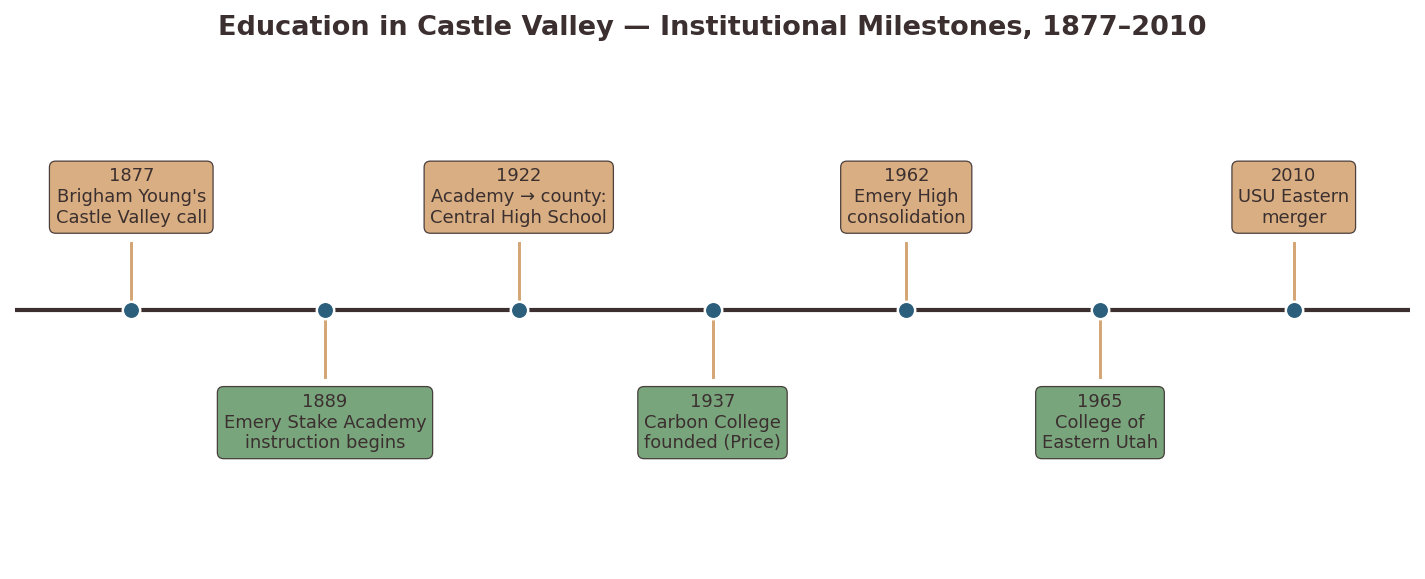
The first families to answer Brigham Young’s August 22, 1877 call to settle Castle Valley (see Ch16: Mormon Colonization ↗ 3 Ch16: Mormon Colonization LDS settlement of Emery County: the call to colonize Castle Valley, founding of pioneer towns, cooperative irrigation, a... Read chapter → ) arrived to a place with no buildings, no roads, and no books. The 1880 federal census found 237 settlers strung along Cottonwood Creek (Utah History Encyclopedia, 1994). Their first schools were improvised: a corner of a dugout, a log cabin doubling as a church, a parlor donated for the winter term. Itinerant teachers — sometimes a literate older sister, sometimes a young man “called” by the LDS bishop — taught the McGuffey Eclectic Readers that travelled west in nearly every Mormon wagon, alongside basic arithmetic, penmanship, and scripture.
By the mid-1880s, almost every settled town in the new county had built a one-room log or adobe schoolhouse. Castle Dale, Huntington, Ferron, Orangeville, Cleveland, Elmo, Emery, and Molen all maintained schools through eighth grade (Emery County Archives, 2010). Smaller settlements that have since become ghost towns — Connellsville on the Cottonwood, Wilsonville south of Ferron — also operated schools for a season or two before the population shifted away. The schools were funded by local subscription, by the LDS ward, and (after Utah statehood in 1896) by the territorial and county school systems that began to extend their reach into the rural valleys.
The pioneer schoolhouse was a multi-purpose civic stage. The same room that hosted Tuesday’s geography lesson hosted Saturday’s dance, Sunday’s sacrament meeting, and the periodic lyceum or spelling bee. Its single woodstove was tended by a parade of older boys whose chore included cutting kindling on the way to school. The building itself was usually the second-most-important community structure after the bishop’s storehouse, and its construction date is often the date the town considers itself to have truly begun.
24.3 The Emery Stake Academy (1889–1922)
In 1888 the LDS Emery Stake formally organized the Emery Stake Academy as a governing body, and regular instruction commenced in 1889 — making it the first high-school-level institution in southeastern Utah (Tabone, 1976). It was part of an extraordinary educational push by the LDS Church: between 1875 and 1910, the Church sponsored thirty-three academies across seven western states, Canada, and Mexico (Encyclopedia of Mormonism). These academies filled the secondary-school gap in towns too small or too remote for state high schools. Emery Stake Academy was the southeastern-Utah anchor of the system.
The academy initially met in rented and donated space. In 1899 it occupied a new two-story brick building, and in 1910 it moved again to a larger three-story building “on the bench” above Castle Dale (Utah Historical Quarterly, 1998). Its curriculum braided religious instruction with college-preparatory work — Latin, mathematics, English literature, history, the natural sciences — and added the practical subjects that made sense for a rural agricultural valley: bookkeeping, music, elocution, and agricultural science. Students came from across Emery County and from neighboring Carbon County, often boarding with families in town during the school week.
By the early 1920s, the public-school system had matured to the point where parallel LDS academies were no longer needed. In 1922 the Church sold the Emery Stake Academy to the Emery County School District, and the institution was rechristened Central High School. The same brick building that had carried the academy banner now carried the school district’s. The transition was repeated across the LDS academy system in the same decade — a quiet but significant handoff of secondary education from church to state in rural Utah. Paul Robert Tabone’s 1976 BYU thesis, The History of the Emery Stake Academy, remains the definitive scholarly treatment.
24.4 The Three-High-School Era (1922–1962)
For forty years after the academy handoff, Emery County operated three high schools, each rooted in a different valley and serving a distinct cluster of communities (Emery County Archives, 2011):
- North Emery High School in Huntington, with the surviving 1925 building still standing as a county landmark.
- Central High School in Castle Dale, in the former academy buildings (and after 1909, in the brick public school still standing today).
- South Emery High School in Ferron, serving Ferron, Molen, Emery, and the southern reaches of the county.
Below the high schools was a dense network of elementary schools — one in nearly every settled community, including those that have since vanished. Children walked or rode horses to their town school through eighth grade, and then were bused to the closest high school for grades nine through twelve. Bus routes were long and unforgiving; winter mornings might begin in the dark with a child standing by a fence post on a ranch lane, breath puffing white, waiting for the yellow Buick or the Model A converted to a bus. School superintendents in the 1930s were as often plowing roads as managing budgets.
The three-school era coincided with the county’s first great population peaks (see Ch22: Demography & Social Change ↗ 3 Ch22: Demography & Social Change From pioneer founding cohort to post-coal crossroads: population boom and bust, LDS social architecture, an aging and sh... Read chapter → ) and with the early decades of the coal industry (see Ch17: Coal, Copper & Uranium ↗ 3 Ch17: Coal, Copper & Uranium The extractive century: coal seams of the Wasatch Plateau, uranium-rich sandstones of the San Rafael Swell, copper bypro... Read chapter → ). Enrollments rose with mining booms and fell with each downturn — precise year-by-year figures for the three schools vary across ECSD archival records, which are incomplete for the 1930s and 1940s, but aggregate district enrollment tracked county population closely. Castle Dale lost a portion of its independent high-school role in a partial 1943 consolidation; the broader three-school structure persisted into the early 1960s. [needs additional sources: ECSD enrollment records 1922–1962]
24.5 Birth of Emery High (1962)
In 1962, citing falling enrollment, rising transportation costs, and the desire to offer a richer college-preparatory and vocational curriculum than three small high schools could each maintain, the Emery County School District closed North Emery and South Emery and consolidated all county high-school students into a new central campus in Castle Dale: Emery High School, the Spartans. It is the school that continues today.
The decision was contested at the time. Huntington and Ferron lost not only buildings but identities — the Friday-night football game, the senior play, the marching band, the homecoming bonfire. North Emery’s 1925 building survived as an elementary school and later a community asset; South Emery’s site was repurposed. The old Central High brick building in Castle Dale was eventually phased out as Emery High moved to a new campus, and the 1909 Castle Dale public school took on a quieter civic life as a landmark and event space.
Emery High has remained the county’s central secondary institution for more than sixty years. Its enrollment has tracked the county’s population: roughly 636 students in recent reporting, essentially flat over five years (Public School Review, 2026).
24.6 The Emery County School District Today
The Emery County School District is headquartered in Huntington and serves an area roughly coterminous with the county itself (Emery County School District, 2026). Its current footprint is ten schools — six elementary, two middle, and two high schools — serving approximately 2,248 students (NCES; Niche, 2026; count confirmed against ECSD 2026 directory). [Note: Some federal datasets and aggregator sites count eight schools by excluding pre-K sites or counting only standard K–12 campuses; the figure of ten reflects all K–12-serving buildings on the district’s 2026 roster.]
Table 24-A — Emery County School District, 2026
| School | Community | Level |
|---|---|---|
| Castle Dale Elementary | Castle Dale | Elementary |
| Cottonwood Elementary | Orangeville | Elementary |
| Ferron Elementary | Ferron | Elementary |
| Huntington Elementary | Huntington | Elementary |
| Cleveland Elementary | Cleveland | Elementary (smallest) |
| Book Cliff Elementary | Green River | Elementary |
| Canyon View Junior High | Huntington | Junior high |
| San Rafael Junior High | Ferron | Junior high |
| Emery High School | Castle Dale | High (Spartans) |
| Green River High School | Green River | High (Pirates) |
Ten schools, ~2,248 students; HQ Huntington. Source: ECSD 2026 roster; NCES; Niche.
- Castle Dale Elementary (Castle Dale)
- Cottonwood Elementary (Orangeville)
- Ferron Elementary (Ferron)
- Huntington Elementary (Huntington)
- Cleveland Elementary (Cleveland) — the smallest, serving the Cleveland-Elmo agricultural community.
- Book Cliff Elementary (Green River)
- Canyon View Junior High (Huntington)
- San Rafael Junior High (Ferron)
- Emery High School (Castle Dale)
- Green River High School (Green River)
The district shares its boundaries with one of Utah’s most physically demanding service areas: a little over 4,400 square miles, much of it federal land, with student populations clustered in the irrigated valleys along the Wasatch Plateau front and the long drive east to Green River. Bus runs are still long, and the closures of small valley schools remain politically sensitive — every reduction reverberates as both an educational and a community loss.
24.7 Green River and the Eastern Fringe
Green River occupies a distinct educational geography within the county. It sits eighty miles east of Castle Dale across the San Rafael Swell on Interstate 70, with no possibility of busing students daily to the central campus. Green River High School therefore operates as a separate secondary school within the district, serving roughly forty to seventy students depending on year and offering a small-school athletic program (the Green River Pirates) and a streamlined curriculum supplemented by distance-learning options.
The Green River schools also serve a more demographically diverse student body than the central valleys: a higher proportion of Hispanic students, a somewhat lower socioeconomic baseline, and historically a more transient population tied to interstate-highway service work, melon-farm seasonal labor, and the proximity of the Utah Test and Training Range (Chapter 22, Chapter 32). The district’s smallest schools sit at the edge of viability, but their loss would mean Green River children boarding away from home — a step the county has never been willing to take.
24.8 Higher Education: From Carbon College to USU Eastern
Higher education came late to the Castle Valley, and when it came, it came from across the Wasatch Plateau ridge in Carbon County. Carbon College was founded in 1937 in Price as a regional public junior college (Utah State University Eastern, 2010). It served Carbon, Emery, and Grand counties from the start, drawing students from across southeastern Utah. In 1959 it joined the University of Utah system; in 1965 it was renamed College of Eastern Utah (CEU), the name that several generations of Emery County families remember.
On July 1, 2010, CEU was merged into Utah State University as USU Eastern, becoming part of the USU statewide regional-campus system. The Price campus — about thirty-five miles from Castle Dale by car — is the closest residential college campus to most of Emery County. Approximately 40% of USU Eastern students are first-generation college attendees, one of the highest such proportions in the state, and the institution maintains one of the lowest tuition rates in Utah’s public higher-education system.
Table 24-B — Higher-Education Lineage Serving Emery County
| Year | Event |
|---|---|
| 1937 | Carbon College founded, Price — serves Carbon, Emery, Grand |
| 1959 | Joins the University of Utah system |
| 1965 | Renamed College of Eastern Utah (CEU) |
| 2010 (Jul 1) | Merged into Utah State University as USU Eastern |
| — | USU Castle Dale Education Center — satellite in-county (associate’s, certificate, continuing ed) |
Source: USU Eastern history; USU Statewide Campuses. ~40% of USU Eastern students first-generation.
The USU Eastern presence in Emery County itself runs through the USU Castle Dale Education Center, a satellite campus that brings associate’s-degree, certificate, and continuing-education courses directly into the county. Students at the Castle Dale center can take a mix of in-person classes, hybrid classes, and live-broadcast classes from Price or Logan via the four-story USU Regional Campus Distance Education Network headquarters. For working adults — coal miners retraining, parents pursuing teaching credentials, ranchers picking up agricultural-business courses — the Castle Dale center is the institutional bridge between high-school graduation and a credentialed career, without the relocation step that has historically pulled young Emery County adults out of the county for good.
24.9 Libraries and Lifelong Learning
The Emery County Library System is headquartered in Castle Dale and operates branches in Castle Dale, Ferron, Huntington, Green River, Emery, and Orangeville (Utah State Library Division). Coordinated through the Utah State Library Division, the system provides print collections, digital resources, public computer access, and programming for children, teens, and adults. Unlike many rural Utah counties (Garfield, Iron, Kane, Piute, Sevier, Wayne), Emery is not served by the state’s bookmobile fleet; the county’s branch network instead provides physical access close to home.
Emery County never received a Carnegie library. Andrew Carnegie’s grant program built libraries in many Utah communities in the early twentieth century but did not extend into Castle Valley, and the county built its branch system from local funds and state appropriations after World War II. The Castle Dale main branch and the Green River branch are particularly active community spaces, hosting summer reading programs, genealogy workshops (with strong support from local family-history enthusiasts), and adult-education partnerships with USU Eastern’s Castle Dale center.
Beyond the library system, the county museum and the Museum of the San Rafael in Castle Dale (see Ch26: Arts, Literature & Media ↗ 4 Ch26: Arts, Literature & Media Emery County's cultural footprint runs unusually deep for a county of fewer than 10,000 residents: pioneer brass bands a... Read chapter → ) operate as quasi-educational institutions, with strong K–12 outreach programs and field-trip curricula tied to county geology, paleontology, and pioneer history.
24.10 Performance, Equity, and Outcomes (2022–2026)
Emery County’s K–12 outcomes track its rural and economically transitioning context. The most recent published indicators show:
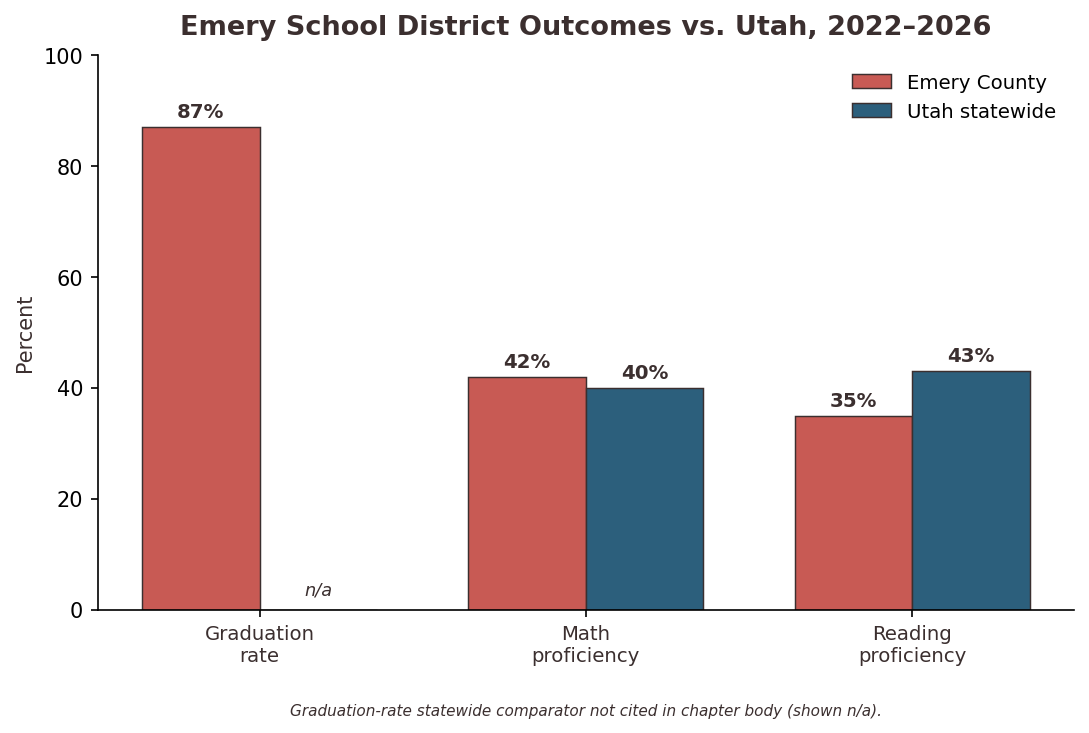
- Graduation rate: 87%, down from 90–94% over the prior five years (Public School Review, 2026).
- Math proficiency: 42% district average, modestly above the Utah public-school average of 40%.
- Reading proficiency: 35%, below the statewide average of 43%.
- By level (recent USBE report card): elementary math 48% / reading 34%; middle 35% / 31%; high 42% / 45%.
- Overall district ranking: top 50% of Utah’s 153 districts (2022–2023 USBE report card).
Table 24-C — District Performance Indicators, 2022-2026
| Indicator | Emery County | Utah statewide |
|---|---|---|
| Graduation rate | 87% (down from 90-94%) | not cited |
| Math proficiency (district avg) | 42% | 40% |
| Reading proficiency (district avg) | 35% | 43% |
| — Elementary math / reading | 48% / 34% | — |
| — Middle math / reading | 35% / 31% | — |
| — High math / reading | 42% / 45% | — |
| Overall district ranking | top 50% of Utah’s 153 districts | — |
Source: Public School Review (2026); USBE 2022-23 report card.
The district’s strongest signal is a math performance that holds at or slightly above the state average despite Emery’s small size, distance from urban resources, and the demographic challenges described in Chapter 22. The weaker reading performance, particularly at the elementary and middle-school levels, is the focus of recent intervention efforts — phonics-aligned curriculum updates, additional reading-coach positions, and partnerships with the Utah State Library’s literacy programs.
Equity gaps within the district are most visible in the contrast between the central-valley schools and Green River, and between economically advantaged and disadvantaged students at every level. Special-education and English-learner enrollment has grown in absolute terms even as overall enrollment has held flat, reflecting both demographic change and improved identification of student needs.
24.11 Education in the Post-Coal Economy
Few rural districts in the country face the workforce-transition pressures that Emery does. Chapter 21 details how the closure of coal mines and the projected retirement of the Hunter and Huntington power plants will reshape the regional labor market within a single generation (see Ch21: Energy Transition ↗ 3 Ch21: Energy Transition From coal peak to post-carbon crossroads: mine closures, shifting retirement timelines for Hunter and Huntington power p... Read chapter → ). Schools have been pulled into that transition as both casualty and remedy.
The Utah Coal Country Strike Team, formed by the state legislature in the late 2010s to support communities affected by coal-industry decline, awarded a combined $50,000 (~$25,000 each) to the Carbon and Emery school districts for high-school computer science and information-technology pathway courses (UNews, University of Utah). The grants were designed to align with the IT Pathways program, a state-led initiative that lets students earn industry-recognized credentials before graduation and step into technology jobs without a four-year degree.
Career and Technical Education (CTE) offerings have expanded at Emery High to include welding, automotive technology, agricultural science, health-careers exploration, business, and computer science — a curriculum aimed less at funneling students to a four-year university and more at producing workforce-ready graduates who can stay in or return to Emery County. GEAR UP, the federally funded college-preparation program operated through USU Eastern, partners with Emery County schools to track cohorts of students from middle school through college enrollment, providing tutoring, college visits, and family-engagement support.
The result is a school system that is consciously trying to do two contradictory things at once: prepare students who will leave the county for college and careers in Salt Lake City or beyond, and prepare students who will stay, retrain into post-coal industries, and keep the county populated. So far, the district has avoided the worst of the rural-decline trap by holding enrollment steady, posting graduation rates well above the historic rural-Utah average, and producing graduates who score competitively on math and increasingly competitively on reading.
24.12 The Future of Learning in Castle Valley
Looking forward, Emery County education faces three structural questions, none of them new:
- Enrollment stability. Can the district maintain its school footprint as the coal economy recedes and out-migration of young families continues? The closure of even one elementary school would reshape several communities (Chapter 22).
- Broadband and distance learning. Rural broadband, accelerated by COVID-era investments and the federal Bipartisan Infrastructure Law funds (see Ch18: Rails, Roads & Infrastructure ↗ 3 Ch18: Rails, Roads & Infrastructure The transportation and utility networks that wove Emery County into the broader region: the Old Spanish Trail, the 1883 ... Read chapter → ), is finally delivering reliable connectivity to most of the county. That changes what is possible at the Green River campus, at the Castle Dale center, and in the home of every student.
- Workforce alignment. Will Emery’s CTE and IT-Pathways investments translate into local employment, or will graduates continue to leave for Wasatch Front jobs as a generation of their parents did? The answer depends on industries that are still being built — solar, transmission, advanced manufacturing, possibly nuclear (Chapter 21).
What has not changed since 1880 is the underlying conviction: a county that loses its schools loses itself. Every closure debate is a referendum on whether the community will keep being a community. So far, Castle Valley has answered yes.
Sources
Primary, secondary, and digital sources cited inline. Detailed citations compiled in sources/Ch24_sources.md (Phase 5).
- Emery County School District. https://www.emeryschools.org/
- Utah State Board of Education report card. https://reportcard.schools.utah.gov/District/Profile?DistrictID=442
- NCES district detail. https://nces.ed.gov/ccd/districtsearch/district_detail.asp?DistrictID=4900270
- Tabone, Paul Robert. The History of the Emery Stake Academy. BYU MA thesis, 1976. https://scholarsarchive.byu.edu/etd/5159/
- Encyclopedia of Mormonism, “Academies.” https://eom.byu.edu/index.php/Academies
- Utah History Encyclopedia, Castle Dale entry. https://www.uen.org/utah_history_encyclopedia/c/CASTLE_DALE.shtml
- Utah Historical Quarterly, Vol. 66 (1998), “History Written on the Land in Emery County.” https://issuu.com/utah10/docs/uhq_volume66_1998_number3/s/10363215
- Emery County Archives (2010, 2011). https://emerycountyarchives.blogspot.com/
- Utah State Library Division — Emery County Library System. https://library.utah.gov/directory/lib_system/emery_county_library_system/
- Emery County Libraries. https://lib.emerycounty.com/
- Utah State University Eastern. https://eastern.usu.edu/ ; https://en.wikipedia.org/wiki/Utah_State_University_Eastern
- USU Castle Dale (Statewide Campuses). https://statewide.usu.edu/castledale/
- Utah Coal Country Strike Team grant award (UNews). https://unews.utah.edu/utah-coal-country-strike-team-awards-50000-to-carbon-and-emery-county-school-districts/
- Public School Review — Emery School District (2026). https://www.publicschoolreview.com/utah/emery-school-district/4900270-school-district
- Niche — Emery School District. https://www.niche.com/k12/d/emery-school-district-ut/
- U.S. News — Emery District. https://www.usnews.com/education/k12/utah/districts/emery-district-106349
See Also
- Ch16: Mormon Colonization ↗ 3 Ch16: Mormon Colonization LDS settlement of Emery County: the call to colonize Castle Valley, founding of pioneer towns, cooperative irrigation, a... Read chapter →
- Ch17: Coal, Copper & Uranium ↗ 3 Ch17: Coal, Copper & Uranium The extractive century: coal seams of the Wasatch Plateau, uranium-rich sandstones of the San Rafael Swell, copper bypro... Read chapter →
- Ch18: Rails, Roads & Infrastructure ↗ 3 Ch18: Rails, Roads & Infrastructure The transportation and utility networks that wove Emery County into the broader region: the Old Spanish Trail, the 1883 ... Read chapter →
- Ch21: Energy Transition ↗ 3 Ch21: Energy Transition From coal peak to post-carbon crossroads: mine closures, shifting retirement timelines for Hunter and Huntington power p... Read chapter →
- Ch22: Demography & Social Change ↗ 3 Ch22: Demography & Social Change From pioneer founding cohort to post-coal crossroads: population boom and bust, LDS social architecture, an aging and sh... Read chapter →
- Ch26: Arts, Literature & Media ↗ 4 Ch26: Arts, Literature & Media Emery County's cultural footprint runs unusually deep for a county of fewer than 10,000 residents: pioneer brass bands a... Read chapter →
Further Reading
- Emery County School District
- Utah State Board of Education — Emery District Report Card
- Tabone, Paul Robert — The History of the Emery Stake Academy (BYU MA thesis, 1976)
- Utah State University Eastern
- Public School Review — Emery School District (2026)
Proposed Maps / Figures
- Map 24.1 — Locations of all Emery County schools, 2026 (district map).
- Map 24.2 — Schoolhouses of 1920 vs. 2026 (overlay showing closed and surviving school sites).
- Figure 24.1 — Photo of the 1909 Castle Dale public school (modern photograph).
- Figure 24.2 — Photo of the 1925 North Emery High School in Huntington.
- Figure 24.3 — Class photo from Emery Stake Academy, c. 1910 (LDS Church History Library or BYU Special Collections, with permission).
- Figure 24.4 — Emery High Spartans logo / mascot (with district permission).
- Figure 24.5 — Enrollment trend chart, Emery County K–12, 1900–2025 (constructed from district + census data).
- Figure 24.6 — USU Castle Dale Education Center exterior.
Proposed Tables
- Table 24.1 — Schools operating in Emery County, by community and year of founding (1880–2026).
- Table 24.2 — Three-high-school enrollments 1922–1962 (North Emery, Central, South Emery) — needs additional sources.
- Table 24.3 — Emery County School District today: schools, levels, enrollment, headquarters.
- Table 24.4 — Emery School District performance indicators, 2018–2024 (math proficiency, reading proficiency, graduation rate).
Engagement Features
Did You Know?
- The Emery Stake Academy, organized in 1888 and opened for instruction in 1889, was the first high-school-level institution in southeastern Utah — and it was run by the LDS Church, not the state. When the Church handed it over to the county in 1922, the building simply changed its sign from “Emery Stake Academy” to “Central High School” and the same students kept coming to class.
- Emery County operated three separate high schools at the same time from 1922 to 1962 — North Emery in Huntington, Central in Castle Dale, and South Emery in Ferron. When they consolidated into one in 1962, communities that lost their high school also lost their Friday-night football games, their marching bands, and a big piece of their civic identity.
- About 40 percent of USU Eastern students are the first in their family ever to attend college — one of the highest rates in Utah — yet the campus charges one of the lowest tuitions in the state’s public university system.
Family Activity
Visit the USU Castle Dale Education Center and pick up a current course schedule, or browse it online at statewide.usu.edu/castledale. Together as a family, find one class each person would sign up for if they could — something that genuinely interests them, from agricultural science to computer science to early-childhood education. Talk about what it would have meant to your own family 30 or 50 years ago if this kind of college access had existed 10 minutes from home instead of 35 miles away in Price. Then visit one of the Emery County branch libraries nearby and look up a book on the subject of the class you picked.
Youth Challenge
You are a school historian. Your mission: find the oldest surviving school building in Emery County still used for any public purpose. Start with the 1909 Castle Dale public school building (described in section 24.5) and the 1925 North Emery High School in Huntington (section 24.4). Visit both if you can, or find photographs of them online or in the Emery County Archives blog (emerycountyarchives.blogspot.com). Then answer: What was the building first used for? What is it used for now? Draw a simple before/after diagram and write three sentences about what changed — and what stayed the same.
Field Trip
Take the Emery County school history driving tour. Start at the current Emery High School campus in Castle Dale — home of the Spartans — and photograph the building. Then drive 10 miles north on US-10 to Huntington and find the 1925 North Emery High School building. Continue to the Emery County School District headquarters in Huntington, also on your route. If you time it right, drop into the Canyon View Junior High gymnasium or the Emery High library to see what a modern rural school actually looks like on the inside. The full loop is under 25 miles and gives you 140 years of Castle Valley school history in a single afternoon.
Photo Assignment
Photograph a bus stop or school bus waiting at the roadside somewhere in rural Emery County. This is the image that tells the whole story of rural education: the long routes, the early mornings, the miles between communities, and the commitment to making sure every child gets to school. Write a caption that estimates how far from the nearest school that stop might be, and connect it to the chapter’s discussion of why consolidation happened in 1962 and why Green River still runs its own separate high school today.