Part 6 · Resources
Archives, Museums & Libraries
The working back-of-the-book for Emery County research: the County Archives in Castle Dale, the Museum of the San Rafael, the Pioneer Museum, the eight-branch library system, the Utah State Archives, the fully digitized Emery County Progress run, university repositories at USU Eastern and BYU, and the practical research workflow that ties them all together.
Ch37 — Archives, Museums & Libraries
37.1 Why a Reference Chapter
Every previous chapter in this book ends in a citation. Behind each of those citations sits a building, a database, a finding aid, or a family member with a box of letters in a basement. Part VI is the working “back of the book” for Emery County — the practical guide to where the evidence actually lives and how an interested reader can pull on the same threads the encyclopedia has pulled.
Three audiences shape this chapter. The first is the genealogical researcher tracing pioneer ancestors through Castle Dale, Huntington, Ferron, Orangeville, or one of the ghost-town settlements such as Victor. The second is the student or amateur historian working on a focused project — a school paper on the coal-camp era, a magazine feature on Cleveland-Lloyd, a community presentation on irrigation history. The third is the visitor, descendant, or curious neighbor who learns something in one of the field-guide chapters and wants to dig deeper.
Emery County is fortunate in that the institutions holding its records are unusually open and unusually generous with researchers. The Emery County Archives accepts research questions by email and phone. The Museum of the San Rafael and the Pioneer Museum in Castle Dale rotate exhibits to feature donor collections from local families. The eight-branch county library system, the Utah State Archives, three university repositories, and the fully digitized run of the Emery County Progress together form a research network that punches well above its weight for a county of fewer than ten thousand residents.
This chapter is organized as a tour rather than a catalog. It begins in Castle Dale, walks outward to the regional and state repositories, and closes with a workflow that ties everything together. A master directory at the chapter’s end consolidates addresses, phone numbers, and websites for quick reference.
37.2 Emery County Archives
The Emery County Archives is the county’s principal repository of donated documents, photographs, oral histories, and artifacts. It exists to gather, preserve, and make available materials that document the history, life, and culture of Castle Valley and the surrounding region. Holdings span personal and family papers, mining-town records, ranching documents, outlaw lore, school records, mill and irrigation-company archives, World War II local-impact material, and the slowly accumulating record of how the landscape itself has changed.
The Archives operates with a small permanent staff, a strong volunteer base drawn from county families, and a working relationship with the Utah State Archives in Salt Lake City. Many of its collections originated as donations from individual families, and the staff are explicit that they prefer to receive material before it is dispersed by inheritance or accident. The Archives’ public blog at emerycountyarchives.blogspot.com publishes periodic notes on new accessions, ongoing oral-history projects, and the kind of research questions the staff field most often.
A 2025 grant marked an important step forward: digitization of the Huntington-Cleveland Irrigation Company minute books beginning in 1888, a primary source that documents one of the most consequential institutions in northern Emery County’s economic history. The water this company allocates still defines what can be farmed, where towns can grow, and how the valley relates to the high country above it. Once digitized and indexed, the minutes will be among the most-used research resources for any chapter touching on agriculture, settlement, or community governance.
A researcher who wishes to use the Archives should expect to begin with a phone call or email. The Archives’ physical reading room is small, hours are limited, and most successful research begins with a focused question that the staff can help connect to relevant collections.
37.3 Emery County Historical Society
The Emery County Historical Society, located at 75 East Main Street in Castle Dale (435-381-3563), is the county’s membership-driven historical organization. It shares its building with the Emery County Travel Bureau and the BLM Emery County Visitor Center, an unusually efficient piece of civic architecture that makes Main Street in Castle Dale a one-stop hub for history, research, and visitor information.
The Historical Society and the Emery County Archives are distinct institutions that work in close partnership. In broad terms, the Archives is the repository — the place where material is physically preserved — while the Historical Society is the membership organization that contributes research, supports oral-history projects, publishes findings, and sustains the community of people who care about local history. Membership is inexpensive and includes a periodic newsletter.
The Society’s current oral-history initiative concentrates on the schools of Emery County, with particular emphasis on the closing of small-community schools and the consolidation of the county’s high schools — a story that intersects nearly every Emery family and that captures, in microcosm, the demographic and economic shifts of the late twentieth century. The interviews are deposited with the Archives once transcribed.
Researchers visiting from out of town are encouraged to call ahead. The Society’s volunteers are generous with time and local knowledge, but coverage of the building varies week to week.
37.4 The Museums of Castle Dale
Two museums occupy Castle Dale’s small museum campus: the Museum of the San Rafael and the Emery County Pioneer Museum. They are administratively distinct, share visitor amenities, and together tell two complementary halves of the county’s deep story.
The Museum of the San Rafael sits along the northern fringe of the San Rafael Swell and treats the natural and pre-settlement history of the region. Its galleries are organized around paleontology and Indigenous material culture, with secondary exhibits on regional natural history and the early industrial period. Highlight specimens include life-size replicas of a Columbian mammoth skull and tooth, the saber-toothed cat Smilodon, the large theropod Albertosaurus, and a Tyrannosaurus rex foot. Many of the original fossils — bones rather than replicas — were collected from the Cleveland-Lloyd Dinosaur Quarry, just a short drive east. The museum maintains a children’s hands-on paleontology dig that has become a fixture of school field trips from across central Utah. Hours are typically Tuesday through Saturday, with seasonal variations.
The Emery County Pioneer Museum (435-381-5154), housed on the same campus, focuses on the material culture of the European-settler period from the 1870s into the mid-twentieth century. Its central exhibits include a fully recreated lawyer’s office, a one-room schoolroom, a pioneer home, and a working-period mercantile shop stocked with the kinds of goods that early settlers actually purchased — boot leather, sewing notions, dry goods, cookware, tools. Furniture in the museum has been preserved or restored to period condition, and many pieces are accompanied by donor cards that name the family from which they came. For a researcher tracing a pioneer ancestor, the donor cards alone can be a useful index of which families have left material behind for study.
Both museums fall under the oversight of the Emery County Museum Board, a state-recognized public body. Board meeting notices are published through the Utah Public Notice Website and the meetings are open to the public.
The Pioneer Museum Detective
- □ The one-room schoolroom — count the desks; would your class fit?
- □ The recreated mercantile shop — find one thing for sale you'd still buy today, and one you'd never recognize
- □ A donor card naming the family who gave an object — read a family's name off the label
- □ The recreated lawyer's office
- □ A piece of period furniture restored to look brand-new
- □ Next door at the Museum of the San Rafael: the T. rex foot or the mammoth skull
Share your finds! #EmeryCountyExplorer
37.5 Cleveland-Lloyd Dinosaur Quarry & Jurassic National Monument
The Cleveland-Lloyd Dinosaur Quarry Visitor Center sits twenty-six miles southeast of the small town of Cleveland, within the boundaries of Jurassic National Monument, designated in 2019 (see Ch31: Parks & Monuments ↗ 5 Ch31: Parks & Monuments From Goblin Valley State Park to Jurassic National Monument: Emery County's four state parks, a BLM national monument, a... Read chapter → ). The site holds the densest concentration of Jurassic-aged dinosaur bones ever excavated, with over twelve thousand bones representing at least seventy-four individual animals, including more than forty individual Allosaurus fragilis — the highest count of that species at any single site in the world.
The visitor center itself is a historical landmark in its own right. Originally opened in 1968, it was the first visitor center ever built by the Bureau of Land Management, marking a transition for the agency from pure land management to interpretive partnership with the public. The current building was dedicated on April 28, 2007 and offers substantial new interactive exhibit space: an Allosaurus skeleton mount, mapped bone beds from the quarry, replica skulls of every species found on-site, and panels reconstructing the paleontologists’ running argument about why so many dinosaurs died in one place.
Operating hours are typically Thursday through Sunday, 10 a.m. to 5 p.m. The quarry dig site itself was temporarily closed for major construction during the recent visitor-center modernization project; the visitor center, picnic areas, and the Jurassic Journey and Cretaceous Climb trails remained open via a bypass during construction. Researchers and visitors should call ahead or check the BLM Jurassic National Monument page for current access status (see Ch36: Travel & Logistics ↗ 5 Ch36: Travel & Logistics The practical infrastructure of visiting Emery County: I-70's longest service-station gap in the lower 48 (the 'fill up ... Read chapter → for gateway and travel logistics).
For a researcher, the visitor center is less an archive than an interpretive layer over the actual scientific archive — the bones themselves, which are housed and studied at the USU Eastern Prehistoric Museum in Price and at BYU in Provo. The visitor center is the right starting point for anyone whose research question begins with “why” or “what was it like”; the university repositories are where bone-level data and excavation records live.
When the Cleveland-Lloyd Dinosaur Quarry visitor center opened in 1968, it was the very first visitor center the Bureau of Land Management ever built anywhere in the United States — the moment a land-management agency decided it also had a story to tell. The quarry it interprets holds the densest concentration of Jurassic dinosaur bones ever excavated: more than 12,000 bones from at least 74 individual animals, including 40-plus Allosaurus — the highest count of that predator at any single site on Earth. Why did so many meat-eaters die in one place? Paleontologists have argued about it for decades.
37.6 John Wesley Powell River History Museum
On the eastern edge of the county, where Interstate 70 crosses the Green River, the John Wesley Powell River History Museum at 1765 East Main Street in Green River stands as the county’s eastern gateway interpretive center. The museum’s mission is to celebrate the rivers and cultures of the Colorado Plateau, and its galleries center on the two expeditions of John Wesley Powell — the 1869 first descent of the Green and Colorado through the Grand Canyon, and the 1871–72 follow-up survey (see Ch15: Powell Expeditions ↗ 3 Ch15: Powell Expeditions John Wesley Powell’s 1869 and 1871–72 voyages through Desolation Canyon and the Green River corridor: scientific mapping... Read chapter → ).
The museum’s centerpiece is the award-winning film The Great Unknown, a feature-length treatment of the 1869 expedition. Surrounding galleries include sculptures depicting both expeditions, a hall of replica and historical boats built to run the rapids in the century and a half since Powell’s voyage, geological exhibits on river formation and the carving of the Colorado Plateau, archival photographs, interpretive maps of the regional river system, and a dinosaur exhibit drawing on the same Cleveland-Lloyd-era material that defines the Castle Dale museums.
The museum also houses the River Runners Hall of Fame, which honors a growing roster of explorers and river runners beyond Powell himself [needs verification: current inductee count — confirm with museum], providing an unusual focal point for the history of river exploration as a sustained tradition rather than a single famous trip. A small art gallery on the premises rotates work by Utah artists.
A signature feature of the museum is its outdoor interpretive patio overlooking the Green River. Approximately two dozen weather-protected panels narrate area ghost towns, the San Rafael Swell, the Outlaw Trail, Powell’s voyages, the history of Green River the town, and the regional geology. For a visitor passing through on I-70 with little time to explore, the outdoor patio alone delivers an hour of substantive context.
37.7 Emery County Library System
The Emery County Library System operates eight branches across the populated county and is the most accessible research resource for everyday users. All branches are part of the Utah State Library Division’s statewide network, which means a card from any branch reciprocates across the state and provides access to interlibrary loan, statewide electronic databases, and the State Library’s downloadable e-book and audiobook collections.
The four largest branches are well-documented:
| Branch | Address | Phone |
|---|---|---|
| Castle Dale | 135 N 100 E, Castle Dale, UT 84513 | 435-381-2554 |
| Ferron | 55 N 200 W, Ferron, UT 84523 | 435-384-2637 |
| Green River | 85 S Long St, Green River, UT 84525 | 435-564-3349 |
| Huntington | 70 S Main St, Huntington, UT 84528 | 435-687-9590 |
Four smaller-community branches — Cleveland, Elmo, Emery, and Orangeville — round out the system. Hours at the smaller branches are limited and vary by season; current schedules and addresses are best confirmed through lib.emerycounty.com or by phoning the Castle Dale branch.
Each branch maintains a small local-history shelf that holds published county histories, family genealogies, school yearbooks, and donated manuscripts from local authors. The Green River branch, for example, has historically held material related to river running and Powell expeditions that complements the Powell Museum’s exhibit collection. The Castle Dale branch holds reference copies of major regional histories and serves as the system’s hub.
For visitors and researchers, the library system is the right first stop for questions that have already been written about — published histories, biographies of public figures, regional folklore, and so on. Questions that haven’t been published yet generally lead to the Archives or to the Historical Society.
37.8 Utah State Archives & the Digital Archives
The Utah Division of Archives and Records Service, headquartered in Salt Lake City at archives.utah.gov, holds the state’s official record of governmental activity going back to 1850. For Emery County researchers, the State Archives is the destination for any record created by a county or municipal government office — case files, land records, vital records, and the working files of county-level administrative agencies.
Key Emery-relevant series include:
- Civil and criminal case files, divorce records, probate case files, and naturalization records held by the Emery County clerk;
- Cemetery records for cities across the county;
- Military discharges, 1923–1952 (Series 6207);
- Mining notices of location, 1907–1992 (Series 82451) — a particularly rich series for anyone researching the coal, copper, or uranium history of the Swell;
- Emery County clerk birth registers, 1898–1905, which have been digitized and are available online through the State Archives’ Digital Archives portal at archives.utah.gov/research/digital/emery-co-vital/.
The State Archives provides several free finding tools — Name Indexes (search a person across multiple record series), Series Inventories (browse what each numbered series contains), and Agency Histories (understand which office created which records and when). For researchers unfamiliar with archival practice, the Series Inventory approach is generally the fastest path to the right box.
The Archives also operates the Utah portion of Archive-It, an institutional web-archiving service. Researchers who need to cite a county or municipal web page that has since changed or disappeared can frequently retrieve a dated snapshot through Archive-It rather than relying on the unstable live version.
Table 37-B — Key Record Series for Emery County Research
| Records | Repository | Series / coverage |
|---|---|---|
| Birth registers | Utah State Archives (digitized) | Emery Co. clerk, 1898–1905 |
| Military discharges | Utah State Archives | Series 6207, 1923–1952 |
| Mining notices of location | Utah State Archives | Series 82451, 1907–1992 |
| Civil/criminal/probate/naturalization case files | Utah State Archives (from county clerk) | various series — use Series Inventory |
| Marriage records | County Clerk, Castle Dale (partially on FamilySearch) | from 1888 |
| Land records | County Recorder, Castle Dale | — |
| LDS ward membership records | FamilySearch | Emery Ward ~1883–1950; Form E reports 1907–1948 |
| Cemetery/burial records | Utah Cemetery and Burial Database (via FamilySearch) | 18 county cemeteries incl. Victor, Desert Lake, Woodside |
| Huntington-Cleveland Irrigation Co. minute books | Emery County Archives (digitization grant, 2025) | from 1888 |
| Emery County Progress full run | Utah Digital Newspapers | 1900–2004, full-text searchable |
| Victor ghost-town record | BYU Perry Special Collections | Laura Wells Stewart collection, MSS 9197 |
The record series named in §37.2, §37.8, §37.10, and §37.11, consolidated by repository. Series numbers as stated in the chapter; confirm against the State Archives Series Inventory before citing.
37.9 University Repositories
Three Utah universities hold collections substantial enough that an Emery County researcher will sooner or later need to visit them in person or request reproductions.
The USU Eastern Prehistoric Museum in Price, just across the county line in Carbon County at 155 East Main, is the most important non-Emery repository for Emery material. Founded in 1961 by the former College of Eastern Utah and the City of Price, it became part of Utah State University in the 2010 system merger and is fully accredited by the American Alliance of Museums. The combined holdings exceed one million artifacts and specimens, with an emphasis on Mesozoic fossils from eastern, central, and southern Utah and the Fremont archaeological culture. (Precise figures vary across USU Eastern’s published materials and should be confirmed with the museum before publication; the archaeological and paleontological collections together rank among the most significant in the Intermountain West.) The archaeological collection emphasizes the Fremont Archaeological Culture — the farming peoples whose rock-art panels and habitation sites are scattered across northern Emery County and which are treated in detail in Part II of this volume (see Ch09: Fremont Culture ↗ 2 Ch09: Fremont Culture The most visible ancient culture in Emery County: Fremont pit houses, pottery, irrigation, and the spectacular rock art ... Read chapter → ). Since 1990 the museum’s ongoing field program has yielded substantial new paleontological material, including multiple new dinosaur species and thousands of additional specimens, many from Cleveland-Lloyd and surrounding Emery sites. [needs verification: exact species count and specimen totals — confirm with USU Eastern]
BYU L. Tom Perry Special Collections at the Harold B. Lee Library in Provo holds the most important single Emery-focused archival collection outside the county: the Laura Wells Stewart collection on Victor, Emery County, Utah (MSS 9197). Laura Wells Stewart, born in Victor in 1917 and the last known resident of that now-vanished settlement when the recordings were made, contributed digitized photographs and oral-history audio that constitute the principal documentary record of Victor’s existence. BYU also holds photocopied typewritten biographies of LDS members in Emery and Sanpete Counties and handwritten minutes of the Emery Stake Academy Board of Education meetings — both essential for early-period community history.
The University of Utah J. Willard Marriott Library, also in Salt Lake City, holds Western Americana collections that include scattered Emery-related material in published books, regional newspapers, and donor-deposited collections. The Marriott Library is also the operational home of Utah Digital Newspapers, the project that makes the Emery County Progress freely searchable online (treated in §37.10 below).
For all three repositories, researchers should expect to make an appointment for in-person visits to special collections, but most institutions offer remote reference services and reproduction requests for those who cannot travel.
37.10 Newspaper Archives
The Emery County Progress — the county’s newspaper of record — was founded on September 1, 1900, the third attempt to establish a regular newspaper in the county. The paper passed through several ownerships, merged with the Green River Leader in 1957 to become the Emery County Progress-Leader, then reverted to the Emery County Progress in 1977 (see Ch26: Arts, Literature & Media ↗ 4 Ch26: Arts, Literature & Media Emery County's cultural footprint runs unusually deep for a county of fewer than 10,000 residents: pioneer brass bands a... Read chapter → ). The print run continued into the early twenty-first century.
The complete print run of the paper from 1900 through 2004 has been digitized and is freely available, with full-text keyword search, on Utah Digital Newspapers at digitalnewspapers.org. The digitization project was completed in two phases — 1900 through 1940 first, then 1940 through 2004 — and was undertaken by the J. Willard Marriott Library in partnership with Ancestry.com’s Lehi operation, which provided the industrial-scale microfilm-to-digital equipment necessary for a project of this size. From 2004 forward, the paper produced digital-born issues that are archived through other channels.
For any research question with a date attached — a birth, death, marriage, mine accident, school closing, county-fair winner, election, fire, flood, court case, or community celebration — the Emery County Progress full-text search is the single most efficient research tool available. Searches that return too many results can be narrowed by date range. Searches that return none are often best retried with alternative spellings, particularly for surnames that have shifted between European-language and Anglicized forms over a century.
The digital archive is keyword-searchable through Optical Character Recognition (OCR), which means it occasionally misreads damaged or faint print. Researchers should not assume a name absent from search results is genuinely absent — page-by-page browsing of the likely issue is a reasonable fallback when OCR confidence is low.
Find Your Family in the Progress
Search the free, full-text run of the Emery County Progress (1900–2004) at digitalnewspapers.org for a family surname, town, or event — and if you get zero hits, try alternate spellings, since the search reads scanned print by machine and sometimes misreads faint pages.
What you'll need:
A computer or phone with internet, A name, date, or event to look for
37.11 Genealogy & Family History
For genealogical research, FamilySearch.org — the free online research portal operated by the Church of Jesus Christ of Latter-day Saints — is the primary destination. A free account is required; there is no fee for any standard research function.
For Emery County, several key FamilySearch holdings deserve special note:
- Emery Ward membership records, approximately 1883–1950 — the LDS ward-level records of members, including the annual genealogical reports (Form E) filed from 1907 to 1948. Because the Emery Stake was the dominant religious and social institution in the county’s settlement era, ward records often capture vital data on residents that no civil record does.
- Utah Cemetery and Burial Database (operated by the Utah State History office and indexed via FamilySearch) — this database holds burial information for cemeteries across Emery County, including Castle Dale, Clawson, Cleveland, Desert Lake, Elmo, Emery, Ferron, Green River, Huntington, Lawrence, Molen, Muddy Creek, Orangeville, Ridge, the Tucker Family cemetery, Victor, Wilsonville, and Woodside. The database is searchable by name, cemetery, and date range.
- Emery County Courthouse marriage records from 1888 — held in the original by the county clerk; partially digitized and indexed through FamilySearch.
- LDS local-bishop records — births, marriages, divorces, censuses, and deaths overseen by local bishops are browsable by location for most early ward-organized communities in the county.
Beyond FamilySearch, the county clerk’s office at the Emery County Courthouse in Castle Dale holds the primary copies of marriage records, divorce decrees, and certain probate matters. The county recorder’s office holds the primary land records. Both offices are open during standard county-government business hours and respond to written and in-person research requests; certified copies of records carry a fee.
37.12 A Researcher’s Workflow
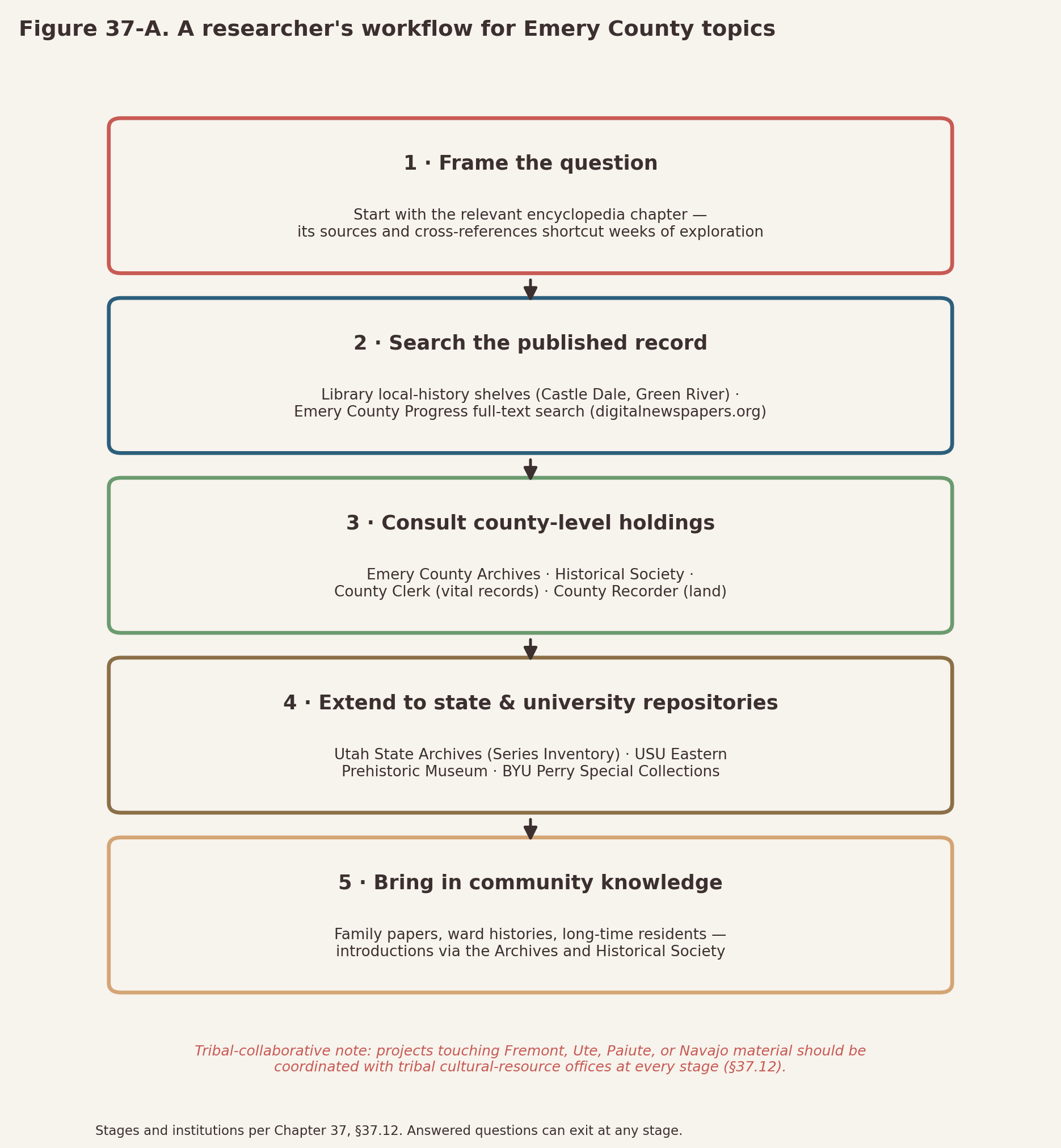
For a researcher beginning a project on any Emery County topic, a productive workflow generally proceeds in five stages.
Stage one — frame the question. Begin with the relevant encyclopedia chapter in this volume. Each chapter’s source list points to the published works, primary documents, and institutional collections most directly relevant to its topic. The chapter footnotes and “See also” cross-references can shortcut weeks of preliminary exploration.
Stage two — search the published record. Use the local-history shelves at the Castle Dale or Green River library branches and the digitized Emery County Progress to find what has already been written about the topic. Newspaper search is fastest if a specific date or person is known; library-shelf browsing is best for broader topics. This stage often resolves simple research questions outright.
Stage three — consult county-level holdings. For questions the published record cannot answer, contact the Emery County Archives and the Historical Society in Castle Dale. The Archives staff can confirm whether they hold relevant donor collections, oral-history transcripts, or photographs. For vital records and land records, contact the County Clerk and County Recorder directly. For more interpretive history, the Historical Society’s membership often knows where unpublished material lives — sometimes in members’ own homes.
Stage four — extend to state and university repositories. For administrative history (case files, mining records, military discharges), use the Utah State Archives’ Series Inventory at archives.utah.gov to identify the right record series, then request copies or schedule a Salt Lake City visit. For Fremont, Ute, or paleontological material, consult USU Eastern Prehistoric Museum in Price. For the Victor ghost-town record and early LDS ward-level material, consult BYU L. Tom Perry Special Collections in Provo.
Stage five — bring in community knowledge. No archive captures everything. Many of the most useful sources for Emery County history remain in family hands, in church-house ward histories, in personal photographs, and in the memories of long-time residents. The Historical Society and the Archives can introduce researchers to community members who hold relevant material and are typically generous in sharing it.
A note on tribal-collaborative research: for any project that touches on Fremont, Ute, Paiute, or Navajo material — and given the county’s Indigenous history, that includes most archaeological and rock-art topics — research should be coordinated with the relevant tribal cultural-resource offices (see Ch13: Archaeological Stewardship ↗ 2 Ch13: Archaeological Stewardship Legal frameworks, monitoring programs, site stewardship, curation practices, and ethical principles for protecting Emery... Read chapter → ). This is both an ethical obligation and a practical research strategy: tribal cultural-resource staff often hold information, perspective, and context that no external archive contains. USU Eastern and BYU both maintain working protocols for tribal-consultation requests, and the Emery County Archives can connect researchers to current contacts.
Master Directory
Table 37-A — Master Directory of Research Institutions
| Institution | Location | Phone | Web |
|---|---|---|---|
| Emery County Archives | Castle Dale | via email/phone (call ahead) | emerycountyarchives.com |
| Emery County Historical Society | 75 E Main St, Castle Dale | (435) 381-3563 | emerycountyarchives.blogspot.com |
| Museum of the San Rafael | Castle Dale museum campus | — | visitemerycounty.com |
| Emery County Pioneer Museum | Castle Dale museum campus | (435) 381-5154 | — |
| Cleveland-Lloyd Quarry VC (Jurassic NM) | 26 mi SE of Cleveland | — | blm.gov (Jurassic NM) |
| John Wesley Powell River History Museum | 1765 E Main St, Green River | — | johnwesleypowell.com |
| Emery County Library — Castle Dale (hub) | 135 N 100 E, Castle Dale | (435) 381-2554 | lib.emerycounty.com |
| Emery County Library — Ferron | 55 N 200 W, Ferron | (435) 384-2637 | lib.emerycounty.com |
| Emery County Library — Green River | 85 S Long St, Green River | (435) 564-3349 | lib.emerycounty.com |
| Emery County Library — Huntington | 70 S Main St, Huntington | (435) 687-9590 | lib.emerycounty.com |
| Emery County Library — Cleveland, Elmo, Emery, Orangeville | small branches; hours vary | via Castle Dale branch | lib.emerycounty.com |
| County Clerk / County Recorder | Emery County Courthouse, Castle Dale | — | emery.utah.gov |
| Utah State Archives | Salt Lake City | — | archives.utah.gov |
| USU Eastern Prehistoric Museum | 155 E Main, Price (Carbon Co.) | — | eastern.usu.edu/prehistoric-museum |
| BYU L. Tom Perry Special Collections | Harold B. Lee Library, Provo | by appointment | archives.lib.byu.edu |
| U of U J. Willard Marriott Library | Salt Lake City | — | lib.utah.edu |
Master directory of the institutions covered in Chapter 37 (§37.2–§37.11). Em-dashes mark contact details the chapter does not state — none invented. Hours deliberately omitted: every institution's hours are described in the chapter as limited, seasonal, or variable, so 'call ahead' is the directory's operative instruction. Spot-verify all contact details before publication.
Further Reading
- Utah Digital Newspapers — Emery County Progress — the fully digitized, full-text-searchable 1900–2004 run.
- Utah State Archives — the state’s official government record, including Emery County vital and land records.
- FamilySearch — Emery County, Utah Genealogy — the free genealogical research portal and county-specific holdings guide.
- Emery County Archives — the county’s principal repository of donated documents, photographs, and oral histories.
- BYU L. Tom Perry Special Collections — the Laura Wells Stewart collection on Victor, Emery County (MSS 9197).
- BLM — Jurassic National Monument — the Cleveland-Lloyd Dinosaur Quarry Visitor Center and monument designation.
Sources
- Emery County Archives — https://www.emerycountyarchives.com/ ; https://emery.utah.gov/home/department-directory/archives/
- Emery County Historical Society — http://emerycountyarchives.blogspot.com/p/emery-county-historical-society.html
- Museum of the San Rafael — https://visitemerycounty.com/museum-of-the-san-rafael ; https://artsandmuseums.utah.gov/utah-museums-directory/locations/emery-county/
- Emery County Pioneer Museum — https://www.museumsusa.org/museums/info/8745
- Emery County Museum Board — https://www.utah.gov/pmn/sitemap/noticeprint/370913.html
- Cleveland-Lloyd Dinosaur Quarry / Jurassic National Monument — https://www.blm.gov/visit/cleveland-lloyd-dinosaur-quarry ; https://www.blm.gov/programs/national-conservation-lands/utah/jurassic-national-monument
- John Wesley Powell River History Museum — https://johnwesleypowell.com/ ; https://www.visitutah.com/places-to-go/cities-and-towns/green-river/john-wesley-powell-river-museum
- Emery County Library System — https://lib.emerycounty.com/ ; https://library.utah.gov/directory/lib_system/emery_county_library_system/ ; https://library.utah.gov/directory/locations/emery-county/
- Utah State Archives — https://archives.utah.gov/ ; https://archives.utah.gov/research/digital/emery-co-vital/
- USU Eastern Prehistoric Museum — https://eastern.usu.edu/prehistoric-museum/ ; https://eastern.usu.edu/prehistoric-museum/collections/
- BYU L. Tom Perry Special Collections (Laura Wells Stewart collection, MSS 9197) — https://archives.lib.byu.edu/repositories/14/resources/12367 ; https://archives.lib.byu.edu/subjects/5022
- Utah Digital Newspapers — Emery County Progress — https://digitalnewspapers.org/newspaper?paper=Emery+County+Progress ; https://etvnews.com/history-preserved-complete-emery-county-progress-collection-digitized/
- FamilySearch — Emery County genealogy portal — https://www.familysearch.org/en/wiki/Emery_County,_Utah_Genealogy
- Carbon County Oral History Project — https://archiveswest.orbiscascade.org/ark:80444/xv38397
- AMR Oral History Program (Utah DOGM) — https://ogm.utah.gov/amr-oral-history/