Latest Research, November 2026: Reading the 1880 Census Again
What the Castle Dale study learned this month: a line-by-line re-reading of the 1880 census, what the town looked like twenty years later, and two newspaper stories that turned out to be about other places.
Line 14, page 8
Sometime between the 11th and the 17th of June 1880, a census taker named L. D. Ensign came to the household of Charles Swasey in Castle Dale. He wrote the wife’s name as “Cena.” He gave her age as 22 and wrote that she was keeping house, that she was born in Iowa, and that both her parents were born in Denmark. Then, in the column that asked whether the person was “sick or temporarily disabled” on the day of his visit, he wrote one word: Consumption.
Consumption was the nineteenth century’s name for tuberculosis. In 1880 there was no cure for it.
We have read that census before. This month we read it again, every line, from the page images, and that one word turned out to matter more than we expected. Not because of what it says about Cena, but because of what it says about the columns around it.

Making a familiar form strange
Most of us treat a census as a list of answers. It is really a list of one man’s habits.
The 1880 form gave Ensign a column for sickness, column 15. In the first reading of Castle Dale’s pages, made in the spring of this year, the marks in that column were taken at face value, and several men went into our records as “sick at enumeration.” Reading every line again with the pages straightened and enlarged, we found that Ensign put a tick in column 15 for 58 people, nearly all of them working men and boys. Fifty-eight sick people in a town of 264 would be an epidemic. Nothing else in the record suggests one.
The likelier reading is that Ensign was using the column for his own purpose, perhaps to mark the people he had recorded an occupation for. That is a hypothesis, not a finding: we have not yet compared his other districts, which is the test that could settle it. What is clear is that only two people in Castle Dale are actually written down as sick. One is Cena Swasey. The other is Grett Burnett, a 68-year-old farmer born in New York, marked “Sick” on page 7 and living with his son Joseph.
So the honest count of illness in Castle Dale in June 1880 is two, not three or five, and certainly not 58. We corrected three records that had said otherwise.
That was not the only thing the second reading changed. In all, eleven records in the study’s database now say something different from what they said a month ago, because the page says something different:
- Occupations. George McKmillan was recorded as a stone mason. The page calls him a rancher. The stone mason is Andrew Boyle, on the next line, and a misaligned reading had slid the trade up one row. Samuel Stowe, recorded as a “stoneman,” is written down as a farmer.
- Ages. Five census ages were wrong or missing in our records. Mary C. Curtis is 57 on the page, not 51; William Gibson is 40, not 45. Those two now disagree with the birth years we hold for them, and we have not changed the birth years. A census age is one person’s answer on one day; we will check baptism and death records before deciding which is right.
- Names as written. For 206 people we had never recorded the name exactly as the census taker spelled it. Now we have all 264, which matters in a town where “Andersen,” “Anderson” and “Andreasen” can all be the same family.
Ensign skipped a number. His dwellings on page 4 run 7, then 9. There was never a dwelling 8 in Castle Dale's 1880 census, and no family is missing.
— 1880 U.S. Census, ED 18, Castle Dale, p. 4, lines 26–28.
The census also answers questions the first reading never asked. Twenty-eight people told Ensign they had been out of work for part of the year, from two to nine months. Thirty-six adults and older children are marked as unable to write, most of them Danish-born adults and the older children of a few Utah-born families. Twenty-three children were attending school in a place that had existed for about a year. And two people, Alex Synderguard and Thomas Farrer, are marked divorced. They are now on our list for the family records.
What the shape of a town tells you
When every age is in, a town takes a shape. Here is Castle Dale in June 1880.
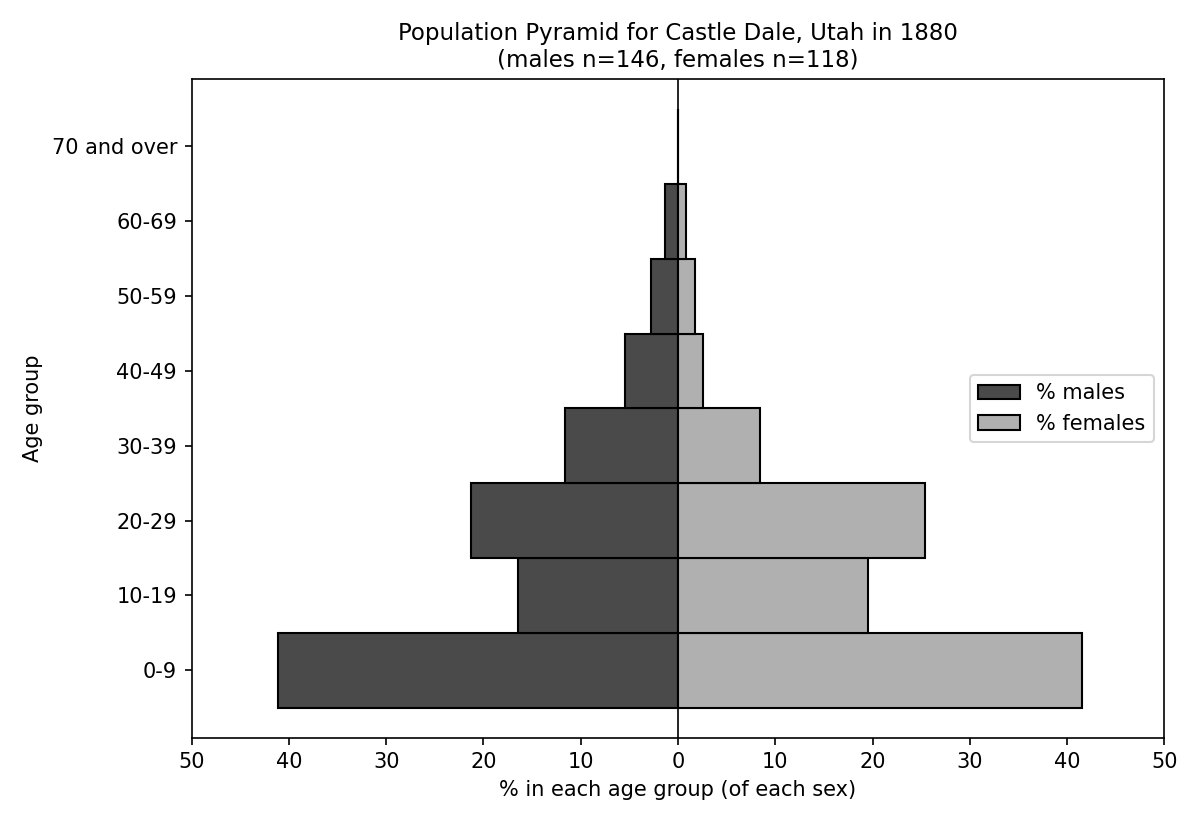
It is a young town, almost absurdly so. Of 146 males, 60 were under ten. Of 118 females, 49 were. Only three people were sixty or older, and nobody had reached seventy. Above the age of thirty, men clearly outnumber women. That is the profile of a place that people move to, not a place where people grow old: young couples, their babies, and single men who came to work.
Twenty years later the same precinct looks different.
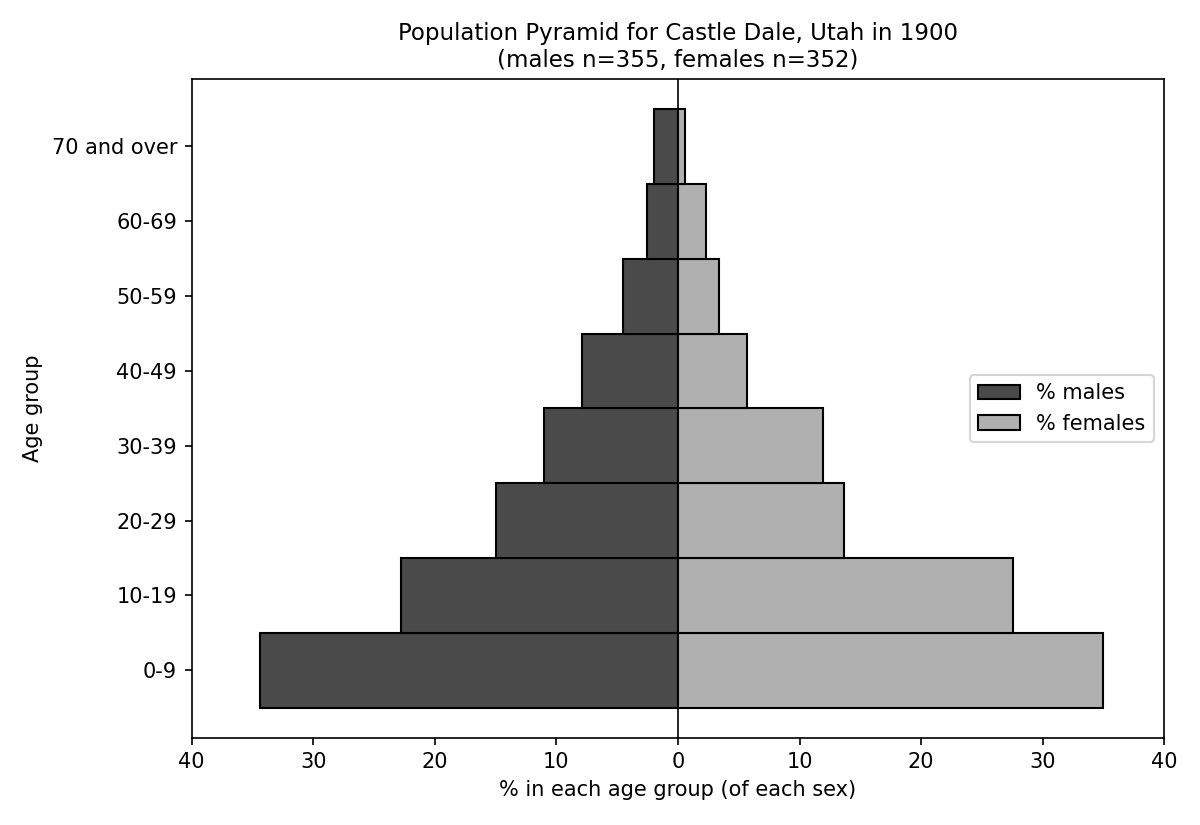
The 1900 town was nearly three times as large. It was still young, with about a third of its people under ten, but now it had grandparents: nine people over seventy, seventeen in their sixties. The extra men had disappeared. By 1900 the numbers of men and women were almost exactly equal, which often means a settlement has stopped being a work camp and become a community of families. (The 1890 census, which would have shown the town halfway between, was destroyed in a fire in Washington in 1921.)
Where did the families of 1880 go?
A bigger town does not mean the same families stayed. This month we followed each of the 49 households of 1880 forward to the 1900 census, looking for at least one member still living in the same enumeration district.
The 49 households of 1880, twenty years on
| Where at least one member was in 1900 | Households |
|---|---|
| Castle Dale precinct | 8 |
| Orangeville precinct, next door | 7 (one of them uncertain) |
| Not found in either precinct by surname | 34 |
Searched by surname in the 1900 census for ED 195. Married daughters under new surnames are not yet traced, so 'not found' does not mean 'gone'.
Only eight of the 1880 households still had someone in Castle Dale itself. Seven more were in the neighboring Orangeville precinct. The rest, 34 households, do not turn up in either place under the same surname.
That number needs care. A daughter who married a neighbor’s son would be in the 1900 census under her husband’s name, and our search would miss her. We suspect that some of the “missing” families are not missing at all. One example, offered as a hypothesis: two young wives in the Jewkes households of Orangeville in 1900, Margrett (born 1870) and Minnie (born 1876), match the birth years and names of two Reid daughters of 1880. If they are the same women, the Reid and Jewkes households, two of the founding families, had become one family network by 1900. A marriage record from the 1890s would settle it.
The Reids are a good family to follow, because they turn up in almost every kind of record the study holds. John K. Reid, the Scottish-born carpenter of dwelling 16, was one of four men who crossed the plateau to Manti in the first winter to bring back Christmas goods for the Cottonwood Creek settlers, according to the county narrative we hold. In July 1881 he gave an interview to a Salt Lake City newspaper as Castle Dale’s postmaster. In 1886 he received a federal homestead patent for 160 acres on the Orangeville side of the creek. And in 1900 he was there, in Orangeville, with six children still at home. A family’s land and its marriages tend to move together. In Castle Valley, as in most farming places, you can often read one from the other.
A story that was about somewhere else
This month the study also set up a proper home for newspaper stories, so that every article we find gets its own record, a saved page image and a transcription. Going through the first five, we found that the most dramatic one was not about Castle Dale at all.
In late June 1881 the Deseret Evening News ran an editorial headed “The Indian Fight in Castle Valley.” Telegraph reports had placed a deadly fight in Castle Valley, and our earlier notes had treated it as part of the valley’s founding years. Reading the weekly edition of 6 July 1881, which prints the same editorial cleanly alongside the letter it answers, settles the question. The letter comes from settlers at Moab, and the fight it describes took place in the La Sal Mountains east of Moab, far from Castle Dale. In 1881 both places were in the same new county, Emery County, and our working guess, still to be tested, is that to a newspaper in Salt Lake City “Castle Valley” could mean the whole new county beyond the plateau.
It is a small correction with a large lesson: a place name in a nineteenth-century newspaper means what it meant to the person writing it, not what it means on a map today. We have stopped using the story in our notes on Castle Dale’s own history. Castle Valley itself was Ute country long before the settlers of 1879 arrived (Geary, Utah Historical Quarterly 66:3, 1998), and that history deserves its own careful telling, from its own sources, rather than borrowing a fight that happened somewhere else.
What’s next
Our list for the coming weeks:
- Save the page images for all five newspaper stories and check the machine-read text against them.
- Trace the 1880 daughters through their marriages, which should bring some of the 34 “missing” households back into view.
- Settle the age disagreements for Mary C. Curtis and William Gibson.
- Recover the mothers’ birthplaces that the binding of the census volume cut off on three pages.
Sheet 2A, line 31
Twenty years after Ensign’s visit, another census taker came through Castle Dale. On sheet 2A he wrote “Cena B. Swasey,” wife, born in Iowa, both parents born in Denmark. She had been married 24 years. She had borne six children, and four were living. Her husband Charley was farming his own land, and the youngest child in the house, a boy, was not yet a year old.
The woman whose name stood next to the word Consumption in 1880 was still there, in the same town, raising a family. According to the record we hold for her, she lived until 1931.
Sources for this note: 1880 U.S. Census, Emery County, Utah Territory, ED 18, Castle Dale, pp. 4–9 (NARA T9, roll 1336); 1900 U.S. Census, Emery County, Utah, ED 195, sheets 1A–8B and the FamilySearch index for the Orangeville precinct; BLM General Land Office patent records; Deseret Evening News, 29 June and c. 21 July 1881; Deseret News (weekly), 6 July 1881, pp. 1 and 8. Detailed citations are kept in the Castle Dale One-Place Study research files.